R' Meir and R' Yehuda: Consistency on Chashash Misa
The sugya
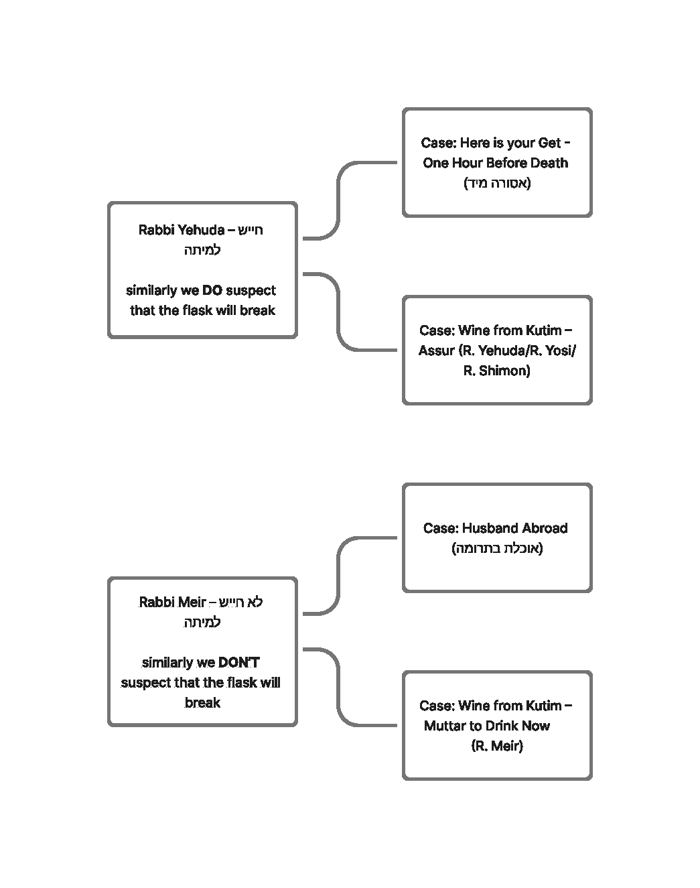
The shiur finishes the long sugya of whether R' Meir or R' Yehuda is chayish l'misa. It began on the earlier daf with the machlokes over using a behemah as a dofen for a sukkah, and the Rebbi says it runs until the bottom of 24a. After answering the kashya on R' Meir from the wine case and the kashya on R' Yehuda (lis lei breira), the Rebbi reviewed the whole journey using his red/blue chart sheet. The Gemara then deflects two more kashyos on R' Yehuda. The first is from the seifa of the wine braisa, answered with l'didi lis li breira, ela l'didach. The second is from the Mishnah in Yoma about preparing another wife for the Kohen Gadol, answered with maalah asu b'kaparah.
Step by step (shakla v’tarya)
- Zooming out: the sugya of chayish l'misa runs about a blatt and a half, from the earlier daf until the bottom of 24a. Knowing where it starts and ends helps, like knowing the direction you are driving.
- TeirutzLine 4, kashya d'R' Meir a'R' Meir: misa shechicha, bekias hanod lo shechicha, and efshar d'masar lei l'shomer. So R' Meir is consistent: he is chayish l'misa, and the wine case has nothing to do with misa.
- TeirutzKashya d'R' Yehuda a'R' Yehuda, the same question flipped: R' Yehuda's reason in the wine case is not a chashash that the flask will break. Rather, lis lei breira.
- ChazarahReview with the chart sheet. R' Meir starts as chayish l'misa (red) and ends so; R' Yehuda starts as not chayish (blue) and ends so.
- ChazarahAbaye's journey: he made the behemah-dofen machlokes depend on misa. He also ascribed to R' Meir the Mishnah (which the Rebbi called the Mishnah in Gittin) that a wife whose husband went overseas eats terumah, and the wine braisa. That made R' Meir look not chayish and R' Yehuda chayish.
- ChazarahThe Gemara answered iphuch: R' Meir forbids the woman to eat terumah and R' Yehuda permits. The wine braisa still remained as a contradiction, which was answered as above.
- KashaLine 9: is R' Yehuda really not chayish for the flask breaking? The seifa of the braisa says they asked R' Meir, 'Don't you agree the flask may break and he will be found drinking tevel retroactively?' R' Meir answered l'kshe'yibaka. Asking this implies R' Yehuda himself has the concern.
- TeirutzLines 14-15: hasam R' Yehuda d'ka amar l'R' Meir. He meant: l'didi lis li breira, ela l'didach d'yesh breira, don't you agree the flask may break? R' Meir answered l'kshe'yibaka, meaning he is not concerned.
- The RebbiThis is arguing within the other person's shitah, not stating your own concern. Forceful arguing doesn't mean it is the arguer's own opinion.
- KashaLine 17, one last cross-examination: is R' Yehuda really not chayish l'misa? The Mishnah (first Mishnah in Yoma) says R' Yehuda omer af isha acheres mesaknin lo, shema tamus ishto.
- Background: on Yom Kippur the Kohen Gadol must have a wife. The pasuk says he atones for himself and his house, and his house is darshened as his wife. Therefore another wife is prepared for him.
- The RebbiThe Rebbi's framing: perhaps this is not chayish l'misa but a technical back-up. If it happened, the whole avodah would not work.
- TeirutzLine 19: ha itmar alah, amar Rav Huna brei d'Rav Yehoshua, maalah asu b'kaparah. This is a heightened precaution, not a general chashash misa.
- The RebbiSo much was at stake: the kaparah of all of Klal Yisrael, unlike one woman eating terumah. So they made an extra precaution even though they did not think it would be needed.
Kashas
- R' Yehuda permits a behemah as a dofen (not concerned it will die), yet forbids drinking the wine in the braisa of buying wine from Kusim.
- From the seifa of the wine braisa: they asked R' Meir, 'Don't you agree the flask may break?' This implies R' Yehuda is chayish for the flask breaking.
- From the Mishnah in Yoma: R' Yehuda says another wife is prepared for the Kohen Gadol shema tamus ishto. So he is chayish l'misa.
Teirutzim
- For R' Meir: misa shechicha, bekias hanod lo shechicha, and one can give the wine to a shomer.
- For R' Yehuda: his reason is lis lei breira, not a concern that the flask will break.
- R' Yehuda was speaking only according to R' Meir: l'didi lis li breira, ela l'didach d'yesh breira, don't you agree the flask may break?
- Rav Huna brei d'Rav Yehoshua: maalah asu b'kaparah. It is a special precaution for the Yom Kippur kaparah.
Mareh mekomos
- Mishnah (the Rebbi called it the Mishnah in Gittin): a bas Yisrael married to a kohen whose husband went overseas eats terumah. It is used in Abaye's ascription of shitos.
- Braisa of one who buys wine from Kusim and relies on breira to drink before separating terumah and maaser. It is the source for the R' Meir and R' Yehuda contradictions.
- First Mishnah in Yoma: R' Yehuda says af isha acheres mesaknin lo, shema tamus ishto. It is the kashya on R' Yehuda.
- Pasuk that the Kohen Gadol atones for himself and his house, darshened as his wife. It is the source that the Kohen Gadol must have a wife on Yom Kippur.
- Gemara in Yoma, where it was already established that the extra wife is a maalah.
The Rebbi’s chiddushim
- Everything is relative: death is relatively common, while a flask breaking is uncommon and more within your control, since you can wrap it and put it away safely.
- The whole wine case only begins if you allow breira. For R' Yehuda, who doesn't hold of breira, it is a technical issue with nothing to do with the flask breaking.
- Mashal of arguing about snow tires, or ordering steak: one can press a point within the other's way of thinking without holding it oneself. This manner of speech appears fairly often.
- The extra wife may be a technical back-up, since without a wife the avodah would not work, rather than true chashash misa.
- The maalah was made because the stakes were communal (the kaparah of the whole Klal), unlike one woman eating terumah.
Unclear in recording
- A reference to an earlier sugya with a similar manner of speech; the name is unclear in recording.
- At the end the Rebbi began comparing to the rope tied to the Kohen Gadol and a concern that he was a faker; the recording cuts off and the point is unclear.
Drafted from the recording of the shiur, for chazarah. Torah terms follow the Rebbi’s own words; anything that could not be made out is marked “unclear in recording”. Tap a time to hear that point. Corrections welcome.