Divorce by money, and krisus: R' Yosi HaGlili vs. Rabbanan
The sugya
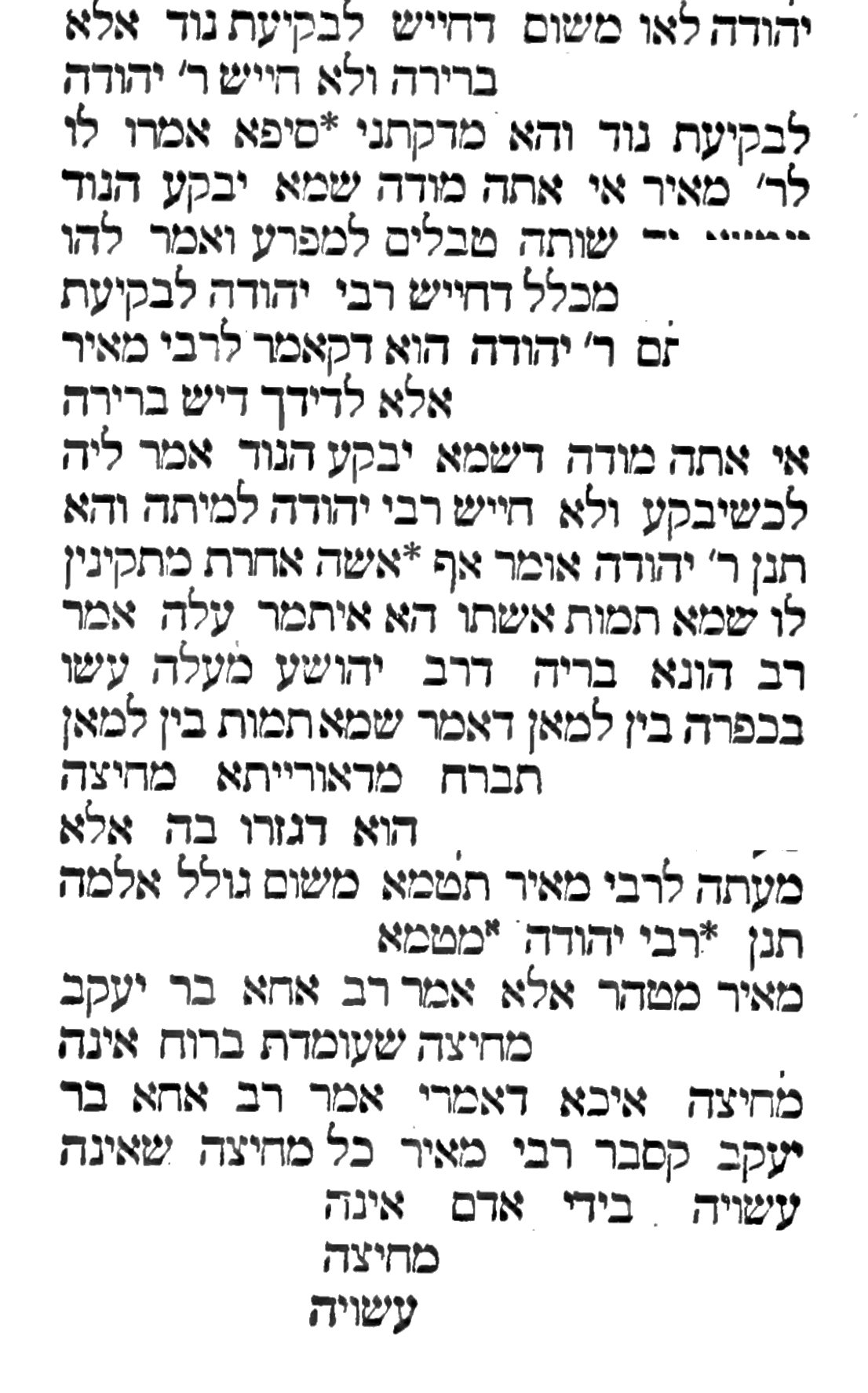
The shiur continues the Gemara's discussion of R' Yosi HaGlili's view that a get may not be written on a living thing or food, and how he and the Rabbanan use the words sefer, v'chasav, sefer krisus and kores krisus. Each side's drashos are tossed back and forth: where each learns that a woman cannot be divorced with money, and that a get must be a permanent severance. Along the way the Rebbi explains the conditional get cases (no wine, never going to her father's house, versus kol shloshim yom), discusses who the Rabbanan are, and ends with a punctuated re-reading from line 14.
Step by step (shakla v’tarya)
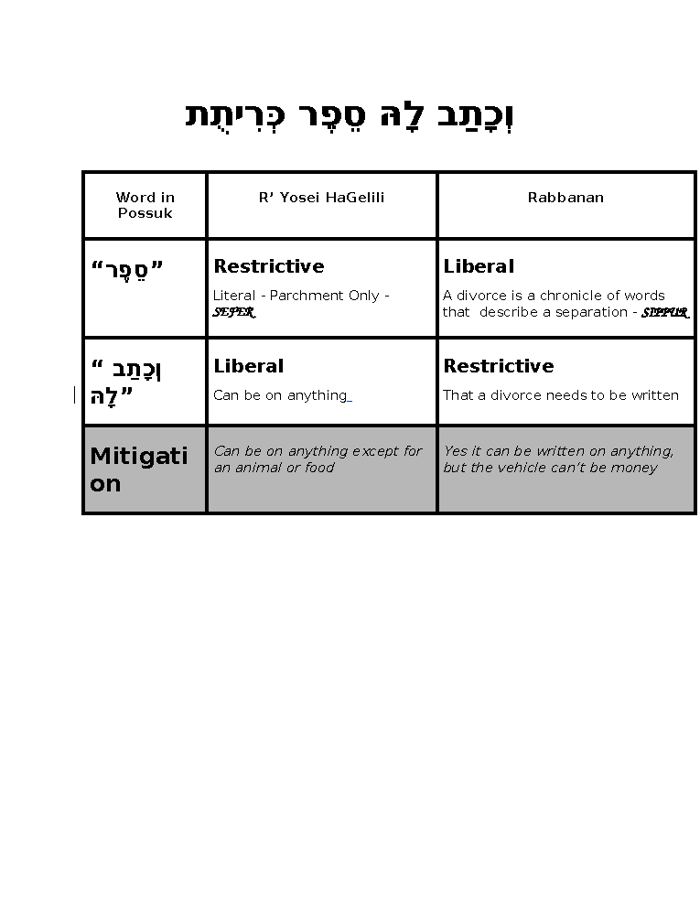
- ChazarahReview: R' Yosi HaGlili first reads sefer as very restrictive (a real sefer, on parchment). V'chasav la opens everything up. The compromise is that a get can be written on anything except something with ruach chaim and a second exclusion.
- ChazarahReview, line 8: the Rabbanan hold there is no restriction on what a get is written on. Had the pasuk said 'ba'sefer', they would agree it is restrictive. Since it says plain sefer, they read it as a sipur, a chronicle of words, so they start off very liberal.
- GemaraSo what do the Rabbanan do with v'chasav? They need it to teach that a woman is divorced through writing and not with money.
- GemaraThe hava amina: since yetziah is compared (hekesh) to havayah, and kiddushin works with money, I would have thought divorce also works with money. V'chasav teaches otherwise.
- KashaLine 14: according to R' Yosi HaGlili, who has already used up both sefer and v'chasav, where does he learn that one cannot divorce with money?
- Side discussion on why the Gemara calls this a svara when it is really a rule. Suggestions: the svara here is not to make the hekesh; or svara means 'what he holds' (from savar).
- TeirutzHe learns it from sefer krisus (line 15): sefer korsah, a sefer severs her, v'ein davar acher korsah, nothing else severs her. 'Nothing else' means not money.
- KashaLine 16, v'idach (the other one, here the Rabbanan): what do the Rabbanan do with sefer krisus?
- Digression on who the Rabbanan are (developed in chiddushim).
- TeirutzThe Rabbanan need sefer krisus for 'davar hakoreis beino l'beinah': a get must completely cut off the relationship between him and her.
- Ra'ayahAs in the braisa: 'harei zeh gitech al menas shelo tishti yayin' or 'shelo telchi l'beis avich l'olam' is not krisus. He is still controlling her for life; even at 87 one sip would undo it.
- Ra'ayahIf he says 'kol shloshim yom', for a defined time limit, it is krisus.
- The RebbiThe emphasis is on the word krisus: a get can be conditional, but it must end in a real, permanent severance.
- Question raised: what if he says 30 years? The Rebbi is unsure whether the test is reasonableness or simply a defined amount of time. A participant suggests 30 days is only an example and it could be a year.
- KashaV'idach: how does R' Yosi HaGlili learn the need for permanent severance?
- TeirutzHe learns it from 'kores krisus'. The Torah could have said 'sefer kores'; the extra, plural word krisus teaches that a get must have permanent severance.
- KashaLine 21, v'idach: what do the Rabbanan do with kores krisus?
- TeirutzKores krisus lo darshi: it is not substantial enough to darshen. That is simply how the Torah writes it.
- ChazarahRe-reading from line 14 with punctuation, summarising the whole back-and-forth.
Kashas
- What do the Rabbanan do with v'chasav?
- Where does R' Yosi HaGlili learn that one cannot divorce with money, if he has used up both sefer and v'chasav?
- What do the Rabbanan do with sefer krisus?
- How does R' Yosi HaGlili learn that a get must be a permanent severance?
- What do the Rabbanan do with kores krisus?
Teirutzim
- Rabbanan: v'chasav teaches that a woman is divorced through writing, not with money, despite the hekesh of yetziah to havayah.
- R' Yosi HaGlili: from sefer krisus. Sefer korsah, v'ein davar acher korsah, so money cannot divorce.
- Rabbanan: sefer krisus teaches davar hakoreis beino l'beinah, that a get must be a complete severance.
- R' Yosi HaGlili: from the extra word in kores krisus.
- Rabbanan: kores krisus lo darshi.
Rashi & Tosafos
- Rashi: Possibly cited (the name is unclear in recording) for this point on kol shloshim yom: the get takes effect now, but the real separation happens at the end of the 30 days.
Mareh mekomos
- Braisa: 'harei zeh gitech al menas shelo tishti yayin / shelo telchi l'beis avich l'olam' is not krisus, while 'kol shloshim yom' is krisus. Brought to illustrate davar hakoreis beino l'beinah.
- Hekesh of yetziah to havayah: kiddushin with money, quoted as the source of the hava amina that divorce works with money.
The Rebbi’s chiddushim
- Framing of R' Yosi HaGlili's drasha: sefer is very restrictive, v'chasav la is very liberal, and the halacha is the compromise between them.
- V'chasav is already 'occupied' (used up) for R' Yosi HaGlili, which is why the Gemara asks where he learns the rule about money.
- V'idach is just a poetic way of saying 'and the other one'.
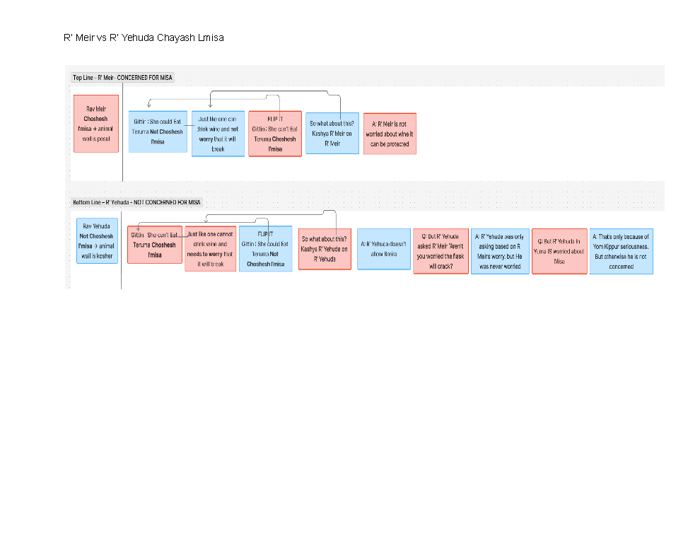
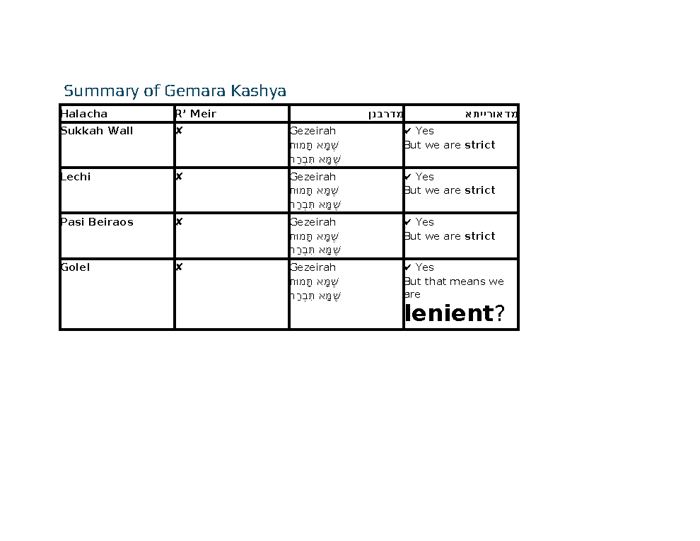
- Who are the Rabbanan here? Only R' Yosi HaGlili explicitly said a get may not be written on an animal. R' Meir and R' Yehuda, who argued about using an animal as a golel, lechi and so on, therefore allow it, so the Rabbanan are the other Tannaim, R' Meir and R' Yehuda.
- A lifelong condition means he is still 'shepherding' her and controlling her whole life, so it is not krisus.
- The Rabbanan began with more room because they did not limit sefer. For them kores krisus is not extra; it is simply how the Torah should be written.
Unclear in recording
- The second exclusion in R' Yosi HaGlili's rule (alongside ruach chaim) is not clearly made out.
- The point that the pasuk 'could have said v'nasan la sefer krisus' is unclear in recording.
- Whether the source cited for the 30-day point is Rashi is unclear in recording.
- Discussion of what happens if she or he dies within the 30 days (yibum, almanah), and of when she may remarry, is unclear in recording.
Drafted from the recording of the shiur, for chazarah. Torah terms follow the Rebbi’s own words; anything that could not be made out is marked “unclear in recording”. Tap a time to hear that point. Corrections welcome.