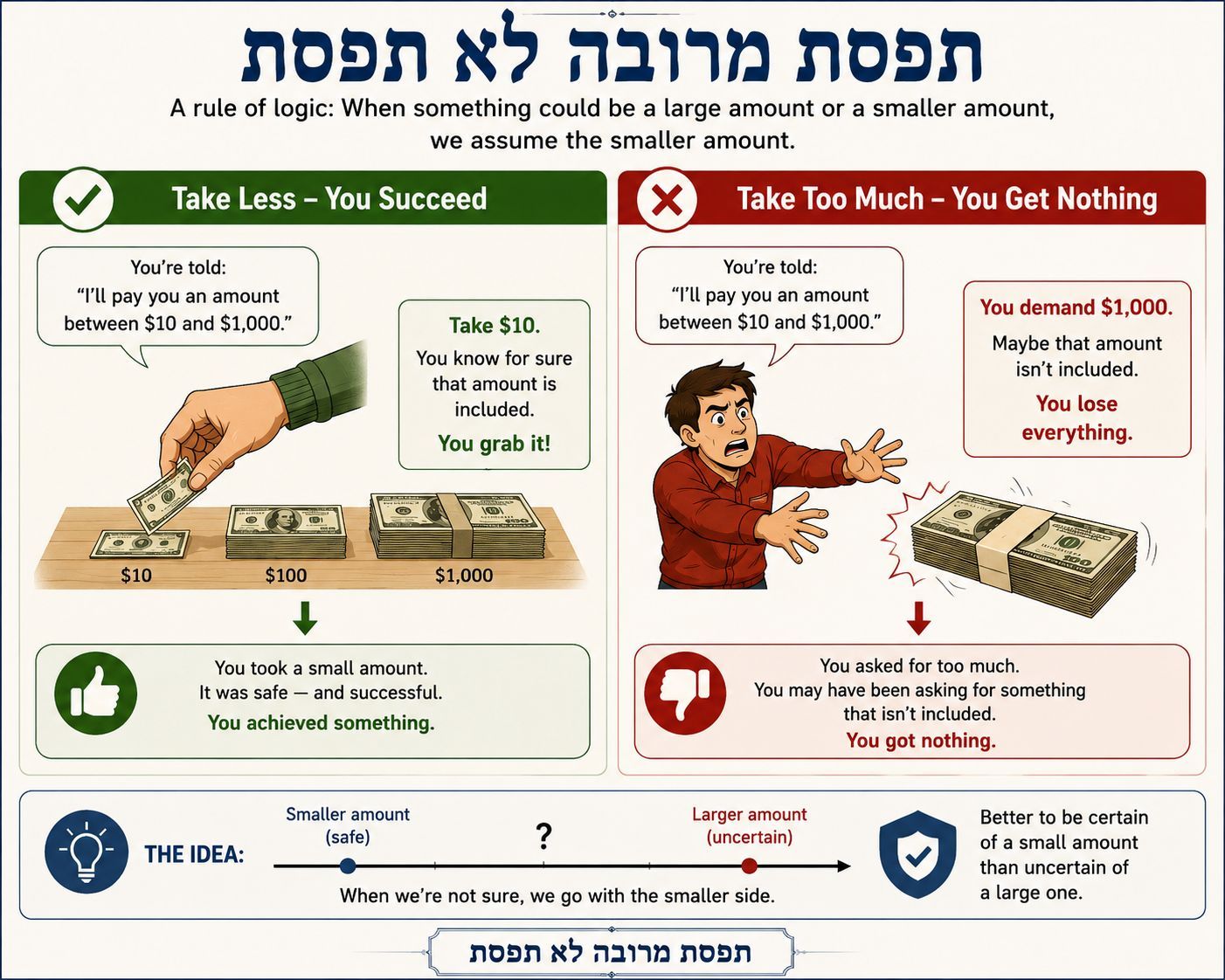
Shiur of ten for R' Yehuda; Shiurin halacha l'Moshe miSinai
The sugya
The shiur reviewed the derivation of the ten-tefach height of a sukkah from the Mishkan. That calculation works for R' Meir, but not for R' Yehuda, so the Gemara answers that for R' Yehuda it is a halacha l'Moshe miSinai, based on R' Chiya bar Ashi in the name of Rav: shiurin, chatzitzin and mechitzin are halacha l'Moshe miSinai. The Gemara then asks how shiurin can be halacha l'Moshe miSinai when Rav Chanin says the pasuk 'Eretz chita...' was said for shiurin. The Rebbi began going through it with 'chita' (beis hamenuga), learning the Mishnah in Negaim on k'dei achilas pras, and the pesukim behind it.
Step by step (shakla v’tarya)
- ChazarahFrom yesterday: the whole calculation works well for R' Meir, who holds all the amos were beinonios (average).
- RashiA talmid pointed out Rashi. Beinonios does not mean an exact midpoint. Rashi explains it as six tefachim and a mashehu (six and something). The exact wording here was partly unclear.
- KashaR' Yehuda holds an amah of binyan is six tefachim and an amah of keilim is five. We are combining a keili with a binyan, so the aron and kapores come to eight and a half (seven and a half for the aron, plus one tefach for the kapores). That leaves eleven and a half. Should a sukkah then need eleven and a half?
- TeirutzFor R' Yehuda, 'hilchesa gemiri lah': the minimum of ten is a halacha l'Moshe miSinai. It needs no limud or drasha; it is simply among the things passed down.
- Ra'ayahR' Chiya bar Ashi said in the name of Rav: shiurin (measurements), chatzitzin (separations/interpositions, e.g. by mikvah) and mechitzin (the laws of the heights of walls) are halacha l'Moshe miSinai.
- KashaThe Gemara pushes back: shiurin are d'oraisa, as it is written 'Eretz chita u'seorah...'. The answer comes later.
- Going through the pasuk of the shivas haminim: chita, seorah, gefen, te'enah, rimon, then 'eretz' again, then zeis shemen and dvash (date honey). The interruption of 'eretz' matters for the order of brachos, e.g. apple, pomegranate and dates on Rosh Hashanah night.
- GemaraRav Chanin: the whole pasuk was said for shiurin. Examples given: a bone the size of a barley for tumas meis, and k'zayis, the most famous.
- GemaraChita is the shiur for beis hamenuga (a house with tzaraas).
- MishnahMishnah in Negaim: one who enters a beis hamenuga with clothes on his shoulders, sandals and rings in his hands. He and they are tamei miyad, immediately, with no time requirement.
- Ra'ayahThe pasuk behind it: one who enters the house while it is closed up 'yitma ad ha'erev'. Anything that comes into the house is tamei until evening; he goes to the mikvah and is fine.
- MishnahIf he was wearing the clothes, the sandals were on his feet and the rings on his fingers: he is tamei immediately. The clothes stay tahor until he remains k'dei achilas pras of wheat bread (not barley bread), reclining and eating it with relish.
- The RebbiThis is the source of k'dei achilas pras used for eating on Yom Kippur. The Mishnah specifies wheat bread because different breads take different times to eat. Meisev with relish means normal, unrushed eating.
- Today there is a large range for this shiur, two to nine minutes. Rashi: a pras is half a loaf. The Rebbi thought a loaf is two beitzim.
- Ra'ayahThe second pasuk speaks of one who lies down in the house and one who eats in the house, both of whom must wash their clothes. It seems redundant. Rashi brings the Gemara that the eating gives the shiur of time: if he stays that long, his clothes also need the mikvah.
- The RebbiThis works out as a kula and a chumra. Coming in alone makes everything that enters tamei immediately, but only until night, with no mikvah for the clothes. Staying k'dei achilas pras requires the worn clothes to go to the mikvah.
- The RebbiThe difference between the two cases: kibbus begadim applies only to clothing being worn, which is like an extension of the person. Clothing being held is as if it walked in on its own legs. It is tamei immediately until evening and needs no kibbus.
- A talmid's question about the levels of tumah was discussed with the example of one man wearing a suit and carrying gym clothes. The carried clothes are tamei right away. The worn clothes are saved if he leaves quickly, but not if he stays the shiur. The Rebbi said he has to look further into the stricter level of tumah.
- Continued at line 42.
Kashas
- For R' Yehuda (amah of binyan six, of keilim five), the calculation leaves eleven and a half. Should a sukkah need eleven and a half?
- How can shiurin be halacha l'Moshe miSinai when they are d'oraisa from the pasuk 'Eretz chita u'seorah...'?
- Why does the pasuk repeat 'washes his clothes' for both lying down and eating in the house?
Teirutzim
- For R' Yehuda, the shiur of ten is a halacha l'Moshe miSinai (hilchesa gemiri lah).
- The eating comes to give the shiur of time for staying in the house (k'dei achilas pras).
Rashi & Tosafos
- Rashi: Beinonios: the amos were six tefachim and a mashehu, not an exact midpoint. Partly unclear.
- Rashi: A pras is half a loaf; they had small loaves.
- Rashi: Brings the Gemara that the eating in the pasuk teaches the shiur of time for one who stays in the house.
Mareh mekomos
- R' Chiya bar Ashi in the name of Rav: shiurin, chatzitzin and mechitzin are halacha l'Moshe miSinai.
- Pasuk 'Eretz chita u'seorah...' (the shivas haminim), used to ask that shiurin are d'oraisa.
- Rav Chanin: the whole pasuk was said for shiurin.
- Mishnah in Negaim on one who enters a beis hamenuga: carried items versus worn clothes, and k'dei achilas pras.
- Pasuk: 'habba el habayis... yitma ad ha'erev'.
- Pasuk: lying down and eating in the house require washing the clothes.
The Rebbi’s chiddushim
- K'dei achilas pras for Yom Kippur comes from this Mishnah. Wheat bread and meisev with relish indicate normal, unrushed eating.
- Worn clothing is an extension of the person, so it needs kibbus only after staying the shiur. Held clothing is like something walking in by itself and is tamei immediately, until evening only.
- Entering is a kula and a chumra: immediate tumah, but only until night and without kibbus begadim.
Unclear in recording
- Exactly how Rashi defines beinonios (five, six, six and a half, or six and a mashehu).
- Discussion of examples of shiurin, e.g. te'enah and Yom Kippur.
- The talmid's question about the two levels of tumah for clothing. The Rebbi said he needs to look into it.
Drafted from the recording of the shiur, for chazarah. Torah terms follow the Rebbi’s own words; anything that could not be made out is marked “unclear in recording”. Tap a time to hear that point. Corrections welcome.