Rav Asi and Rabbanan d'Kisrei on R' Yochanan's 24
The sugya
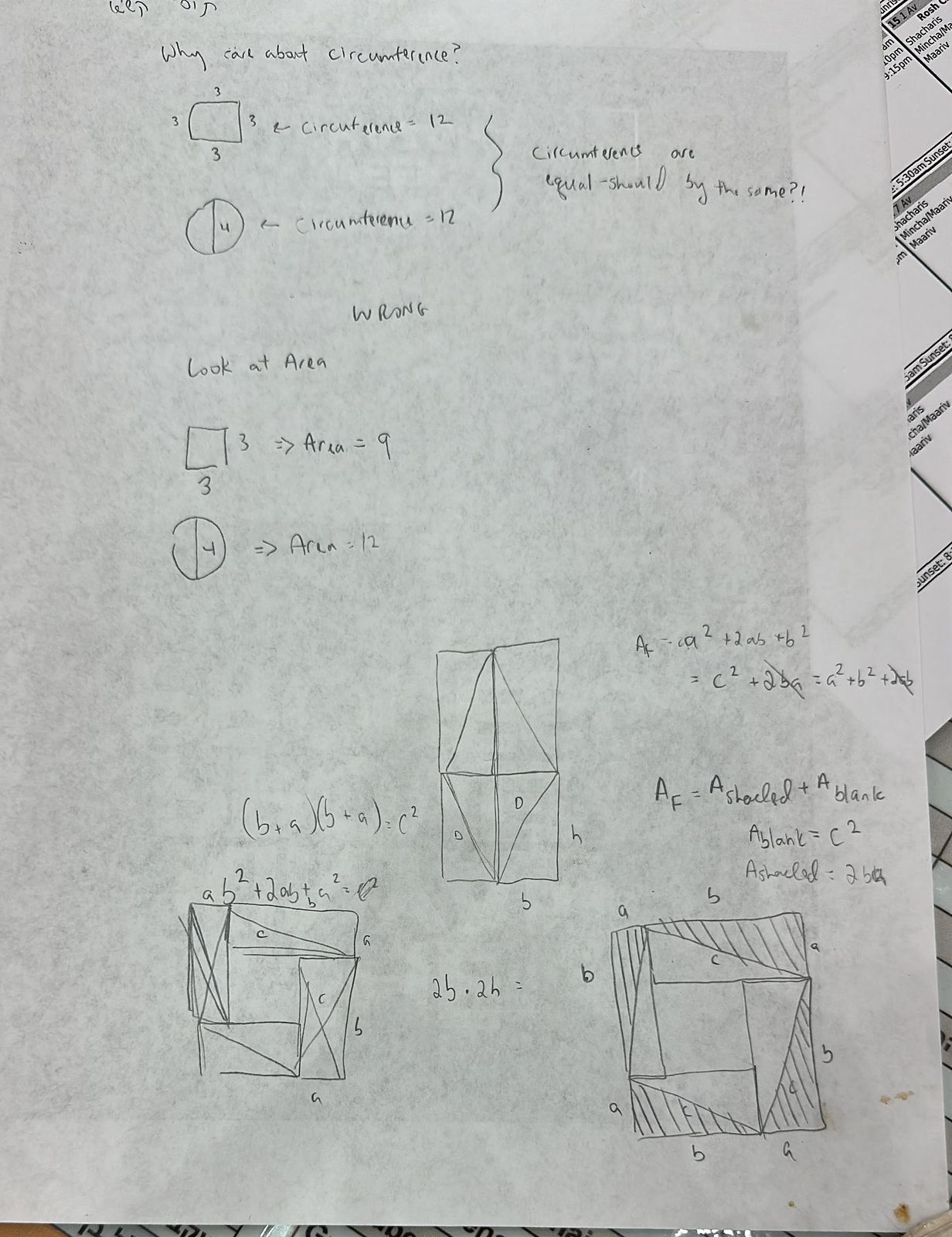
The shiur finishes the cheshbon of R' Yochanan's round sukkah that seats 24 people, measured against Rebbi's 4x4 sukkah. Rav Asi explains that R' Yochanan put the people outside the circle, which gives a circumference of 18 against the 16.8 that is needed, so his lo dak is l'chumra. The Rebbi then learns Rabbanan d'Kisrei, who reach exactly 24 with a different rule for a square inside a circle, and the Gemara's rejection, 'we see it is not that much'. The shiur ends with a discussion of perimeter versus area and a Tosafos the Rebbi still plans to learn.
Step by step (shakla v’tarya)
- ChazarahReview: we got stuck because the earlier lo dak underestimated what is needed. You can say lo dak, but only if you overestimate.
- TeirutzRav Asi: l'olam gavra b'amsa yasiv. We keep what we said at the beginning, that every person takes up a square amah.
- TeirutzWhen R' Yochanan said 24 people, mekom gavri lo kachashiv: he did not count the people's place inside the circle but put them outside it.
- Taking away a person on each side brings the diameter from 8 down to 6. Six times three gives a circumference of 18.
- MaskanaRebbi's square sukkah must fit inside the circle, and for that 16.8 is enough. R' Yochanan rounded up to 18: haynu d'lo dak, and l'chumra lo dak.
- The RebbiThe earlier lo dak was off by only 0.8, but it was l'kula, and you cannot come in under what halacha requires. This lo dak is off by more, 1.2, but it is l'chumra. 18 is also a nice round, even number, gematria chai.
- Introduction to Rabbanan d'Kisrei. The Gemara rejects them because we just don't see it that way. Their aim is to get you to exactly 24, a circumference of 24, which was the starting kasha.
- KashaThe Rebbi asks how this works. Every hava amina in the Gemara must have plausibility, yet what Rabbanan d'Kisrei say is not so plausible, at least according to the pashtus of the Gemara and Rashi.
- GemaraRabbanan d'Kisrei, v'amri lah dayanei d'Kisrei. It was either the rabbis or the dayanim; there is a difference between a Rav and a Dayan.
- ShitahFirst part, which they agree with: when a circle is inside a square, the square is a quarter more. In perimeter, 16 for the square versus 12 for the circle.
- ShitahSecond part, on the other amud: when a square is inside a circle, the circle exceeds it by palga, half.
- ShitahThe square's perimeter is 16. Adding half, which is 8, gives 24. Everyone agrees Rebbi's square must fit inside the circle. The question is only how much more the circle is: 16.8 by our cheshbon, 24 according to Rabbanan d'Kisrei.
- DechiyahThe Gemara says v'lo hi, d'ka chazinan d'lo havi kulei hai: we see it is not that much more. Put a string around the square and around the circle and measure it.
- RashiSimply, like us, it is just not true. All we see is the diagonal, 1.414, which makes it 5.6 across. Three times around gives 16.8.
- The RebbiRabbanan d'Kisrei wanted to fit the 24 people in with a shoehorn. They set a rule that does not apply and plugged it in. If you actually draw that circle, it ends up way out.
- RashiIt is interesting that Rashi takes Rabbanan d'Kisrei at face value. Rashi is l'shitaso, going with perimeter the whole time. But it is the Gemara itself, not Rashi or Tosafos, that says it is not true, and it sounds way off.
- ChazarahThe Rebbi re-reads line 19 with punctuation: a circle inside a square, the excess is a quarter; a square inside a circle, the excess is half the square's perimeter. 16 plus 8 gives 24.
- The RebbiAlmost always, when the Gemara says v'lo hi, it brings a sevara or a different calculation. Here it says only d'ka chazinan, from the word for seeing: we see it is not that much.
- If you think in terms of area, it might come closer. But we are trying to get the perimeter of Rebbi's square inside the circle, not its area.
- KashaThe whole cheshbon makes no sense if we only want an area of 16 square amos, because a smaller circle would do. Why require a circle that is half more, or larger?
- Chabura discussion: Rebbi's original 4x4 means an area of 16 square amos. R' Yochanan used the 24 people as measuring tools, like pacing out square feet with your feet.
Kashas
- The earlier lo dak underestimated, which is l'kula, and that cannot be.
- Every hava amina in the Gemara needs plausibility. How was the shita of Rabbanan d'Kisrei plausible, according to the pashtus of the Gemara and Rashi?
- If we only need an area of 16 square amos, a smaller circle would suffice. Why need a circle half again as large, or more?
Teirutzim
- Rav Asi: R' Yochanan did not count the people's place in the circle but put them outside it. The diameter becomes 6 and the circumference 18. Only 16.8 is needed, so this lo dak is l'chumra.
- Chabura discussion: R' Yochanan was using the 24 people as a measuring tool.
Rashi & Tosafos
- Rashi: Seems simply to say Rabbanan d'Kisrei are not true. With the diagonal at 1.414, it is 5.6 across and 16.8 around.
- Rashi: Takes Rabbanan d'Kisrei at face value, l'shitaso going with perimeter throughout.
- Tosafos: There is a Tosafos on Rabbanan d'Kisrei. The Rebbi has not yet learned it in depth and plans to learn it this summer, possibly dealing with area; see unclear.
The Rebbi’s chiddushim
- A lo dak of 0.8 l'kula is unacceptable, while a larger lo dak of 1.2 l'chumra is fine. 18 is a round number, gematria chai.
- The Gemara must have a plausibility to every single thing it puts forth, including a rejected hava amina.
- Rabbanan d'Kisrei shoehorned the 24 people in by setting a rule that does not apply.
- Unusually, the Gemara's v'lo hi rests on observation, d'ka chazinan, rather than on a sevara.
- The 24 people are a measuring tool, like pacing square feet.
Unclear in recording
- The opening remarks about Tosafos and Rabbanan d'Kisrei are garbled.
- The Rebbi's statements on how Tosafos learns the area approach, including that it is more than half or 57.1% larger and 'the other way around', are unclear and inconclusive.
- The chabura discussion at the end, on area versus perimeter, is partly unclear.
Drafted from the recording of the shiur, for chazarah. Torah terms follow the Rebbi’s own words; anything that could not be made out is marked “unclear in recording”. Tap a time to hear that point. Corrections welcome.