Shiur summary (draft from the recording)
Pasuk source for schach; bundles of straw
בפסולת גורן ויקב
Sukkah 12a · lines 1–17 · Tuesday, October 27, 2026
The sugya
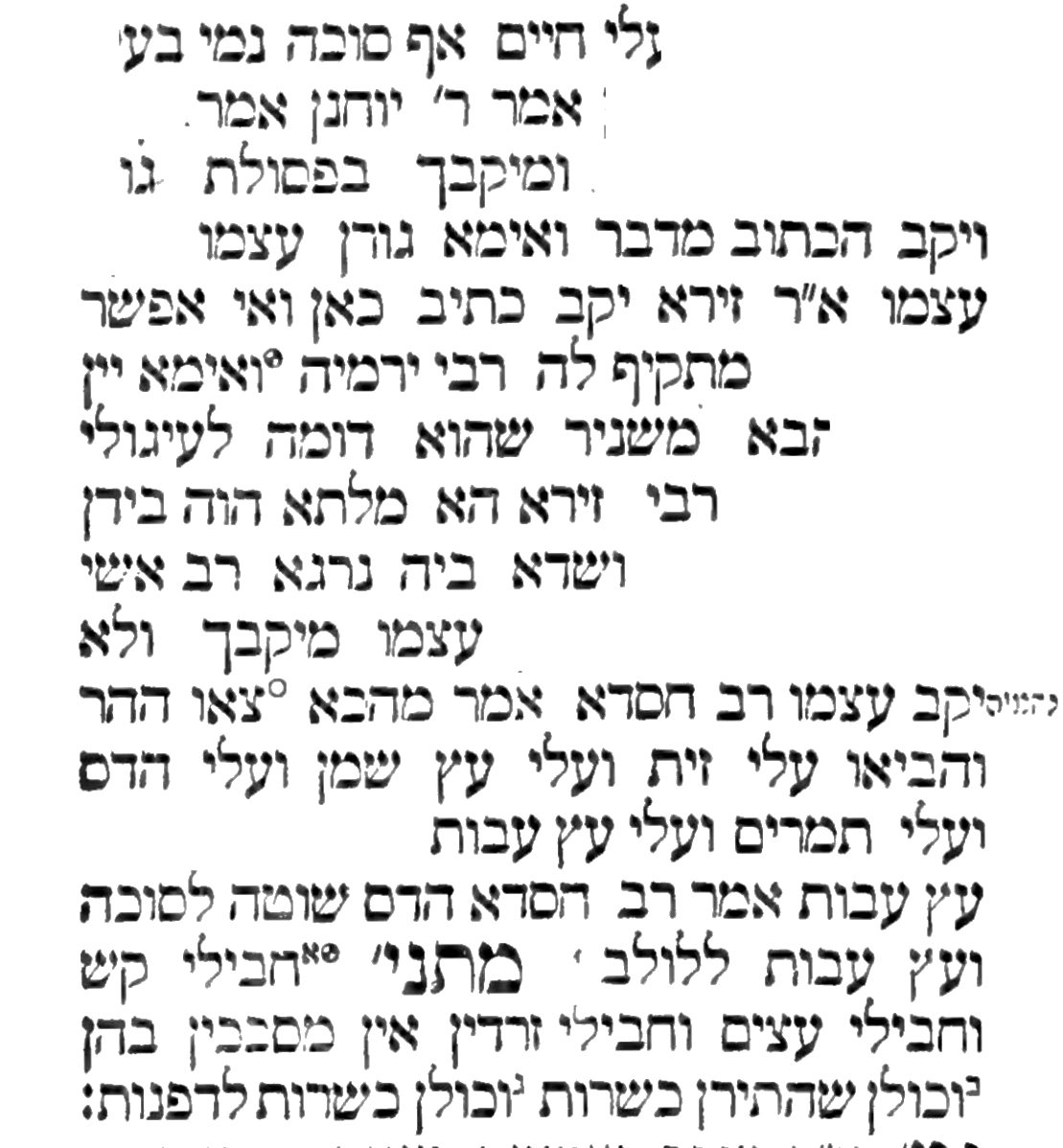
The Gemara continues looking for the source that schach must be not mekabel tumah and gidulo min ha'aretz. After the hekesh to chagigah is rejected (a live animal), Ravin brings b'ospecha migornecha umiyikvecha, meaning the psoles of goren and yekev. After R' Zeira and R' Yirmiyah go back and forth, Rav Ashi learns it from the mem of migornecha. Rav Chisda brings a second source from the pasuk in Nechemiah with hadas shoteh. The shiur then began the Mishnah of chavilei kash, chavilei eitzim and chavilei zeradin.
Step by step (shakla v’tarya)
- ChazarahReview: we are looking for the source that schach must be not mekabel tumah and gidulo min ha'aretz.
- Ra'ayah'Chag hasukkos ta'aseh lecha': a hekesh of sukkah to the korban chagigah. Just as chagigah is gidulo min ha'aretz (it is nourished from the ground), so schach must come from the ground.
- Placeholder removed
- KashaChagigah is a live animal. Will you say you can be mesakech with a live animal too?
- Ra'ayahRavin in the name of R' Yochanan: 'b'ospecha migornecha umiyikvecha'. The pasuk is talking about the psoles (chaff) of the goren and the yekev.
- KashaSay it means the goren and the yekev themselves, the actual grain and grapes. Those are mekabel tumah.
- TeirutzR' Zeira: it says yekev, which is already wine, and you cannot be mesakech with wine because it pours right through. Since goren and yekev are written together, once yekev cannot mean the thing itself, goren cannot either. The psoles of yekev is the stems and vines.
- DechiyahR' Yirmiyah: maybe it means congealed wine that comes from Snir, which is like iguley d'veilah. That could technically be put on, and it is mekabel tumah.
- R' Zeira: we had this matter in hand and R' Yirmiyah came and threw an axe into it (in the Rebbi's words, a wrench).
- TeirutzRav Ashi: a diyuk from the mem. 'Migornecha' means from your goren, not the goren itself. 'Miyikvecha' means from your yekev, not the yekev itself. It must be a byproduct.
- From this source we extend to similar psoles-type materials such as bamboo, branches and the like.
- Ra'ayahRav Chisda brings a source from a pasuk in Nechemiah said about preparing for Sukkos: 'Tze'u hahar v'havi'u alei zayis, alei etz shemen, alei hadas, alei temarim, alei etz avos.'
- KashaHadas is the same as etz avos. Why is it mentioned twice?
- TeirutzRav Chisda: hadas shoteh is for the sukkah, and etz avos is for the lulav.
Kashas
- On the hekesh to chagigah: chagigah is a live animal, so should one be able to be mesakech with a live animal?
- Perhaps the pasuk means the goren and yekev themselves (grain and grapes), which are mekabel tumah.
- R' Yirmiyah: perhaps yekev means congealed wine from Snir, which resembles iguley d'veilah and could be put on as schach.
- Hadas and etz avos are the same thing. Why the redundancy?
Teirutzim
- Ravin/R' Yochanan: b'ospecha migornecha umiyikvecha refers to the psoles of goren and yekev.
- R' Zeira: yekev is wine, which cannot be used as schach, so goren also cannot mean the thing itself.
- Rav Ashi: the mem of migornecha and miyikvecha teaches from them, not the thing itself.
- Rav Chisda: hadas shoteh is for sukkah, and etz avos is for lulav.
Rashi & Tosafos
- Rashi: Rashi says the pasuk Rav Chisda quotes is in Sefer Ezra, although it is marked as Nechemiah. The Rebbi explained that Ezra and Nechemiah are treated as one sefer in Kesuvim.
Mareh mekomos
- 'Chag hasukkos ta'aseh lecha', used for the hekesh of sukkah to chagigah.
- 'B'ospecha migornecha umiyikvecha', used as the source that schach is psoles of goren and yekev.
- Pasuk in Nechemiah (Ezra according to Rashi), 'Tze'u hahar v'havi'u...', used as Rav Chisda's source.
The Rebbi’s chiddushim
- The simple meaning of the pasuk is celebrating Sukkos when you gather in your harvest and thank Hashem. For the limud we read it literally: from your goren, not the goren itself.
- R' Zeira's statement is the Gemara's way of saying 'we were so close' before R' Yirmiyah threw in a wrench.
- The pasuk in Nechemiah is like a shopping list for Sukkos. Hadas shoteh means a pasul hadas that does not meet the criteria for the lulav, such as meshulash, but is fine for schach.
- Zeradin: when very soft, humans eat it; when harder, animals eat it; when very hard, it is used for fuel. The Rebbi suggested calling it fodder.
- The Rebbi said the next part of the Gemara (R' Yaakov's two rulings from R' Yochanan) never clicked for him until this Shabbos, and he intends to simplify it.
Unclear in recording
- Which tree 'etz shemen' refers to; the discussion was not conclusive.
- A remark about cane and a Rashi elsewhere comparing it to strong straw; unclear in recording.
- A student asked what the problem is with a bundle. The Rebbi's answer (that it comes later in the Gemara or 'this might be the source') is unclear in recording.
Drafted from the recording of the shiur, for chazarah. Torah terms follow the Rebbi’s own words; anything that could not be made out is marked “unclear in recording”. Tap a time to hear that point. Corrections welcome.