Shiur summary (draft from the recording)
Abaye's Contradiction: Is R' Meir Concerned for Death?
ומי אמר אביי
Sukkah 23b · Thursday, November 27, 2025
The sugya
Abaye explained that R' Meir forbids using an animal as a wall of the sukkah because he is concerned it will die, so R' Yehuda is not concerned for death. The Gemara challenges this from Abaye himself. On the two Mishnayos in Gittin, Abaye said R' Meir is not concerned for death and R' Yehuda is, and he brought support from a braisa about wine bought from Kusim. The shiur reached the Gemara's answer, 'ipuch', switch the opinions, and broke off as it began the proof.
Step by step (shakla v’tarya)
- ChazarahReview: R' Meir says an animal cannot be used as a wall for the sukkah and R' Yehuda says it can.
- ChazarahAbaye said R' Meir's reason is that the animal may die, which means R' Yehuda is not concerned that it will die. The underlying question is whether we are concerned for rarer events.
- Preview: we will find that Abaye himself said R' Meir and R' Yehuda hold the opposite, which is a real contradiction.
- KashaLine 1, ומי אמר אביי: did Abaye really say that R' Meir is choshesh for death and R' Yehuda is not?
- MishnahFirst Mishnah in Gittin: a bas Yisrael married to a Kohen whose husband went overseas. She may eat terumah with the chazakah that he is alive and need not worry that he died.
- MishnahContradiction from another Mishnah in Gittin: a husband says הרי זה גיטיך שעה אחת קודם מיתתי. She may not eat terumah immediately, so she must be concerned that he will die.
- KashaThe Mishnah must decide: do we have to be concerned for death for halachic purposes or not?
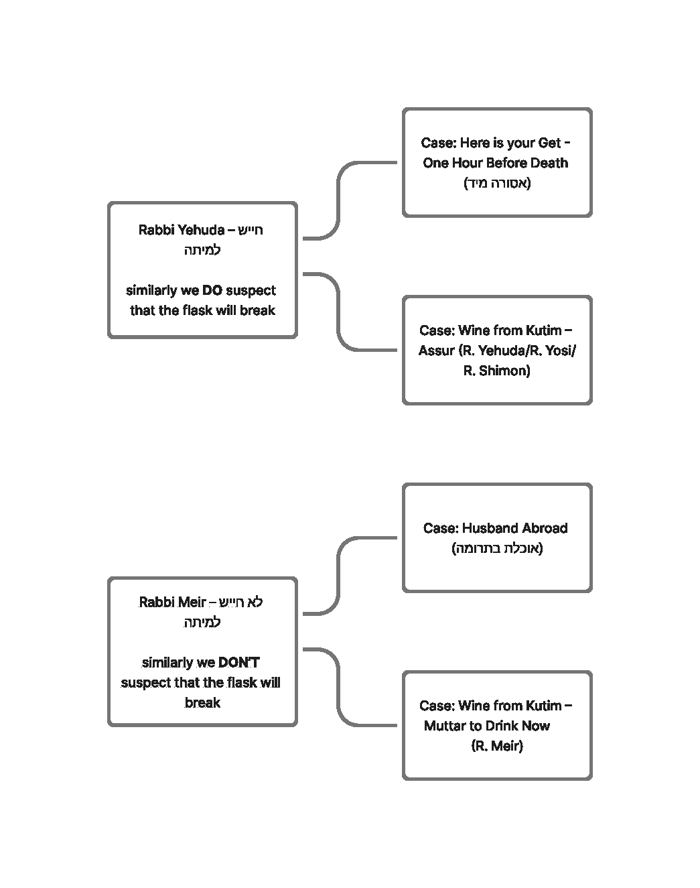
- TeirutzAbaye answers 'lo kashya', these are two different Tannaim. The first case, where she keeps eating terumah, is R' Meir, who is not concerned for death. The second is R' Yehuda, who is concerned for death.
- The RebbiThis is the opposite of what we have been learning until now in the sukkah case.
- The simplest approach would be to flip it and say Abaye got it mixed up, which is what the Gemara will end up doing.
- Ra'ayahIt is not so simple, because of the דתניא on line 9. Abaye derives their positions from a different case, not involving death, about whether we worry for stringent, unlikely situations.
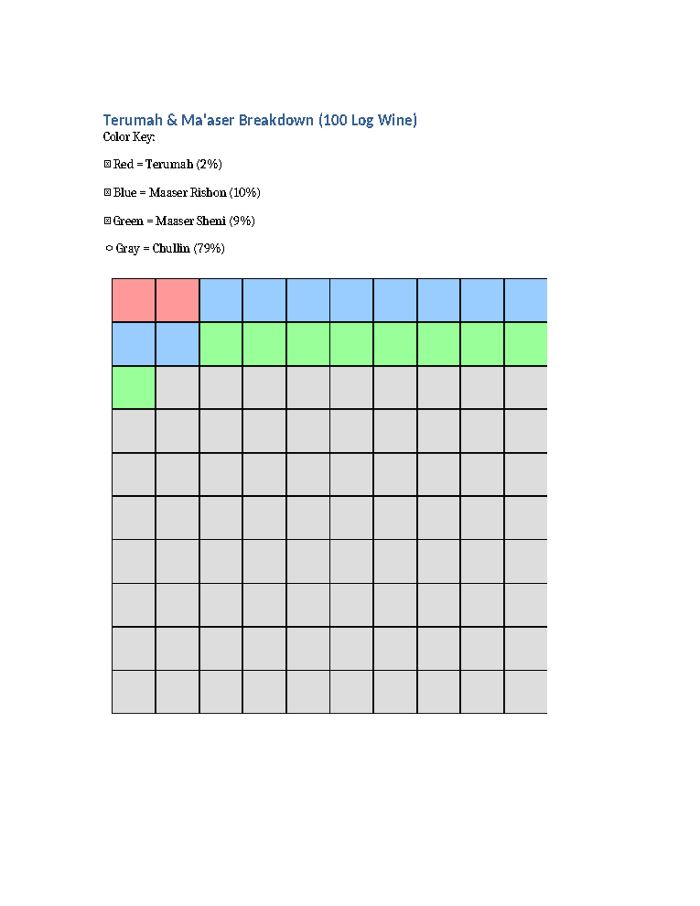
- Introduction: in Eretz Yisrael the required matanos must be given before one drinks wine. Buying from a Jew who is trustworthy needs no worry. One who buys wine from the Kusim must worry that maaser was not taken.
- The RebbiR' Meir is not a nervous person: enjoy your terumah, your husband will not die; enjoy your wine, the barrel will not break. R' Yehuda says no and is very nervous.
- TeirutzThe Gemara's answer is איפוך, switch it. R' Meir is the one concerned for death and R' Yehuda is not.
- The RebbiWhen Abaye said 'lo kashya' on line 7, he should simply have switched it.
- Ra'ayahThe Rebbi began to ask what the proof for the switched version would be: a דתניא, used instead of the case of wine. The shiur broke off here.
Kashas
- ומי אמר אביי: Abaye said in the sukkah case that R' Meir is concerned for death and R' Yehuda is not. Elsewhere he said the opposite.
- The two Mishnayos in Gittin contradict each other. In the case of the husband overseas there is no concern for death. In the case of הרי זה גיטיך שעה אחת קודם מיתתי she may not eat terumah immediately, which shows concern for death.
Teirutzim
- Abaye: lo kashya. The first Mishnah is R' Meir, who is not choshesh for death. The second is R' Yehuda, who is choshesh.
- איפוך: switch the opinions. R' Meir is choshesh for death and R' Yehuda is not.
Mareh mekomos
- Mishnah in Gittin: a bas Yisrael married to a Kohen whose husband went overseas eats terumah b'chezkas shehu kayam. Used as the case of no concern for death.
- Mishnah in Gittin: הרי זה גיטיך שעה אחת קודם מיתתי, she is forbidden to eat terumah immediately. Used as the case of concern for death.
- Braisa (דתניא, line 9) about one who buys wine from the Kusim. Abaye's source for R' Meir being lenient and R' Yehuda being concerned.
The Rebbi’s chiddushim
- Framing of the sugya: are we concerned for rarer events or not?
- In the case of the get before death, the husband's intent is to protect the wife from yibum.
- Personality framing: R' Meir is not nervous (the husband won't die, the barrel won't break, eat and drink). R' Yehuda is the nervous one.
- The Gemara's איפוך means Abaye should have switched the opinions when he said 'lo kashya' on line 7.
Unclear in recording
- A remark about 'today' and Boston Logan is unclear in recording.
- A sentence about which case is R' Yehuda and which is R' Meir is unclear in recording.
- The shiur cuts off while introducing the braisa used as proof for the switched version.
Drafted from the recording of the shiur, for chazarah. Torah terms follow the Rebbi’s own words; anything that could not be made out is marked “unclear in recording”. Tap a time to hear that point. Corrections welcome.