
Does R' Meir Worry About Death? Abaye's Contradiction
The sugya
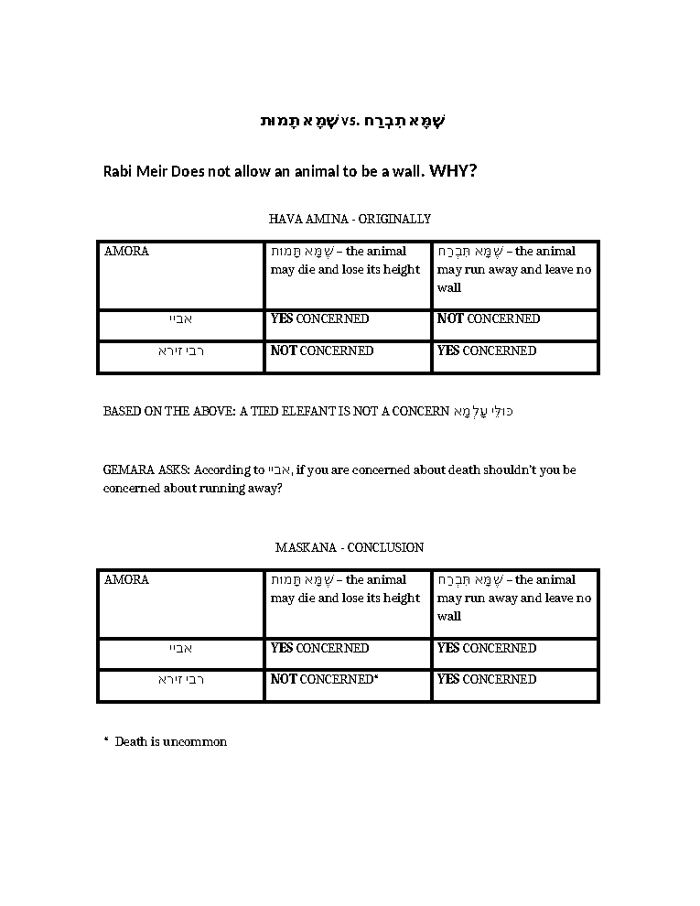
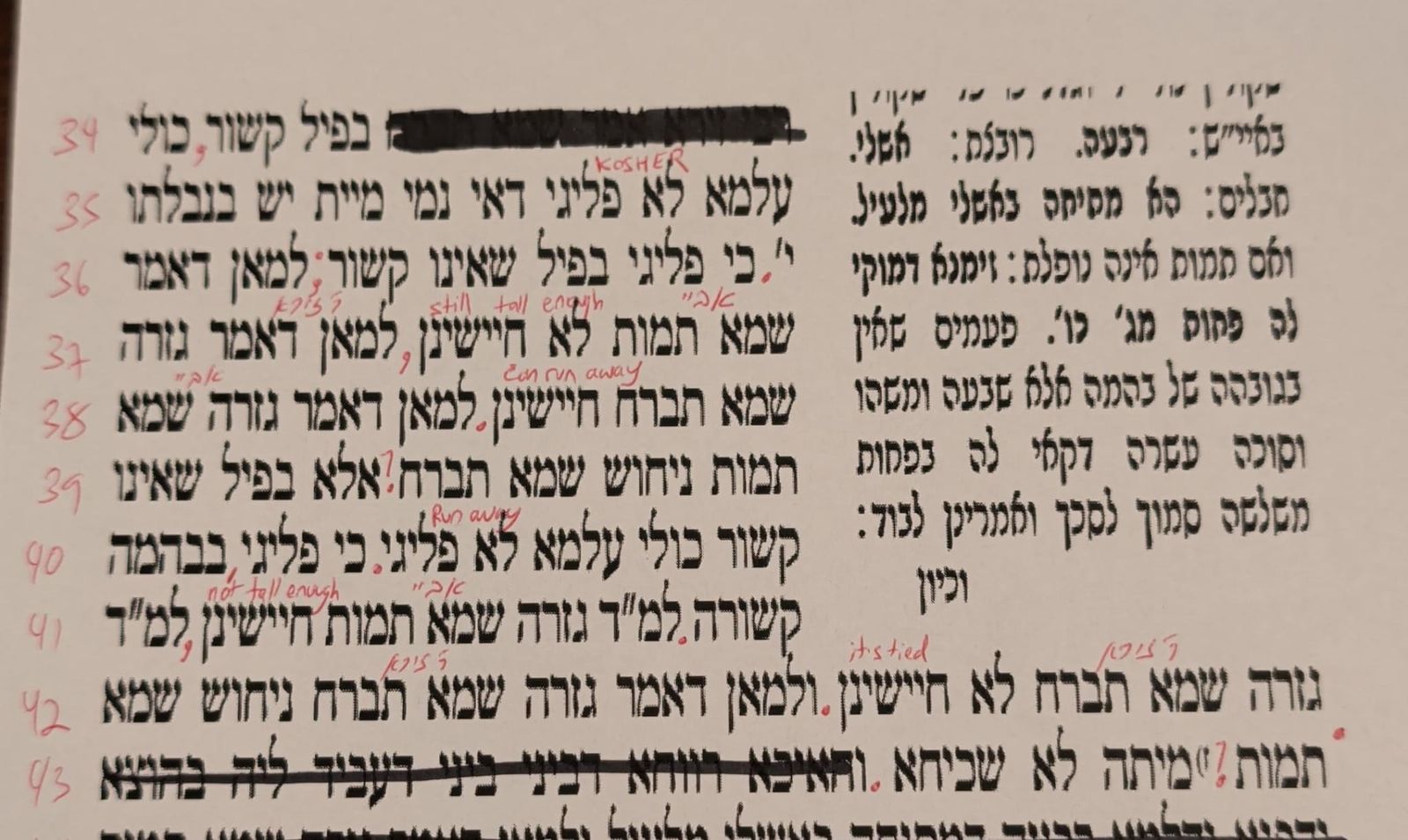
The shiur finished the shakla v'tarya on using an animal as a dofen for the sukkah (the space between its legs, crouching, and the shrinking of a dead animal). It then moved to the Gemara's challenge to Abaye, who said R' Meir is chayish l'misah and R' Yehuda is not. The challenge comes from a Mishnah in Seder Nashim (wife of a kohen whose husband went overseas eats terumah) and a Mishnah in Gittin (a get effective one hour before death forbids her terumah immediately). Abaye there answers that the first is R' Meir, who is not chayish l'misah, and the second is R' Yehuda, who is. That is the reverse of what he says in our sugya. The resolution was left for the next shiur.
Step by step (shakla v’tarya)
- KashaIf we worry the animal will die or run away, what about the space between its legs?
- TeirutzHe fills the gap with branches and leaves.
- KashaMaybe the animal will crouch, and the wall will be too short.
- TeirutzIt is suspended with ropes from above (מתיחה באשלי מלעיל), so it cannot crouch.
- KashaLine 44: according to the one who says gezeirah shema tamus, it is also hanging from ropes, so if it dies, who cares?
- TeirutzSometimes it is set up within less than three of the schach. Once it dies it shrinks (כווצא), and he will not notice (ולאו אדעתיה).
- Gemaraומי אמר אביי: did Abaye really say R' Meir is chayish l'misah and R' Yehuda is not?
- The RebbiThe Rebbi frames R' Meir as more 'pessimistic', concerned for uncommon things, and R' Yehuda as not concerned. He stresses this is a general issue, and the sources brought have nothing to do with sukkah.
- Background: a bas Yisrael married to a kohen eats terumah. Once divorced or widowed, she eats only if she has children or descendants from that marriage.
- MishnahMishnah (somewhere in Seder Nashim): a bas Yisrael married to a kohen whose husband went to medinas hayam eats terumah b'chezkas shehu kayam. The case assumes she has no children.
- MishnahContradiction from a Mishnah in Gittin: הרי זה גיטיך שעה אחת קודם מיתתי. She is forbidden to eat terumah immediately (מיד).
- KashaThe setups differ, but the facts are the same: the same husband on the same trip. In one Mishnah we assume he is alive, and in the other we suspect the worst.
- TeirutzAbaye: lo kashya. The first Mishnah (husband overseas, she eats terumah) is R' Meir, who is not chayish l'misah. The second (the get) is R' Yehuda, who is chayish l'misah.
- KashaThis is the opposite of our sugya. There R' Meir disqualifies the animal as a wall, and according to Abaye that is a concern of death. R' Zeira is out of the picture, since his reason is running away.
- One might simply say the names are switched, which the Gemara eventually will say. The next part is more technical and will be done next time.
- ChazarahReview from line one: Abaye's statement, the Mishnah of the husband overseas, the Mishnah of the get one hour before death, and Abaye's answer pinning them on R' Meir and R' Yehuda. Ends with: 'That's a problem.'
Kashas
- What about the space between the animal's legs?
- Maybe the animal will crouch, and the wall will be too short.
- According to gezeirah shema tamus: it hangs from ropes anyway, so why does its death matter?
- Mishnah of husband overseas (she eats terumah) vs. Mishnah in Gittin (get one hour before death, forbidden miyad): do we worry he will die or not?
- Abaye's assignment there (R' Meir not chayish l'misah) is the reverse of what he says in our sugya (R' Meir chayish l'misah).
Teirutzim
- He fills the gap with branches and leaves.
- It is suspended with ropes from above, so it cannot crouch.
- Sometimes it is within less than three of the schach. When it dies it shrinks, and he will not notice.
- Abaye: the first Mishnah is R' Meir, who is not chayish l'misah. The second is R' Yehuda, who is chayish l'misah.
Mareh mekomos
- Mishnah (the Rebbi said somewhere in Seder Nashim): bas Yisrael married to a kohen whose husband went to medinas hayam eats terumah b'chezkas shehu kayam. Used as the first side of the contradiction.
- Mishnah in Gittin: הרי זה גיטיך שעה אחת קודם מיתתי, she is forbidden in terumah immediately. Used as the second side of the contradiction.
- The Gemara there (on the first Mishnah) asks the contradiction from the second Mishnah, and Abaye answers.
The Rebbi’s chiddushim
- R' Meir vs. R' Yehuda framed as a general attitude. R' Meir is more 'pessimistic' and concerned for uncommon occurrences, while R' Yehuda is not. It is almost psychological: do you believe it will happen?
- Chazaka means an ongoing status.
- Why a husband gives such a get, e.g. when going to war: if he dies childless she would need yibum or chalitza with his brother. A divorcee is better off than a widow, and she still gets her kesubah.
- Sha'ah literally means an hour, but maybe it means a moment.
- The cases differ only in the stipulation. Making the stipulation does not make death more likely. His analogy: arranging legal papers before a trip does not make the plane more likely to crash. It only shows a more cautious person.
- Both Mishnahs are anonymous; Abaye pins names on them.
Unclear in recording
- An exchange about a daughter married to a Yisrael who has grandchildren is unclear in recording.
- Portion of the discussion about whether the wife must suspect something happened to the husband is unclear in recording.
- Student suggestion about whether the husband has brothers is unclear in recording.
- Extended back-and-forth with talmidim on why the stipulation might matter is partly unclear in recording.
- At 19:04 the Rebbi says the second Mishnah is R' Meir and the first is R' Yehuda, then says 'mixed it up'. In the review (22:51) he states that Abaye assigns the first to R' Meir and the second to R' Yehuda. The intent at 19:04 is unclear in recording.
Drafted from the recording of the shiur, for chazarah. Torah terms follow the Rebbi’s own words; anything that could not be made out is marked “unclear in recording”. Tap a time to hear that point. Corrections welcome.