Shiur summary (draft from the recording)
Osek B'Mitzvah: Tirda and the Pesach Sheni Source
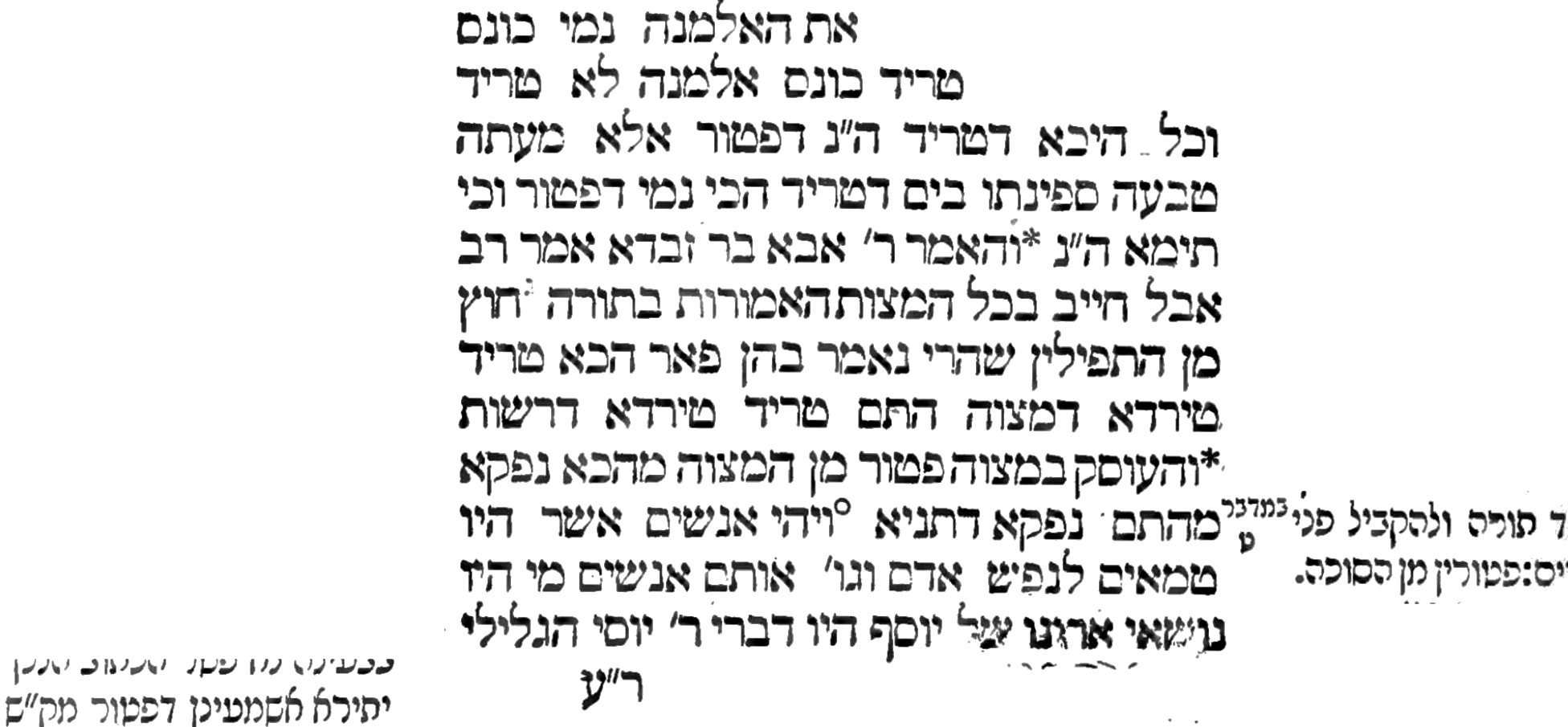
העוסק במצוה פטור מן המצוה
Sukkah 25a · from line 22 · Thursday, December 25, 2025
The sugya
The Gemara continues the source for osek b'mitzvah patur min hamitzvah. It asks why only kones besulah is patur and not kones almana, and answers that a besulah causes tirda. It then distinguishes tirda d'mitzvah from tirda d'reshus, using an avel and a man whose ship sank. The Gemara next asks whether the source is really the pasuk of Pesach Sheni. The shiur covers the machlokes over who the temei'im were and R' Yitzchak's view that they were busy with a meis mitzvah whose seventh day fell on erev Pesach.
Step by step (shakla v’tarya)
- KashaIf someone busy with a mitzvah is patur, then even one who marries an almana should also be patur. Why only a besulah?
- TeirutzKones besulah is tarid; kones almana is not tarid. It does not take up all his head space as much.
- KashaThen anyone who is tarid should be patur? What about one whose ship sank at sea? He is certainly tarid. Is he really patur?
- KashaAnd if you say yes, he is patur: R' Abba bar Zavda said in the name of Rav that an avel is chayav in all mitzvos of the Torah except tefillin, since tefillin are called pe'er.
- TeirutzWe do not exempt someone just for being tarid. The chassan's tirda is a tirda d'mitzvah; the avel's is a tirda d'reshus.
- The RebbiAn avel has certain things he must observe. But wallowing in his pain is reshus, and he would be required to put it out of his mind to do the mitzvos.
- GemaraNew question: is osek b'mitzvah patur min hamitzvah learned from here, from b'shivtecha b'veisecha / b'lechtecha baderech? Or is it learned from there, a different part of the Torah?
- The RebbiNo one questions that the concept is true. The question is only about its source.
- Ra'ayahThe other source is the pasuk in Bamidbar about Pesach Sheni. Temei'im could not bring the korban Pesach and complained, 'why should we be deprived?' They were given a make-up day a month later.
- GemaraThe Rebbi reads the pasuk: the men were tamei l'nefesh adam and could not make the korban Pesach on that day. The Gemara quotes only the first part and says v'gomer.
- GemaraThe Beraisa asks: who were these men?
- MachlokesR' Yosi HaGlili: they were the carriers of Yosef's aron.
- MachlokesR' Akiva: they were Mishael and Eltzafan, who were busy with Nadav and Avihu.
- ShitahR' Yitzchak, whom the Rebbi calls an early Amora, disagrees with both.
- KashaIf they were the carriers of Yosef's aron, they could already have become tahor. They had plenty of time, since tumas meis takes seven days.
- KashaLikewise, if they were Mishael and Eltzafan, they also could have become tahor.
- TeirutzRather, they were busy with a meis mitzvah, and their seventh day fell on erev Pesach.
- The RebbiThis is not the prototypical meis mitzvah. It was a meis they personally had to take care of, perhaps a relative. It may have been several groups of people, which fits the pasuk better since a number of people came to Moshe.
- The RebbiTumas meis is a seven-day tumah, requiring sprinkling with parah adumah water on the third and seventh days. They could not have finished earlier.
- Ra'ayahAs the pasuk says, 'v'lo yachlu la'asos haPesach bayom hahu.' On that day they could not, but the next day (line 8) they could have. So they were short by just one day.
- MaskanaThe Gemara ends with a question mark, to be answered tomorrow: it appears the source of osek b'mitzvah is really here, not from b'shivtecha b'veisecha.
- The RebbiOne might have thought the korban Pesach is more important, and they should have deferred the burial. The Torah says it was fine. They were busy with a mitzvah and were patur even though it stopped them from bringing the korban Pesach.
Kashas
- If osek b'mitzvah is patur, why not kones almana as well?
- Is everyone who is tarid patur, such as one whose ship sank at sea?
- R' Abba bar Zavda in the name of Rav: an avel is chayav in all mitzvos except tefillin, so being tarid does not exempt.
- Is osek b'mitzvah learned from b'shivtecha b'veisecha, or from elsewhere (the Pesach Sheni pasuk)?
- R' Yitzchak: the carriers of Yosef's aron, and Mishael and Eltzafan, could already have become tahor.
Teirutzim
- Kones besulah is tarid; kones almana is not.
- Chassan: tirda d'mitzvah. Avel and similar cases: tirda d'reshus, which does not exempt.
- They were busy with a meis mitzvah whose seventh day fell on erev Pesach. Bayom hahu they could not; the next day they could have.
Rashi & Tosafos
- Rashi: There is a long Rashi with a cheshbon on R' Yitzchak's statement. Its content was not discussed.
- Rashi: Mentioned regarding what kind of meis mitzvah this was. Unclear in recording.
Mareh mekomos
- R' Abba bar Zavda amar Rav: an avel is chayav in all mitzvos except tefillin, which are called pe'er. Brought as a kasha against exempting anyone who is tarid.
- Pasuk in Bamidbar about Pesach Sheni (the temei'im who could not bring the korban Pesach). Brought as a possible source for osek b'mitzvah.
- 'V'lo yachlu la'asos haPesach bayom hahu': the diyuk that the next day they could have, so their seventh day fell on erev Pesach.
The Rebbi’s chiddushim
- An avel's preoccupation with his pain is reshus. He must remove it from his mind to do the mitzvos, unlike a chassan's tirda d'mitzvah.
- The Gemara's question is only about the source of osek b'mitzvah, not whether the concept exists.
- The meis here was not the prototypical meis mitzvah but a meis they had to care for personally, perhaps a relative.
- R' Yitzchak's view fits the pasuk better: several people with their own meisim came to Moshe, not just two.
- The Torah approved their dealing with the meis even though it caused them to miss the korban Pesach. This shows a mitzvah being done exempts from another mitzvah.
Unclear in recording
- Opening remarks before the Gemara.
- The specific things an avel must do (some words garbled).
- Side discussion about Yosef's instructions regarding his bones and whether the carriers would be tamei.
- Side discussion about Nadav and Avihu, how many people came, and who buried Moshe.
- The date the Rebbi said they camped (perhaps Rosh Chodesh Nissan).
- Closing remarks.
Drafted from the recording of the shiur, for chazarah. Torah terms follow the Rebbi’s own words; anything that could not be made out is marked “unclear in recording”. Tap a time to hear that point. Corrections welcome.