Shiur summary (draft from the recording)
Osek B'Mitzvah: Source from Pesach Sheni
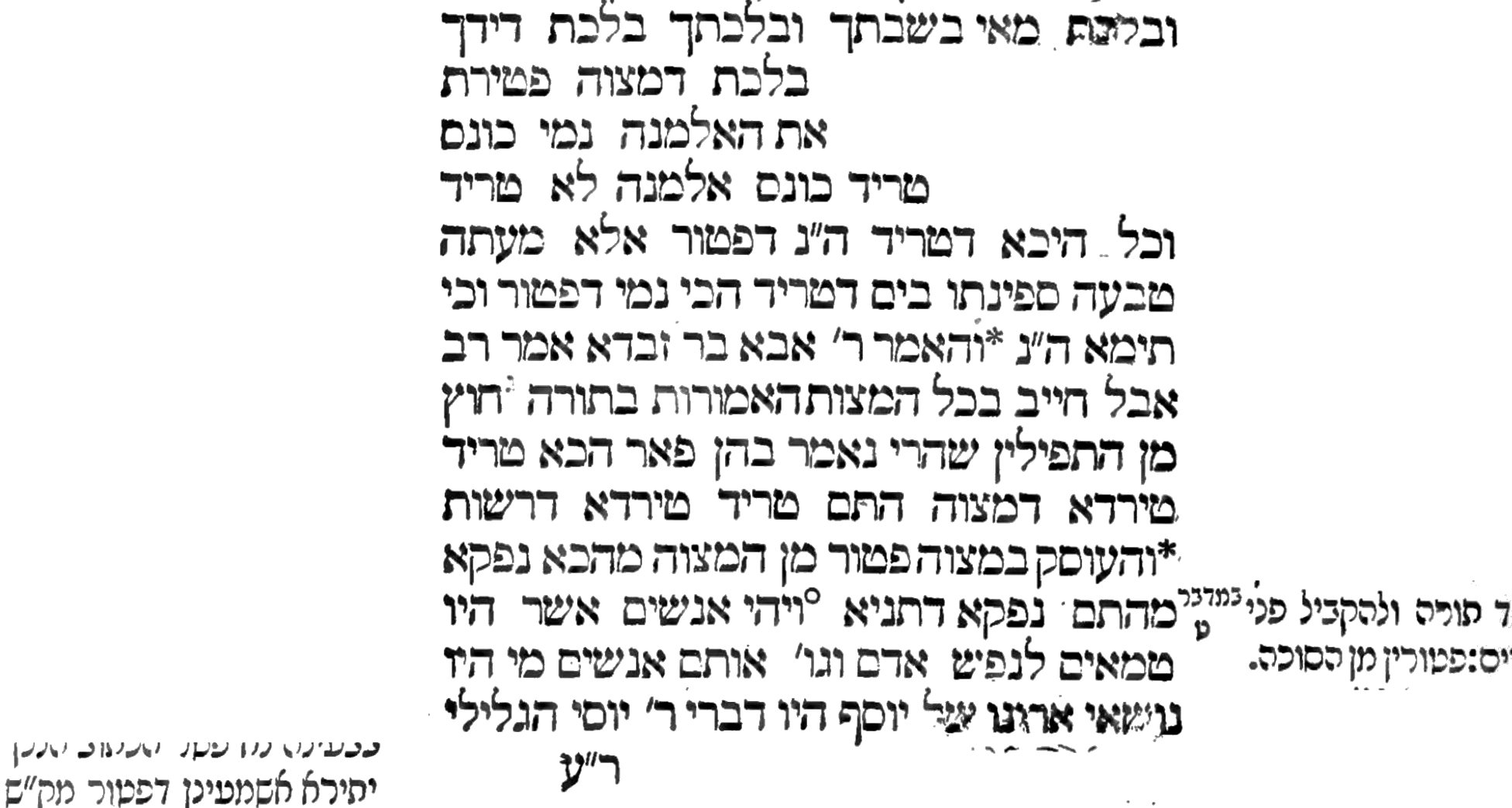
העוסק במצוה פטור מן המצוה
Sukkah 25a · from line 20 · Friday, December 26, 2025
The sugya
The Gemara asks whether the rule that one busy with a mitzvah is exempt from another mitzvah comes from the pasuk of Krias Shema or from a Braisa about the people who were tamei and could not bring the Korban Pesach. The shiur went through the three-way machlokes over who those people were, R' Yitzchak's proof from 'ביום ההוא', and then the Gemara's answer of צריכא: both sources are needed. The Rebbi closed with a summary of why neither source alone would be enough.
Step by step (shakla v’tarya)
- GemaraStarting from the rule that one busy with a mitzvah is exempt from another mitzvah (shluchei mitzvah).
- KashaIs this learned from here, the pasuk of Krias Shema with 'ובלכתך בדרך', or from there, a Braisa?
- Ra'ayahThe Braisa on the pasuk about the men who were tamei lameis asks who these men were. There is a three-way machlokes.
- ShitahR' Yosi HaGlili says they were the men carrying Yosef's coffin.
- Shitah(Amud beis, line one) R' Akiva says they were Mishael and Eltzafan, who were busy with the bodies of Nadav and Avihu.
- DechiyahR' Yitzchak rejects both views: either group could already have become tahor. Yosef's bones were carried long before. Mishael and Eltzafan may have become tamei on Rosh Chodesh Nisan, which left two weeks, and tahara takes only seven days.
- ShitahR' Yitzchak concludes they were busy with a meis mitzvah (their own relatives), and their seventh day fell on Erev Pesach, the day the Korban Pesach is brought.
- Ra'ayahThe pasuk says they could not bring the Pesach 'ביום ההוא'. So on that day they could not, but the next day they could. This proves it was an issue of that very day.
- The RebbiThe Rebbi said this shows a person may take on a mitzvah and so be exempt from another mitzvah, even if the coming mitzvah is more serious. His example was someone busy escorting a mishulach who knows he will miss the time for tefillin. He stressed he was not paskening.
- KashaSo which is the source: the pasuk of Shema or this Braisa?
- The RebbiUsually, when the Gemara asks which is the source, the answer is that both are needed, because each teaches something different.
- Teirutz(Line 9) צריכא: both limudim are needed. In this sugya, 'hasam' is Pesach and 'hacha' is Krias Shema.
- TeirutzHad we only the Pesach source, we would say it is because the time of the Pesach obligation had not yet arrived (it starts Erev Pesach), and they became involved days before. So we would limit osek b'mitzvah to cases where the second mitzvah is not yet due.
- TeirutzBut by Krias Shema, where the time has already arrived, we would say one may not set it aside. So the Shema source is needed.
- KashaThen why not have only the Shema source? If Shema may be set aside even when one is already obligated, surely Pesach, which is not yet due, may be.
- TeirutzHad we only Shema, we would say it may be set aside because missing it carries no kares. It is an aveirah (bitul asei) but not kares.
- TeirutzBut Pesach carries kares, so we would say it may not be set aside. Pesach and milah are two mitzvos asei that carry kares.
- Asked whether Shema is not also an asei: it is. Missing it is bitul asei, which requires teshuvah. That is a real obligation, but it is not kares.
- TeirutzThe source of Shema would cover Shema, tefillin, lulav and similar mitzvos without kares. It would not tell us that one may stay with burying a dead relative and forgo the Korban Pesach.
- ChazarahSummary. Shema alone is not enough because missing Shema carries no kares. Pesach alone is not enough because the Pesach obligation had not yet arrived and the meis came first. By Shema, the chassan has the mitzvah of the besulah and Shema at the same time. Therefore both are needed.
Kashas
- Is osek b'mitzvah patur min hamitzvah learned from the pasuk of Krias Shema or from the Braisa about the tamei men and the Korban Pesach?
- R' Yitzchak against R' Yosi HaGlili and R' Akiva: both of the groups they name could already have become tahor before Pesach.
- Why not learn everything from Shema alone, since it is the stronger case (one is already obligated)?
Teirutzim
- R' Yitzchak: they were busy with a meis mitzvah whose seventh day fell on Erev Pesach, as the pasuk says 'ביום ההוא'.
- צריכא: both sources are needed.
- From Pesach alone we would say the exemption applies only where the second mitzvah's time has not yet arrived. Shema teaches it applies even when the time has already arrived.
- From Shema alone we would say it applies only to a mitzvah without kares. Pesach teaches it applies even to a mitzvah with kares.
Mareh mekomos
- Pasuk of Krias Shema, 'ובלכתך בדרך': the first proposed source for osek b'mitzvah.
- Pasuk in Parshas Pesach Sheni about the men who were tamei lameis, as explained in the Braisa: the second proposed source.
- The last Mishnah in Yoma, which deals with teshuvah: cited to show that bitul asei requires real teshuvah.
The Rebbi’s chiddushim
- The Pesach Sheni source shows one may take on a mitzvah knowing it will cause him to miss another, even a more serious one. Example: escorting a mishulach and missing the time for tefillin. This was not stated as psak.
- When the Gemara asks which is the source, the answer is usually that both are needed, each teaching its own chiddush.
- The Pesach case is a 'level one chiddush', since the second obligation had not yet arrived.
- In the Shema case the chassan has both mitzvos at the same moment. In the Pesach case the meis came first, before the Pesach obligation.
Unclear in recording
- A side discussion about Pesach Sheni as a make-up day.
- A remark about R' Yitzchak being the Tanna 'we're sticking with' (possibly about psak).
- Examples of what one might be busy with when the time of Shema arrives (learning Torah and others) are partly garbled.
- A back-and-forth with the chabura about a chassan and planning a wedding, and about Shema at night (about 10:16 to 12:00).
Drafted from the recording of the shiur, for chazarah. Torah terms follow the Rebbi’s own words; anything that could not be made out is marked “unclear in recording”. Tap a time to hear that point. Corrections welcome.