Shiur summary (draft from the recording)
Choleh, Mitztaer, and Achilas Arai Outside Sukkah
חולים ומשמשיהם
Sukkah 26a · Monday, January 5, 2026
The sugya
The shiur continued the Gemara on the Mishnah's second part, cholim u'meshamshehem. It covered how minor a choleh may be, Rava's ruling that a mitztaer is patur, and the kasha from the Mishnah's wording. It then moved to the third part of the Mishnah, achilas arai outside the sukkah: the machlokes between Rav Yosef and Abaye on the shiur, and the braisa that forbids even shinas arai outside the sukkah because of a gezeirah, shema yeradem. The Rebbi reviewed lines 41-47 and previewed the next shiur.
Step by step (shakla v’tarya)
- ChazarahThe Mishnah has three parts: shluchei mitzvah, cholim u'meshamshehem, and how much one may eat outside the sukkah. The third part leads into the next Mishnah.
- GemaraTanu Rabbanan (line 28): the choleh in the Mishnah need not be a choleh she'yesh bo sakana. Even someone with pain in his eyes or a slight headache counts.
- Ra'ayahA story is brought of someone whose eyes were hurting. R' Yosi b'Ribi permitted him and his attendants to sleep outside the sukkah.
- GemaraRav permitted Rav Acha Bardela to sleep in a small tent (kila) inside the sukkah because of gnats or mosquitoes.
- GemaraRava permitted (R' Acha bar Ada) to sleep outside the sukkah. The reason was the smell of the dirt used for the sukkah, which mixed with rain and became putrid.
- ShitahRava follows his own view: a mitztaer is patur from sukkah. All these stories fit his position.
- KashaThe Mishnah says cholim u'meshamshehem are patur. That implies a choleh is patur but a mitztaer is not. So why bring stories about people bothered by a smell or by mosquitoes?
- TeirutzThe diyuk is on u'meshamshehem. A choleh is patur together with his attendants. A mitztaer is patur himself, but his attendants are not.
- MishnahLast part of the Mishnah (line 41): ochlin achilas arai chutz la'sukkah. One may eat casually, a light snack, outside the sukkah.
- GemaraThe Gemara asks: v'kama achilas arai? How much is the casual eating the Mishnah permits?
- ShitahRav Yosef: two or three eggs (beitzim).
- DechiyahAbaye: many times a person is satisfied with that amount, so it would count as a seudas keva. That is too much to call arai.
- ShitahAbaye: the shiur is what a talmid (bar bei rav) tastes before going in to the kallah. Here kallah means a shiur.
- RashiRashi: the talmid is afraid the Rebbi will go over time and he will get hungry, so he quickly eats something first.
- The Mishnah spoke only about eating arai, not about sleeping. The braisa adds to the Mishnah on this point.
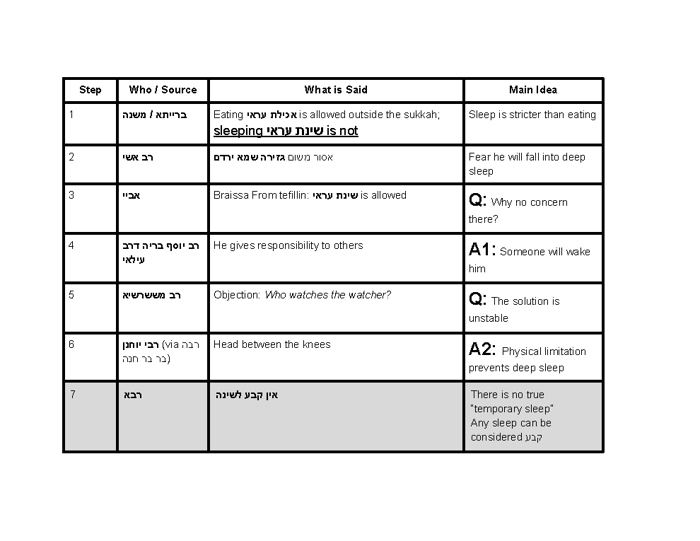
- GemaraBraisa (line 46): one may eat achilas arai outside the sukkah, but one may not sleep shinas arai outside the sukkah.
- KashaWhy not? One sits in the sukkah like his house, and small snacks are allowed outside. Why should a short sleep be different?
- TeirutzRav Ashi: it is a gezeirah, shema yeradem. He may fall into a deep sleep.
- The RebbiWhen eating, a person is conscious and can stop. Once he dozes off, he cannot control how long he sleeps.
- ChazarahReview of lines 41-47: the Mishnah of achilas arai, Rav Yosef and Abaye, the braisa on shinas arai, and the reason shema yeradem.
- Preview for the next shiur: there may be ways a person can sleep briefly, such as with his head between his knees, where his sleep will stay short because he will wake up.
Kashas
- The Mishnah's wording, cholim u'meshamshehem, implies only a choleh is patur and not a mitztaer. Why bring stories of people bothered by gnats or a bad smell?
- Abaye on Rav Yosef: two or three eggs is often enough to satisfy a person, so it would be a seudas keva.
- Why is shinas arai outside the sukkah forbidden when achilas arai is permitted?
Teirutzim
- A choleh is patur together with his attendants. A mitztaer is patur himself, but his attendants are not.
- Abaye: achilas arai is the amount a talmid eats before going in to the shiur.
- Rav Ashi: a gezeirah, shema yeradem, lest he fall into a deep sleep.
Rashi & Tosafos
- Rashi: Rashi uses a French word in his explanation of the shiur. The Rebbi thinks it means 'morsels', i.e. two or three morsels.
- Rashi: The talmid eats before the shiur because he fears the Rebbi will go over time and he will become hungry.
Mareh mekomos
- Yoma, where a shiur is given as a cheekful to drink. Brought as another example of a shiur based on a person's typical capacity, like Rav Yosef's somewhat arbitrary-seeming shiur.
The Rebbi’s chiddushim
- Why a mitztaer's attendants are not patur: he does not need attendants. As soon as he leaves the sukkah he is no longer mitztaer. A choleh needs his attendants to bring him what he needs.
- On why Rav Yosef says 'two or three eggs': perhaps two large eggs or three small ones.
- A kezayis is considered an eating (achilah) in halacha, but not a meal. It does not reach the level of satisfaction.
- Rav Yosef's two or three eggs refers to the size or volume, not to actual eggs.
- Kallah here, as in yarchei kallah, means a shiur, not a bride.
- The Mishnah allowed only light snacking. It gave no wiggle room for dozing off outside the sukkah.
- When eating, a person is conscious and can stop himself. Once he falls asleep he loses control. For example, someone takes a short nap with Mincha in 20 minutes and ends up missing Mincha.
Unclear in recording
- The name of the person in the story whose eyes hurt, and the place, are garbled in the recording.
- The exact wording of Rashi that the Rebbi quoted is unclear in the recording.
- The Rebbi first said Rav Yosef was addressing Abaye, then corrected himself: Abaye is the one arguing with Rav Yosef.
- In the review, the reason shema yeradem sounds as if it is attributed to Abaye. Earlier (t=1002) it was given in the name of Rav Ashi. Unclear in recording.
- The discussion of potato chips versus meat, and of Lubavitch practice regarding drinking and sleeping outside the sukkah, is unclear in the recording. It is not clear who said what.
Drafted from the recording of the shiur, for chazarah. Torah terms follow the Rebbi’s own words; anything that could not be made out is marked “unclear in recording”. Tap a time to hear that point. Corrections welcome.