Own Sukkah or Borrowed: Lecha vs. Kol Ha'ezrach
The sugya
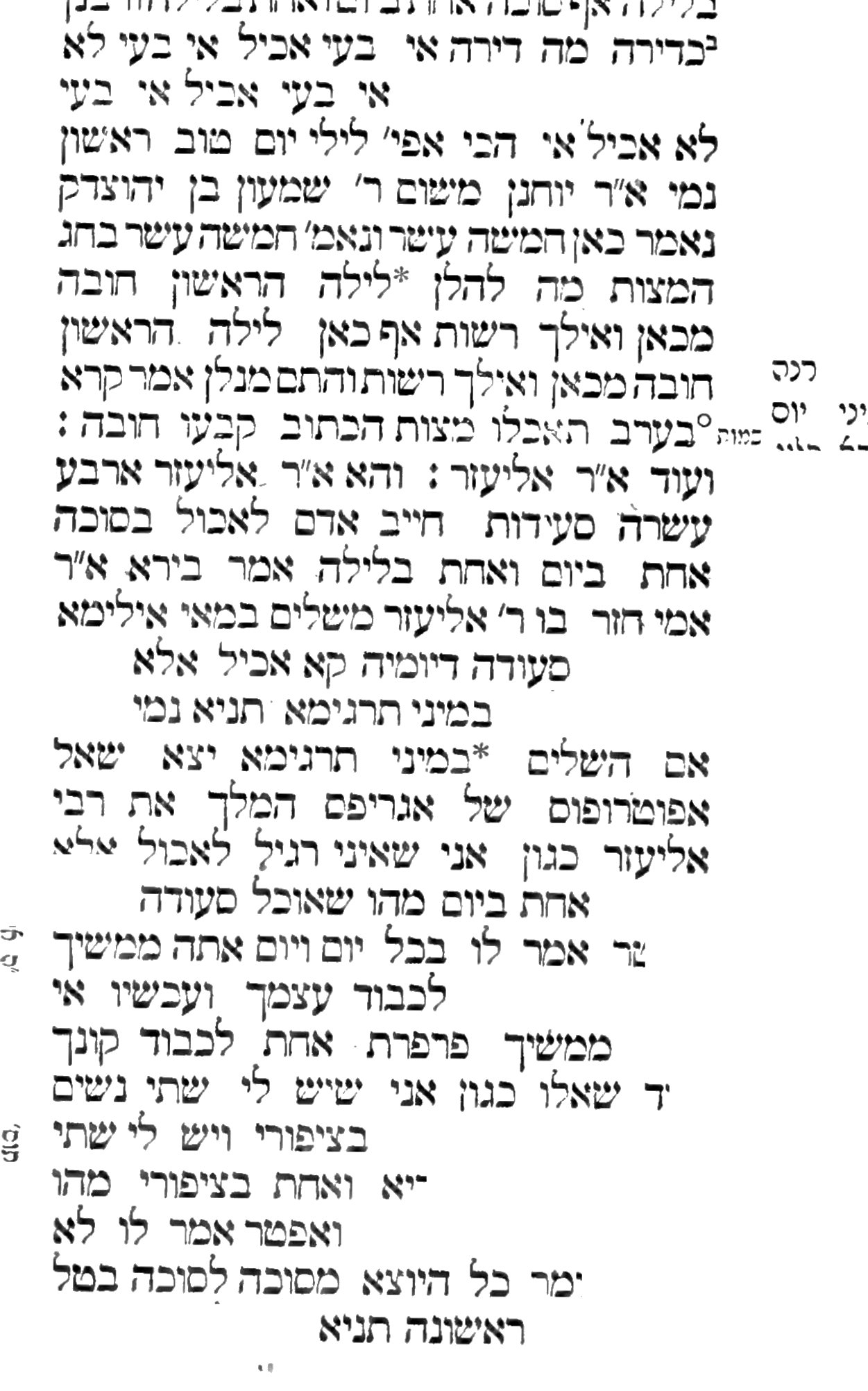
The shiur continues the machlokes between R' Eliezer and the Chachamim over whether a person is yotzei in his friend's sukkah. R' Eliezer learns from 'lecha' that the sukkah must be your own, like lulav. The Chachamim learn from 'kol ha'ezrach' that all Yisrael can sit in one sukkah. The Gemara then asks what each side does with the other's pasuk: the Rabbanan use 'lecha' to exclude a stolen sukkah, and R' Eliezer uses 'kol ha'ezrach' for a ger who converted, or a katan who came of age, during Sukkos. The Rabbanan answer that they need no pasuk for that case, since in their view one may build a sukkah on Chol HaMoed.
Step by step (shakla v’tarya)
- ShitahR' Eliezer draws a parallel from arba minim to sukkah: just as one is not yotzei with a friend's lulav, so too one is not yotzei in a friend's sukkah ('lecha').
- ShitahThe Chachamim (line 17) do not compare the two; they contrast them. They agree about lulav (line 20) but hold that one is yotzei in a friend's sukkah, based on a different pasuk.
- Ra'ayahThe Chachamim cite 'kol ha'ezrach b'Yisrael yeshvu basukkos'. 'Sukkos' is written chaser, without a vav, which teaches that all of Yisrael could sit in one sukkah.
- Each side must account for the other's pasuk, since the Torah mentions both pesukim. You cannot just pick and choose.
- KashaLine 23: what do the Rabbanan expound from 'lecha'? 'Lecha' is something extra, and for R' Eliezer it means you must sit in your own sukkah, not a borrowed one.
- TeirutzThe Rabbanan need 'lecha' only to exclude a gezulah, a stolen sukkah.
- The RebbiOften with mitzvos, stealing is an aveirah, yet one can still fulfil the mitzvah. With sukkah, 'lecha' teaches that one is not even yotzei in a sukkah built from stolen materials, beyond the issur itself.
- TeirutzLine 24: a borrowed sukkah, however, is kosher, because 'kol ha'ezrach' is written. This includes using a friend's sukkah with permission, or simply sitting in his sukkah without building one.
- KashaAnd R' Eliezer: what does he do with 'kol ha'ezrach'?
- The RebbiThe Gemara asks on the Rabbanan 'mai darshi bei', but on R' Eliezer 'mai avid leih'. With the Rabbanan, the question was about one extra word. With R' Eliezer, the question is what he does with the whole pasuk.
- ChazarahThis ties back to the 'all or nothing' idea discussed two days ago. According to R' Eliezer one must sit in one sukkah for all seven days, and may not go between a sukkah in Tzippori and one in Teveria.
- TeirutzR' Eliezer needs 'kol ha'ezrach' for a ger who converts in the middle of Sukkos, and a katan who grows up during Sukkos. Even though they cannot have a sukkah for all seven days, the pasuk includes them.
- TeirutzThe Rabbanan do not need a pasuk for that case. They already said (top of the amud, line 2-3) that one may go from sukkah to sukkah and build a sukkah on Chol HaMoed, so 'lo itztrich kra'.
- ChazarahThe Rebbi reviews the lines again: the Rabbanan use 'lecha' to exclude a stolen sukkah, a borrowed one is included by 'kol ha'ezrach', and R' Eliezer uses 'kol ha'ezrach' for the ger and the katan.
Kashas
- According to the Rabbanan, what do they expound from the extra word 'lecha'?
- According to R' Eliezer, what does he do with the pasuk 'kol ha'ezrach'?
Teirutzim
- The Rabbanan use 'lecha' to exclude a stolen sukkah. A borrowed sukkah is kosher because of 'kol ha'ezrach'.
- R' Eliezer uses 'kol ha'ezrach' for a ger who converted, or a katan who came of age, in the middle of Sukkos.
- The Rabbanan need no pasuk for the ger and katan, since they hold one may build a sukkah on Chol HaMoed.
Mareh mekomos
- Pasuk 'kol ha'ezrach b'Yisrael yeshvu basukkos', with 'sukkos' written chaser: the Chachamim's source that all Yisrael can sit in one sukkah, so a friend's sukkah is kosher.
- Pasuk 'chag hasukkos ta'aseh lecha shivas yamim': 'lecha' excludes a stolen sukkah (Rabbanan), or requires your own sukkah (R' Eliezer).
- Back-reference to the shiur two days ago: R' Eliezer's view that one must sit in one sukkah for seven days, not moving between Tzippori and Teveria.
The Rebbi’s chiddushim
- With most mitzvos, stealing is an aveirah but one may still be yotzei. By sukkah, a stolen sukkah is not merely assur but one is not yotzei at all.
- Practical example: kids collecting wood for bonfires. Don't leave your materials outside, and you cannot build a sukkah from someone else's stolen wood.
- The change in language from 'mai darshi bei' (on the Rabbanan, about one word) to 'mai avid leih' (on R' Eliezer, about a whole pasuk) is a meaningful nuance.
- The ger and katan case shows that R' Eliezer still has a use for the pasuk, even for someone who could not have a sukkah for all seven days.
Unclear in recording
- A side comparison to lulav, about having to fully own it and the need to buy in, is unclear in recording.
- A side remark about the pasuk 'kol ha'ezrach' possibly being said when taking leave of the sukkah is unclear in recording.
- An illustrative story about someone who decided mid-Sukkos to become a ger is unclear in recording.
- A comparison to whether one who becomes bar mitzvah in the middle of the Yom Tov makes a bracha ('same idea') is only partly audible and unclear in recording.
- A final student question about stolen lulav as a separate pasuk is unclear in recording.
Drafted from the recording of the shiur, for chazarah. Torah terms follow the Rebbi’s own words; anything that could not be made out is marked “unclear in recording”. Tap a time to hear that point. Corrections welcome.