Borrowed Sukkah; Visiting One's Rebbe on Regel
The sugya
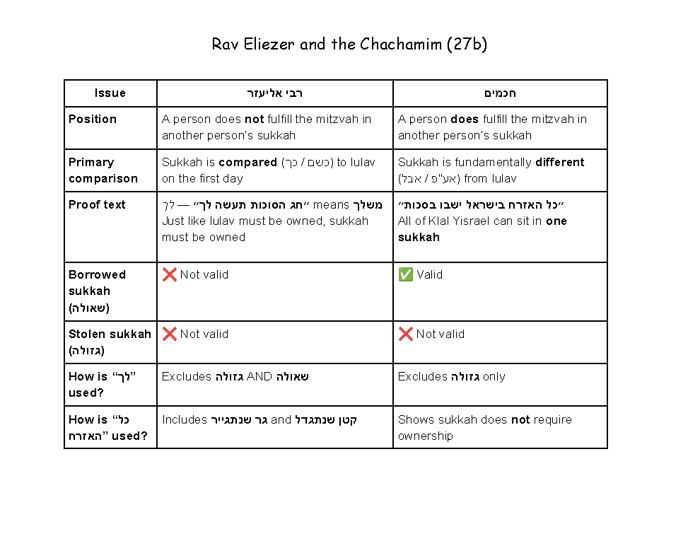
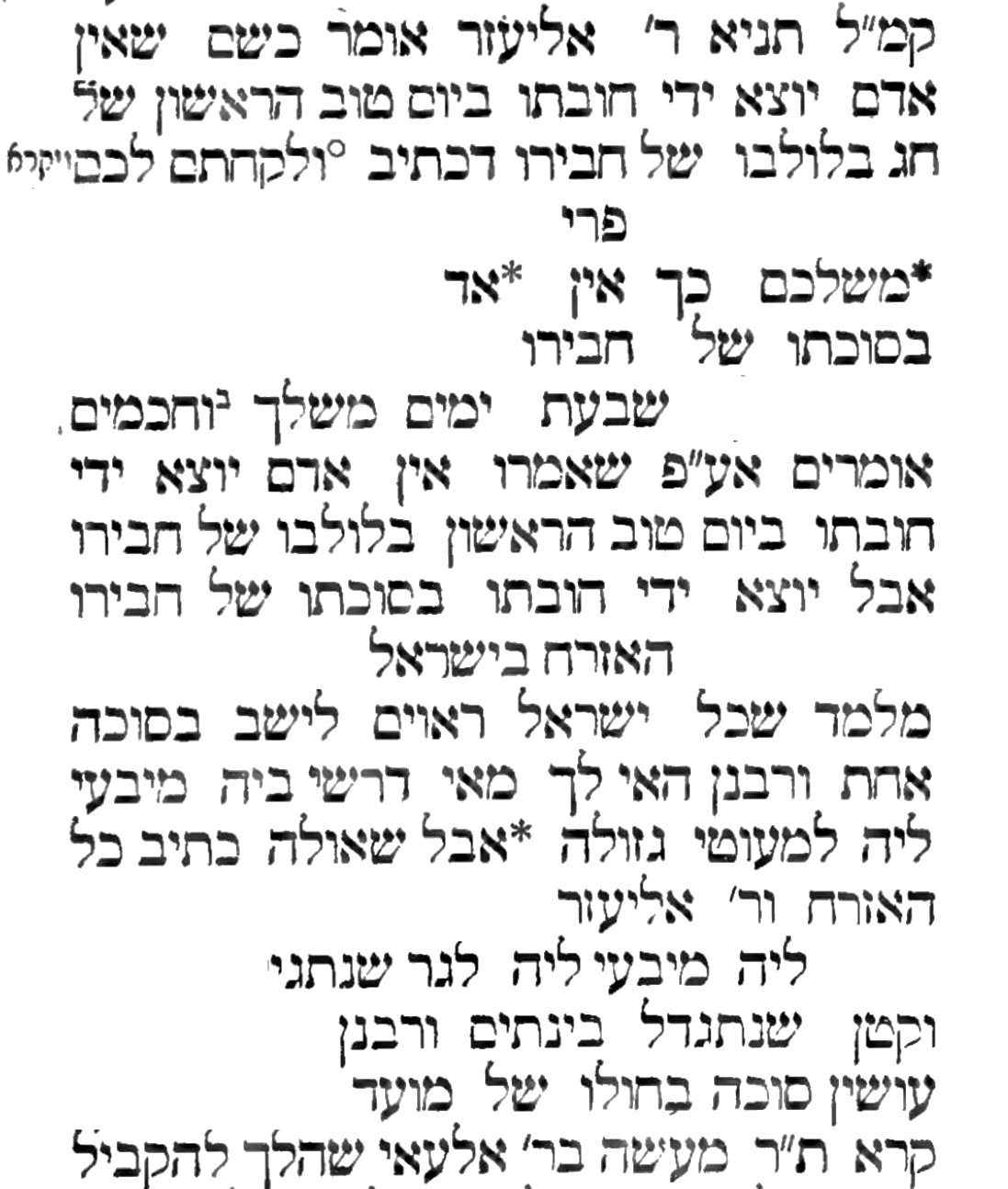
The shiur finished the braisa on whether one is yotzei in a friend's sukkah. The Rabbanan learn from 'kol ha'ezrach' that all of Yisrael are fit to sit in one sukkah, and the Gemara asks what each side does with the other's pasuk. The Rebbi then began the aggadic section, with R' Eliezer as the main character: R' Ilai visits R' Eliezer in Lod on the regel, and R' Eliezer praises those who stay home on Yom Tov because of 'v'samachta atah u'veisecha'. The Gemara's challenge (apparently R' Yitzchak's) was just being introduced when the rest of the recording became unintelligible.
Step by step (shakla v’tarya)
- ChazarahPicked up at line 11 of the braisa about being yotzei in a friend's sukkah.
- ShitahRabbanan, from 'kol ha'ezrach b'Yisrael yeshvu b'sukkos': every citizen sits in the sukkah, so everyone is fit to use the same sukkah. It need not be one's own.
- KashaLine 23: what does R' Eliezer do with 'kol ha'ezrach'? R' Eliezer's answer is unclear in recording.
- TeirutzThe Rabbanan do not need that pasuk at all. Since we already said a sukkah may be made on chol hamoed, no pasuk is needed.
- Introduction to the next section: mostly aggadah, many stories connected to Sukkos, with R' Eliezer as the main character.
- GemaraLine 29: R' Ilai went to greet the face of his Rebbe, R' Eliezer, in Lod (a city today) on the regel.
- GemaraR' Eliezer said: 'Ilai, aincha mishovsei haregel'. You are not among those who observe (rest on) the holiday. 'Mishovsei' is from the word Shabbos. The talmid schlepped all the way to his Rebbe, and the Rebbe asks what he is doing there.
- GemaraThe reason: R' Eliezer would say, I praise the atzlanim (lazy people) who do not leave their homes on Yom Tov.
- The RebbiThroughout the Torah, for example in Mishlei, atzlanim is a derogatory term. Here R' Eliezer finds a silver lining in being lazy, only in this area: they stay home.
- Ra'ayahThe pasuk 'v'samachta atah u'veisecha': a person should rejoice together with his household, so stay home with your family on Yom Tov.
- A talmid asked whether R' Eliezer had an issue with being in his own sukkah for seven days. The discussion that followed is unclear in recording.
- Discussion of another girsa leading to a different pasuk, possibly one about bikurim, and another source that brings it down. Unclear in recording.
- KashaBegan the Gemara's challenge: what is the source that a man is obligated (apparently R' Yitzchak's statement). The rest is unclear in recording.
Kashas
- What does R' Eliezer do with the pasuk 'kol ha'ezrach'?
- A talmid asked whether R' Eliezer had a problem with leaving his own sukkah, since he requires a sukkah for seven days. The resolution is unclear in recording.
- The Gemara asks for the source of an obligation on a man (apparently R' Yitzchak). Details unclear in recording.
Teirutzim
- The Rabbanan need no pasuk, since a sukkah may anyway be made on chol hamoed.
- R' Eliezer rebuked R' Ilai because he praised those who stay home on Yom Tov, based on 'v'samachta atah u'veisecha'.
Mareh mekomos
- Pasuk 'kol ha'ezrach b'Yisrael yeshvu b'sukkos': the Rabbanan's source that all can sit in one sukkah.
- Mishlei: cited as an example of atzel being derogatory. The exact pasuk is unclear in recording.
- Pasuk 'v'samachta atah u'veisecha': R' Eliezer's source for staying home on Yom Tov.
The Rebbi’s chiddushim
- 'Mishovsei haregel' is from the root of Shabbos: those who rest and observe the holiday.
- Laziness is normally bad, but staying home on Yom Tov to rejoice with one's family is the one silver lining.
Unclear in recording
- What the Rabbanan darshen from 'lecha', and R' Eliezer's use of 'kol ha'ezrach'.
- Where the pasuk 'v'samachta atah u'veisecha' is located. It was mentioned tentatively and not settled.
- A reference to Rashi about lazy people; unclear who said it and what exactly it says.
- Discussion with the talmidim about R' Eliezer and his own sukkah, and about Rosh Hashanah or staying home.
- Discussion of another girsa, a pasuk about bikurim, and another source that brings it down.
- From here to the end, the Gemara's challenge and anything after it could not be made out.
Drafted from the recording of the shiur, for chazarah. Torah terms follow the Rebbi’s own words; anything that could not be made out is marked “unclear in recording”. Tap a time to hear that point. Corrections welcome.