Shiur summary (draft from the recording)
Source that women are patur from sukkah
אזרח זה אזרח
Sukkah 28a · Tuesday, February 10, 2026
The sugya
The Gemara asks for the source of the second part of the Mishnah, that women are patur from sukkah and that ketanim are included. A braisa learns from the pasuk 'kol ha-ezrach': the hey of ha-ezrach excludes women and 'kol' includes ketanim. The Gemara then begins its kasha: another braisa on Yom Kippur uses the hey of ha-ezrach to include women, which implies that 'ezrach' alone means only men. The Rebbi stopped at the kasha so it can be absorbed, and previewed the questions still to come.
Step by step (shakla v’tarya)
- Gemaraמנא הני מילי: from where do we know the second part of the Mishnah, that women are patur and about ketanim?
- The first part of the Mishnah, the machlokes Beis Shammai and Beis Hillel, was already discussed a lot in the first perek. Maybe that is why the Gemara does not discuss it much here.
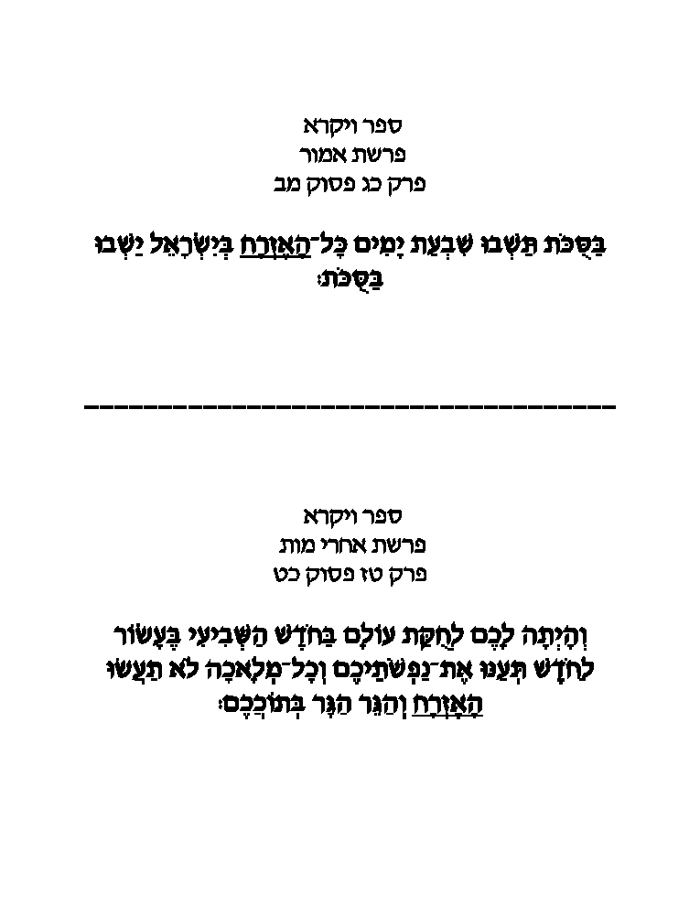
- GemaraBraisa: 'ezrach' is an ezrach, a citizen. The pasuk in Vayikra (Emor) says 'kol ha-ezrach b'Yisrael yeishvu ba-sukkos'.
- GemaraThe hey of ha-ezrach comes to exclude women. 'Kol' comes to include ketanim, since 'kol' means more than just an ezrach.
- Tomorrow the Gemara will ask a kasha from the Mishnah, which says ketanim are patur. For now the focus is on women.
- GemaraAmar mar: the Gemara now nitpicks the words just cited. If the hey of ha-ezrach excludes women, does that mean 'ezrach' alone implies both women and men?
- KashaBut another braisa, on the pasuk about Yom Kippur (tenth day of the seventh month, fasting and no melachah), says the hey of ha-ezrach includes the women citizens, who are chayav in inuy (fasting).
- KashaAlma: from there it follows that 'ezrach' alone implies only men. So which is it: does ezrach include women or not?
- The RebbiAn extra hey can logically be used either way. Read as 'even the', it is a ribuy. Read as 'only the', it is a miut.
- Preview of a further question: why do we need the pesukim at all? Women are patur from sukkah because it is a mitzvas aseh shehazman grama. For fasting, women are chayav in every lo saaseh in the Torah, and one who does not fast is chayav kares.
- ChazarahThe Rebbi stopped here to let the kasha sink in, and reviewed the braisa and the Amar mar.
Kashas
- The braisa on sukkah says the hey of ha-ezrach excludes women, implying ezrach alone means men and women. The braisa on Yom Kippur says the hey of ha-ezrach includes women, implying ezrach alone means only men.
- Previewed: why are pesukim needed at all? Sukkah is a mitzvas aseh shehazman grama, and women are chayav in all lo saasehs, including fasting on Yom Kippur, which carries kares.
- Previewed for tomorrow: the Mishnah says ketanim are patur, yet 'kol' includes ketanim.
Mareh mekomos
- Vayikra, parshas Emor: 'ba-sukkos teishvu shivas yamim, kol ha-ezrach b'Yisrael yeishvu ba-sukkos'. Source that women are patur (hey) and ketanim are included (kol).
- Pasuk about Yom Kippur (tenth day of the seventh month, fasting, no melachah, 'ha-ezrach'). The braisa learns from it that women are chayav in inuy.
The Rebbi’s chiddushim
- 'Ezrach' in modern Hebrew means a citizen.
- Whenever the Gemara says 'amar mar', it is going to nitpick the point just cited.
- A hey meaning 'the' can be read as 'even the' (ribuy) or 'only the' (miut). That is why the two braisos can read it in opposite directions, and the question becomes what 'ezrach' itself means.
Unclear in recording
- A discussion with the chabura about how the hey works and about learning from extra words; unclear in recording.
- A remark about ketanim, chinuch and Yom Kippur; unclear in recording.
- A remark that context matters; unclear in recording.
Drafted from the recording of the shiur, for chazarah. Torah terms follow the Rebbi’s own words; anything that could not be made out is marked “unclear in recording”. Tap a time to hear that point. Corrections welcome.