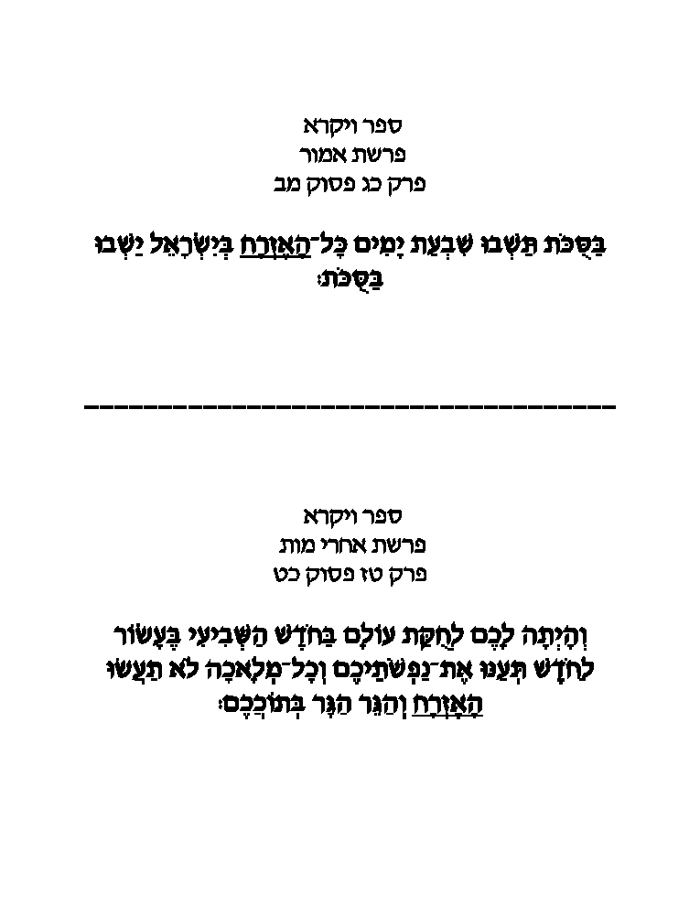
Ha-Ezrach: Women Exempt from Sukkah
The sugya
The Gemara asks for the source that women are patur from sukkah. A braisa learns it from 'ha-ezrach', but this contradicts a braisa that learns from 'ha-ezrach' that women are chayav to fast on Yom Kippur. Rabbah answers that these are halachos l'Moshe miSinai, and the Rabbanan leaned them on pesukim as an asmachta. The Gemara then asks which one is the pasuk and which the halacha, and why either is needed at all: sukkah is a mitzvas asei shehazman grama, and Yom Kippur is learned from Rav Yehuda amar Rav, 'ish o isha', that women and men are equal for all onshin. The second half of the shiur was chazarah of the same lines.
Step by step (shakla v’tarya)
- Gemaraמנה״מ: from where do we know that women are patur from yeshivas sukkah?
- GemaraBraisa: 'ezrach' alone would mean all citizens. 'Ha-ezrach', the hey, excludes women. 'Kol' includes ketanim.
- KashaAmar mar: does this mean plain 'ezrach' implies both women and men, and the hey takes out the women?
- KashaBut a braisa learns from 'ha-ezrach' by Yom Kippur that it includes the women citizens, who are chayav in innui. That shows plain 'ezrach' means only men.
- Discussion: is the source of the contradiction the hey or the word 'ezrach'? The Rebbi leaned toward the hey, since the question is whether the hey is a ribui or a miut. The class did not settle it.
- TeirutzRabbah: these are halachos, halacha l'Moshe miSinai and not a scriptural inference. The Rabbanan leaned them on pesukim.
- The RebbiAn asmachta: the Rabbanan connected the halacha to the text. It is a reference, not an inference.
- KashaFirst question: which one is the pasuk and which one is the halacha?
- Working it through. If the hey includes women, Yom Kippur is the pasuk and sukkah is the halacha. If the hey excludes, the pasuk is on sukkah and Yom Kippur is the halacha. Either way, keep the hey consistent.
- KashaSecond question: why do we need a pasuk or a halacha at all?
- KashaSukkah is a mitzvas asei shehazman grama, and women are patur from all such mitzvos, like tzitzis, shofar and lulav.
- KashaYom Kippur is learned from Rav Yehuda amar Rav, and so taught the Tanna d'vei R' Yishmael: 'ish o isha'. The Torah equates women to men for all onshin in the Torah.
- The RebbiYom Kippur carries kareis for not fasting, which is an onesh, so women are automatically included.
- Sidebar: shaking lulav has no onesh. The Mishnah at the end of Yoma lists different levels for asei and lo saaseh. Pesach and milah are asei with kareis.
- ChazarahChazarah of line 43: Rabbah's answer, asmachta as a reference, and the two questions (which is which, and why we need them at all).
Kashas
- Does plain 'ezrach' mean both men and women, so that the hey excludes women?
- By Yom Kippur, 'ha-ezrach' includes women, which implies plain 'ezrach' means men only.
- Which is the pasuk and which is the halacha l'Moshe miSinai?
- Why do we need either? Sukkah is a mitzvas asei shehazman grama. Yom Kippur is learned from 'ish o isha', that women equal men for all onshin.
Teirutzim
- Rabbah: they are halachos l'Moshe miSinai, and the Rabbanan leaned them on the pesukim.
Mareh mekomos
- Braisa on Yom Kippur: 'ha-ezrach' includes women citizens, who are chayav in innui.
- Tanna d'vei R' Yishmael, via Rav Yehuda amar Rav: 'ish o isha' teaches that the Torah equates women to men for all onshin. The Rebbi said he thinks the pasuk is by me'ilah.
- Mishnah at the end of Yoma: different levels for asei and lo saaseh.
The Rebbi’s chiddushim
- Asmachta is a reference, not an inference (said by a talmid, praised by the Rebbi).
- The Gemara's even style: 'hai kra v'hai hilchasa', 'kra lamah li, hilchasa lamah li'.
- 'Nafka' means 'it is learned out'. 'Nafka mina' literally means what is learned out from here.
- Since not fasting on Yom Kippur brings kareis, an onesh, 'ish o isha' covers women.
Unclear in recording
- The Rebbi links this to a Gemara learned last week on line 26 about a halacha l'Moshe miSinai. Unclear in recording.
- Discussion about women being chayav in matzah. Unclear in recording.
- The exact term used for the levels in the Mishnah at the end of Yoma. Unclear in recording.
Drafted from the recording of the shiur, for chazarah. Torah terms follow the Rebbi’s own words; anything that could not be made out is marked “unclear in recording”. Tap a time to hear that point. Corrections welcome.