Shiur summary (draft from the recording)
Leaving the Sukkah in Rain; Omens of Eclipses
Sukkah 29a · from line 8 · Thursday, February 26, 2026
The sugya
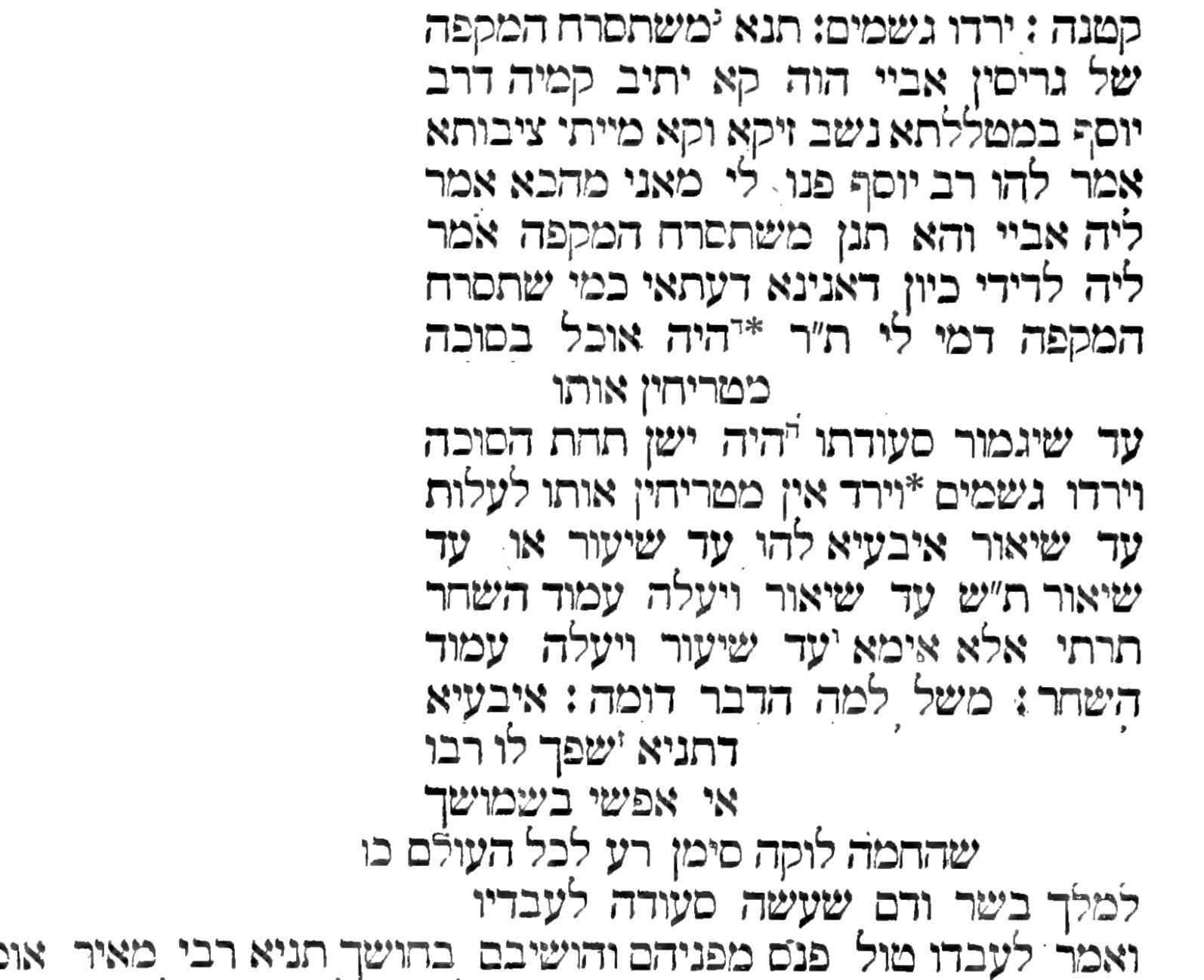
The shiur continues the Mishnah of 'yardu geshamim': the Baraisa's shiur of mishetisrach hamikpah, the story of Rav Yosef leaving the sukkah, and the Baraisa about someone who left the sukkah during rain while eating or sleeping (ad she-ye'or). It then covers the mashal of the eved and the kiton (who poured on whom) and goes into the Baraisos about eclipses as bad signs, ending with Rabbi Meir's mashal of the sofer with the strap. The shiur closed with a quick review from line 21.
Step by step (shakla v’tarya)
- GemaraTanna: mishetisrach hamikpah shel grisin. This expands the Mishnah's shiur for when one may leave the sukkah in rain: a mushy, bean-like consistency.
- GemaraAbaye was sitting before Rav Yosef in the sukkah. A wind blew and brought down twigs, and Rav Yosef said: clear my kelim from here. In other words, I am leaving.
- KashaAbaye asked: didn't we learn that one may leave only mishetisrach hamikpah?
- TeirutzRav Yosef answered: for me, since I am an istenis, it is as if the mikpah has spoiled.
- The RebbiThe Rebbi pointed out that the Mishnah's shiur is about rain, while here it was not rain at all but a different event. He also noted the emphasis on 'lididi' (for me). The shiur is a general measure, not a personal one, and Rav Yosef was being honest about himself.
- GemaraTanu Rabbanan, line 14: someone was eating in the sukkah, rain fell, and he went down. The same applies to someone sleeping. We do not trouble him to go back up.
- KashaIba'ya lehu: is it 'ad she-ye'or' with an ayin (until he wakes up) or with an aleph (until it gets light, alos hashachar)? The Rebbi noted that they had heard the words rather than seen them written.
- Ra'ayahTashma: another Baraisa says 'ad she-ye'or v'ya'aleh amud hashachar'.
- MaskanaTarti? The Baraisa cannot say the same thing twice, so both phrases cannot refer to light. Rather, read it with an ayin: until he wakes up and dawn rises.
- Discussion: today, if someone's sukkah is in his house and he only has to move to the dining room, is that called a tircha? Suggestions included closing a hydraulic roof, clearing up, and stopping one's seudah. It was left open.
- MishnahThe Mishnah's mashal: sitting in the sukkah while it rains is like a master throwing a jug in his servant's face. The Mishnah sounds as though it applies to any day of Yom Tov. The Rebbi recalled a source (he did not remember which) saying it refers to the first night.
- KashaIba'ya lehu: who poured on whom?
- The RebbiTwo ways to see it. Either the rain is a siman that our avodah has been like throwing water in Hashem's face, meaning we have not served Him properly. Or Hashem is saying: you have not served Me properly, and I am not letting you fulfill this mitzvah.
- The RebbiA mashal the Rebbi cited, based on the servant who mixes his master's cup by diluting concentrated wine with water. We come out of Rosh Hashanah and Yom Kippur with din (wine), and the water of Sukkos represents rachamim. When it rains, Hashem throws the water in our face and does not let the din be diluted. It is a bad siman that the din was kept.
- Ra'ayahTashma, the Baraisa: his master poured a kiton on his face and said 'I do not want your service.' This makes it clear that the master threw it at the servant.
- The RebbiThe Mishnah ends at 'shafach lo kiton al panav'. As in the past few days, the Baraisa adds a few words that reveal the real meaning.
- GemaraTanu Rabbanan: when the sun is 'lokah' (an eclipse, or diminished), it is a bad sign for the whole world. From here the Gemara turns to other omens, not necessarily related to Sukkos.
- Some say this does not mean an eclipse but the sun being covered by clouds. Others say it means the sun is diminished. Even though an eclipse is preplanned, it is a time of din, when Hashem takes a closer look.
- GemaraThe mashal: a king made a seudah for his servants and set a lantern (panas) before them. He became angry, told his servant to remove the lantern, and left them in the dark.
- The RebbiThe sun is like our seudah of living in this world, and Hashem taking it away is the same idea. Note that this applies to the whole world, not specifically to Yidden.
- GemaraLine 26: Rabbi Meir says that whenever the me'oros are diminished, it is a bad sign for 'the enemies of Yisrael'.
- The Rebbi'Sonehem shel Yisrael' really refers to Yisrael. The Gemara avoids saying bad things directly about the Jews, the way one describes a blind person as having a lot of light.
- GemaraLine 27: the reason is that we are already accustomed to makkos.
- GemaraMashal: a sofer comes to the beis hasefer with a strap in his hand. Who worries? The child who is used to being hit every day.
- The RebbiHere 'sofer' means a Rebbe, not a scribe; he is called that because he teaches in the beis hasefer.
- The RebbiWhen something happens in the world, Klal Yisrael must worry about what we are doing, because it comes because of us. It is like the talmid who has a unique relationship with his Rebbi.
- ChazarahQuick review from line 21: the who-poured question and the Baraisa, the eclipse Baraisa with the lantern mashal, and Rabbi Meir with the sofer mashal. It ended with 'we are the ones who worry, because we are the cause'.
Kashas
- Abaye to Rav Yosef: we learned that one leaves only mishetisrach hamikpah, so why leave because of falling twigs?
- Is it 'ad she-ye'or' with an ayin (until he wakes) or with an aleph (until it gets light)?
- Tarti: if both phrases mean dawn, the Baraisa would be saying the same thing twice.
- In the Mishnah's mashal, who poured on whom?
Teirutzim
- Rav Yosef: since I am an istenis, for me it is as if the mikpah has spoiled.
- Read it with an ayin: until he wakes up and dawn rises.
- The Baraisa shows that the master poured on the servant and said 'I do not want your service'.
Rashi & Tosafos
- Rashi: Rashi translates panas as 'lanterna' in French.
Mareh mekomos
- A source (the Rebbi did not remember which) that the Mishnah of rain refers to the first night of Sukkos.
- A mashal of the servant mixing wine with water: din of Rosh Hashanah and Yom Kippur as wine, Sukkos water as rachamim (source name unclear).
The Rebbi’s chiddushim
- Rav Yosef's case was not rain but a different event. His 'lididi' shows honesty about his own sensitivity, whereas the shiur is a general measure.
- Two readings of the mashal: our avodah is like throwing water at Hashem, or Hashem rejecting our avodah.
- Rain on Sukkos means Hashem does not let the din be diluted with rachamim.
- The Baraisa adds a few words to the Mishnah that reveal its meaning, a pattern of the past few days.
- The sun is our seudah of living in this world; the eclipse omen applies to all mankind.
- 'Sonehem shel Yisrael' is a euphemism for Yisrael.
- Klal Yisrael must take world events as a reason to examine ourselves, like the talmid with a special relationship to his Rebbi.
Unclear in recording
- Part of the discussion on Rav Yosef's 'lididi' and whether staying in the sukkah after that point is proper.
- What the Rebbi referred to as 'the first part of Rashi' on who poured on whom.
- The name of the source for the wine-and-water mashal.
- The remark about Yidden in connection with the sun omen.
Drafted from the recording of the shiur, for chazarah. Torah terms follow the Rebbi’s own words; anything that could not be made out is marked “unclear in recording”. Tap a time to hear that point. Corrections welcome.