Shiur summary (draft from the recording)
Sukkah Above Twenty Amos: Pesulah vs. Takanta
סוכה שהיא גבוהה
Sukkah 2a · the Mishnah (Perek 1 begins) · Wednesday, March 18, 2026
The sugya
Opening shiur of the first perek. The Rebbi went through the Mishnah's four cases of a pasul sukkah, then the Gemara's comparison to the Mishnah in Eruvin about a mavoi higher than twenty amos. Both Mishnahs carry the same machlokes between the Chachamim and R' Yehuda, so the Gemara asks why by sukkah the Mishnah says 'pesulah' while by mavoi it gives a fix ('yema'et'). The shiur covered the Gemara's two teirutzim and closed with a review.
Step by step (shakla v’tarya)
- Introduction. After the second perek was learned, the chabura is now starting the first perek, which jumps right into the halachos of sukkah. The Rebbi said several references to earlier sugyos would come up today.
- MishnahMishnah: a sukkah taller than 20 amos is pasul, and R' Yehuda is machshir. The Rebbi noted that 'gevohah' together with 'l'maalah' seems a little redundant.
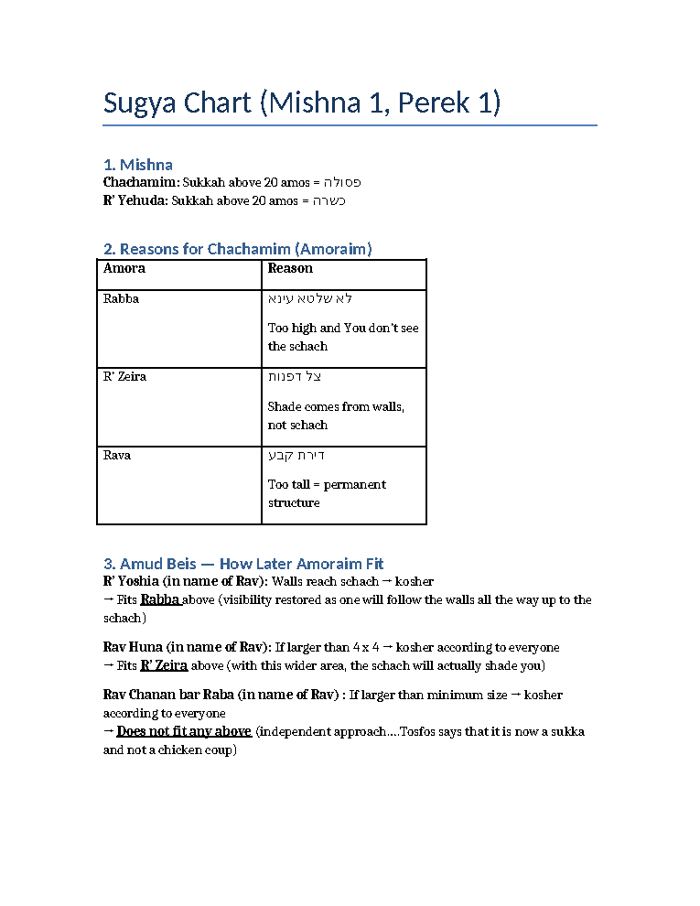
- Preview: the Gemara will discuss why a sukkah has a height limit at all, and will give three reasons: Rabbah, R' Zeira and Rava.
- MishnahThe remaining cases in the Mishnah are all pasul: a sukkah not 10 tefachim tall, one without three walls, and one whose chamah (sun) is more than its tzel (shade).
- ChazarahSo there are four pasul cases, and R' Yehuda argues only on the first. The 'v' here means 'or'. Each case alone makes the sukkah pasul; you do not need all of them together.
- ChazarahReference to earlier learning on chamasah merubah mitzilasah: the diyuk from this Mishnah that if sun and shade are equal, the sukkah is kosher.
- ChazarahA second reference: the sugya of Chava Rami about higher than 20 and lower than 10, which relates to mavoi.
- The RebbiMeasurements: there are six tefachim in an amah, so 20 amos is 120 tefachim, which is very tall. 10 tefachim is extremely low, roughly knee-to-waist height, about three to three and a half feet.
- GemaraTenan hasam: the Gemara brings a Mishnah in Eruvin that is very similar. A mavoi higher than 20 amos must be lowered ('yema'et'), and R' Yehuda says there is no need ('eino tzarich').
- The RebbiWhat a mavoi is: an alley closed on three sides. Courtyards (chatzeros) with houses open into it, and it opens onto the reshus harabim. The entrance needs something recognizable, such as a post or a koreh (beam). This reminds a person who is comfortably carrying in the mavoi not to walk straight into the reshus harabim.
- Gemara'Yema'et' comes from the word 'me'at': bring it down below 20 amos, because if it is too high people will not see it.
- KashaBoth Mishnahs give the same halacha with the same machlokes. So why does the sukkah Mishnah come out flat with 'pesulah', while the mavoi Mishnah gives a fix?
- GemaraThe Gemara asks this explicitly. Why by sukkah does it teach 'pesulah', and by mavoi it teaches 'takanta'? 'Takanta' means the same as 'yema'et': fix it.
- TeirutzFirst teirutz: sukkah is d'oraisa, so the Mishnah teaches 'pesulah'. Mavoi is d'rabbanan, since carrying in a mavoi closed on three sides is basically permitted and the post is only an extra reminder from the Rabbanan. So the Mishnah teaches 'takanta'.
- The RebbiThe Rebbi explained that both can really be fixed. By a d'oraisa you come out with a hard no. Saying 'pasul' gives a person pause, while saying 'lower it' lets him push it off to tomorrow or next week.
- TeirutzSecond teirutz ('ibayis eima', meaning 'if you have a problem with the first answer, here is another'): even by a d'oraisa the Mishnah could teach a fix. But sukkah 'nafishi milsei', meaning it has many halachos: three walls, the walls, sun and shade, and so on. So the Mishnah is pasik v'tani 'pesulah'. A mavoi only needs a recognizable post, so it teaches 'takanta'.
- The RebbiThe Rebbi's mashal: when a child asks how to connect a device to Bluetooth, if it takes many steps you just say 'you can't'. If it is one simple step, you tell him 'just do this'.
- ChazarahReview: today's focus is only the first case of the Mishnah, and only the Chachamim. Sukkah above 20 is pasul, while a mavoi must be lowered. Answer one: d'oraisa versus d'rabbanan. Answer two: sukkah has many halachos to get right, while a mavoi needs only a small piece of wood.
- Marking the Gemara: put an end-quote after 'eino tzarich' and an open-quote before 'mavoi' on line five. To emphasise the kasha, underline 'pesulah' on line seven and 'takanta' on line eight.
Kashas
- Why does the Mishnah say 'pesulah' by a sukkah above 20 amos, but give a fix ('yema'et' / takanta) by a mavoi above 20 amos?
Teirutzim
- Sukkah is d'oraisa, so the Mishnah teaches pesulah. Mavoi is d'rabbanan, so it teaches takanta.
- Even by a d'oraisa the Mishnah could teach takanta. But sukkah has many halachos (nafishi milsei), so the Mishnah is pasik v'tani pesulah. A mavoi does not, so it teaches takanta.
Mareh mekomos
- Mishnah in Eruvin: a mavoi higher than 20 amos 'yema'et', and R' Yehuda says 'eino tzarich'. Brought as the parallel to our Mishnah.
- Earlier sugya on chamasah merubah mitzilasah: the diyuk that if sun and shade are equal, the sukkah is kosher.
- Earlier sugya of Chava Rami about higher than 20 and lower than 10, which relates to mavoi and the koreh.
- Upcoming in the Gemara: three reasons for the 20-amah limit, from Rabbah, R' Zeira and Rava.
The Rebbi’s chiddushim
- The 'v' in the Mishnah means 'or'. Each case is a separate psul.
- The post or beam of a mavoi is a reminder, so a person carrying in the mavoi does not walk straight into the reshus harabim. Seeing it reminds him to empty his pockets.
- On the first teirutz: both can really be fixed. Saying 'pasul' by a d'oraisa is a hard no that gives pause, while 'lower it' invites putting it off.
- The Bluetooth mashal for the second teirutz: if the fix has many steps you just say 'you can't', and if it is one simple step you give the fix.
Unclear in recording
- Which perek he said today's references would come from is unclear in recording.
- A remark comparing the height limit to the menorah is unclear in recording.
- A comment about the walls ('two and one, one and two') is unclear in recording.
- Suggestions from the chabura about the kasha (e.g. that a sukkah might be lowered on Shabbos) are unclear in recording.
- A question about R' Yehuda's view in the first teirutz and the Rebbi's reply are unclear in recording.
- A reference to 'another place in Shas' about not saying pasul by a d'rabbanan is unclear in recording.
Drafted from the recording of the shiur, for chazarah. Torah terms follow the Rebbi’s own words; anything that could not be made out is marked “unclear in recording”. Tap a time to hear that point. Corrections welcome.