Rav Huna vs Rav Chanan bar Rabbah: Hechsher Sukkah
The sugya
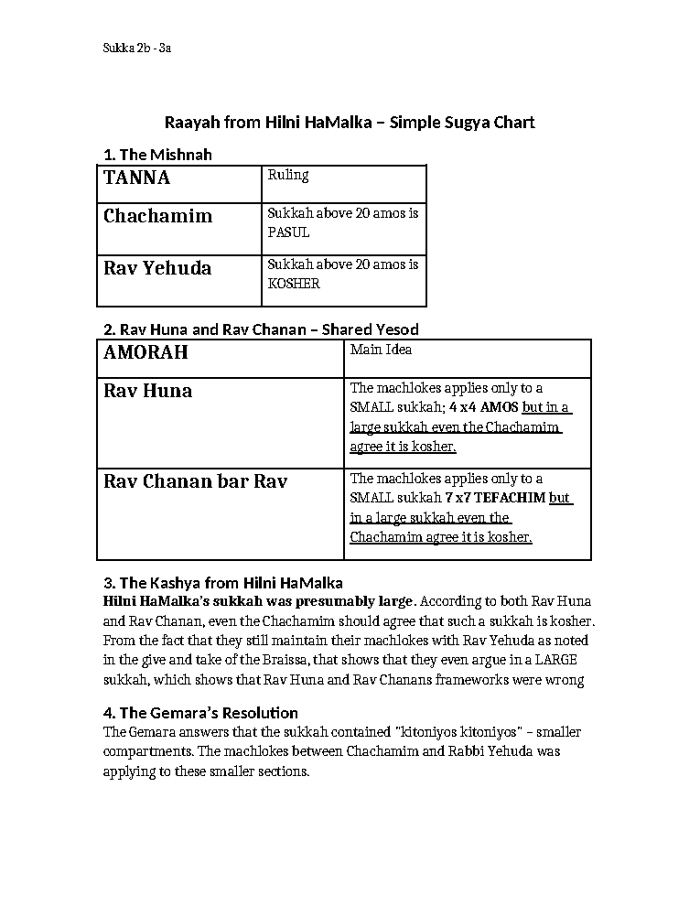
The shiur reviews the three statements of Amoraim limiting the machlokes in the Mishnah about a sukkah higher than 20 amos. Rav Chanan bar Rabbah's statement fits none of the three reasons. The Gemara separates R' Yoshiya, who gives no shiur b'meshecha (no area measure), from Rav Huna and Rav Chanan bar Rabbah. It first suggests that those two argue about the minimum size of a kosher sukkah, then rejects that: both agree on rosho v'rubo v'shulchano (7 by 7 tefachim) and argue only about how far the Mishnah's machlokes on height extends. The Rebbi illustrated this with a two-dimensional diagram.
Step by step (shakla v’tarya)
- Plan for today: from line 23 to the period.
- ChazarahReview of the three statements: R' Yoshiya amar Rav, Rav Huna amar Rav, and Rav Chanan bar Rabbah amar Rav.
- ChazarahRav Chanan bar Rabbah (line 18): the machlokes about 20 amos applies only when the sukkah holds exactly rosho v'rubo v'shulchano. If it holds more, it is kosher even above 20.
- KashaKiman? It goes like no one. No reasoning says that being a drop over hechsher sukkah should help: not tzel, not shalta bah eina, and not 'Kaviyah' (apparently the keva reasoning).
- GemaraLine 22, bishlama: it is understandable that R' Yoshiya argues on Rav Huna and Rav Chanan bar Rabbah. They (inhu) give a shiur b'meshecha, a measure in area. He (ihu) does not. His whole point is that the walls reach the schach, so the eyes reach the top.
- GemaraWith R' Yoshiya taken out of the picture, we are left with Rav Huna and Rav Chanan bar Rabbah.
- GemaraNima b'hechsher sukkah kamifligi. Rav Huna holds a kosher sukkah must be 4 by 4 amos (about 8 by 8 feet). Rav Chanan bar Rabbah holds it must be machzekes rosho v'rubo v'shulchano (7 by 7 tefachim). Both would then say: once you have a kosher sukkah in length and width, go as high as you want.
- Measurements: 6 tefachim in an amah, so 4 by 4 amos is 24 by 24 tefachim. 7 tefachim is 1 1/6 amos.
- Discussion with the chabura on whether the hava amina really explains Rav Chanan bar Rabbah. The Rebbi notes that reasoning-wise it is still hard to see why being slightly over the minimum size should remove the height problem. Much of this is unclear in recording.
- DechiyahLo. Kulei alma, meaning both of these two Amoraim only, agree that a kosher sukkah is rosho v'rubo v'shulchano, 7 by 7 tefachim. They argue about something else.
- ShitahRav Chanan bar Rabbah: the machlokes of R' Yehuda and the Chachamim is only in the bare-minimum sukkah. Once you are beyond it, they do not argue and it is kosher above 20.
- ShitahRav Huna: the machlokes spans from rosho v'rubo v'shulchano (7 by 7 tefachim) until 4 amos. At 10 by 10 or 15 by 15 tefachim the Chachamim still limit it to 20. Only beyond 4 by 4 amos (24 tefachim) is there no machlokes.
- R' Yoshiya is paired with Rabbah, since his point is height and the eyes. For the other two, the Mishnah only limits height when the sukkah is exactly at the minimum kosher length and width.
- MaskanaThe Gemara does not force the simple reading. Both agree on the minimum kosher area. Rav Chanan bar Rabbah lets you go as high as you want once you exceed it. Rav Huna says the height machlokes stays with you until you expand the 7 by 7 tefachim sukkah out to 4 by 4 amos.
- Diagram (two-dimensional, not to scale). In the hava amina, Rav Chanan bar Rabbah's box is 7 by 7 tefachim and Rav Huna's box is 4 by 4 amos. In the maskana, both agree the small box is kosher. Rav Chanan permits any height once you exceed it; Rav Huna only once you fill out to 4 by 4 amos.
- The Rebbi notes that this means they certainly have totally different reasons. Further discussion followed, partly unclear in recording.
- Discussion: even at 9 by 9 there is still a maximum height. A sliding scale between area and height was raised, which would not reach 20 until 4 by 4 amos. The details are unclear in recording.
Kashas
- Like whom is Rav Chanan bar Rabbah? Being just over the minimum size does not fit tzel, shalta bah eina, or the keva reasoning.
Teirutzim
- Hava amina: Rav Huna and Rav Chanan bar Rabbah argue about hechsher sukkah (4 by 4 amos vs rosho v'rubo v'shulchano). Once the sukkah is kosher in area, there is no height limit.
- Maskana: both agree hechsher sukkah is rosho v'rubo v'shulchano. They argue whether the Mishnah's height machlokes applies only at that minimum (Rav Chanan bar Rabbah) or all the way up to 4 amos (Rav Huna).
The Rebbi’s chiddushim
- Bishlama probably comes from shalom: we are good with it, it makes sense.
- Inhu (plural) refers to Rav Huna and Rav Chanan bar Rabbah. Ihu refers to R' Yoshiya alone.
- Rosho v'rubo v'shulchano is 7 tefachim, about 1 1/6 amos, a tiny individual sukkah. 4 by 4 amos is 24 by 24 tefachim.
- Kulei alma here refers only to the two Amoraim under discussion, not to everyone.
- In the hava amina, if your laser measure shows exactly 7 by 7, you have the height complication. A drop more, and there is none.
Unclear in recording
- The exchange with the chabura on why Rav Chanan bar Rabbah still fits none of the three reasons.
- An example about a regular sukkah 10 or 12 tefachim high, and sitting in a small area.
- A comparison to another place where kulei alma refers to just two Amoraim; the source and names are garbled.
- A remark linking an opinion with R' Zeira's tzel and area reasoning. The name said is unclear.
- The walls-reaching-the-ceiling reasoning (as high as the Empire State Building) is attributed by name in a garbled way. The content matches R' Yoshiya's view as explained earlier.
- A mention of reading Rashi to show the reasons differ even in the hava amina; the speaker and content are unclear.
- The sliding scale / ratio discussion at the end.
Drafted from the recording of the shiur, for chazarah. Torah terms follow the Rebbi’s own words; anything that could not be made out is marked “unclear in recording”. Tap a time to hear that point. Corrections welcome.