Size of the Sukkah: Rebbi, Beis Shammai, Beis Hillel
The sugya
The shiur continues the sugya of the minimum area of a sukkah, after the story of Heleni HaMalkah. It reviews R' Shmuel bar Yitzchak's psak that a sukkah must hold rosho v'rubo v'shulchano, R' Abba's comment that this is like Beis Shammai, and Rav Nachman bar Yitzchak's objection that Beis Shammai and Beis Hillel may be arguing about a sukkah gedolah. The Gemara then brings two braysos where the Chachamim contradict each other. It concludes that one is Beis Shammai and the other Beis Hillel, which gives three shitos on the area of a sukkah: Rebbi, Beis Shammai and Beis Hillel.
Step by step (shakla v’tarya)
- ChazarahReview: the perek discussed the height of the sukkah, and then brought in the width of the sukkah as it relates to the height.
- ChazarahThere are three possible shitos on the width of a sukkah. The most machmir is 4 amos by 4 amos. The other two are rosho v'rubo, or rosho v'rubo v'shulchano.
- The RebbiIn tefachim the shiur is 6 by 6 or 7 by 7. There are 6 tefachim in an amah (about 2 feet, give or take), so Rebbi's 4 amos by 4 amos is a very big difference from the others.
- ShitahBeis Shammai require the larger size and Beis Hillel the smaller.
- The RebbiPractically, here we hold like Beis Shammai: our sukkahs only have to be zayin al zayin (7 by 7). You need part of your table in the sukkah.
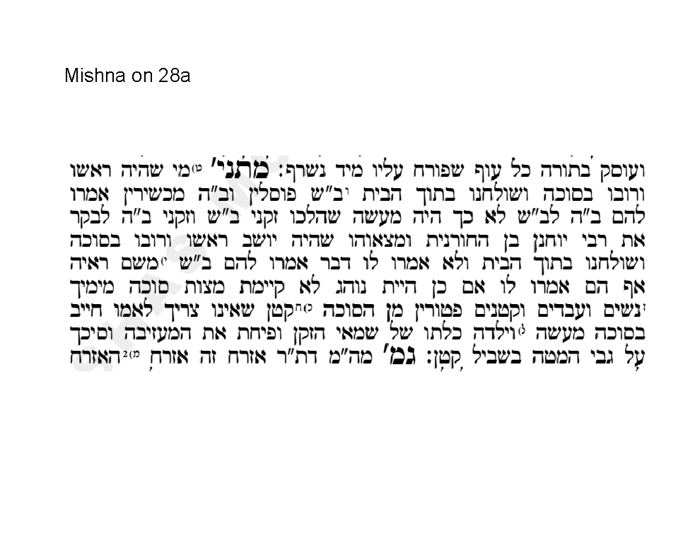
- GemaraLine 11: R' Shmuel bar Yitzchak says the halacha is that a sukkah must hold rosho v'rubo v'shulchano, i.e. 7 tefachim by 7 tefachim.
- KashaR' Abba asks: like whom? Like Beis Shammai? R' Shmuel bar Yitzchak answers: like whom else? This is one of the rare cases where we hold like Beis Shammai.
- GemaraIka d'amri: R' Abba said to him, it is Beis Shammai, and don't budge from it.
- KashaRav Nachman bar Yitzchak (the meitzik) wants to uproot the whole thing. How do we know Beis Shammai and Beis Hillel argue about a sukkah ketanah? Maybe they argue about a sukkah gedolah.
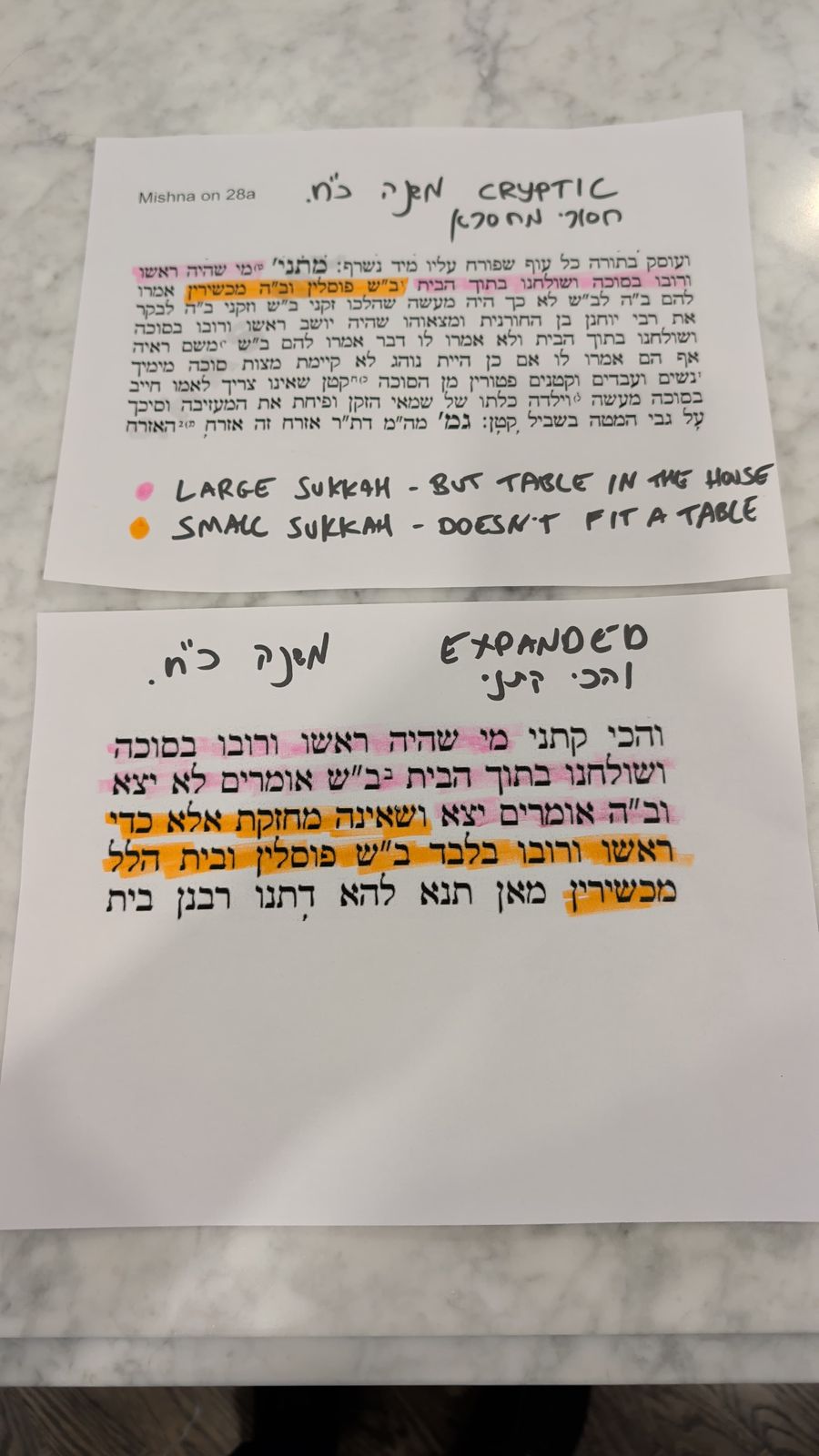
- TeirutzLine 18: the case is where he sits at the opening of the sukkah and his table is in the house. Beis Shammai are gozer lest he be drawn after his table and end up inside, even though the sukkah is huge. Beis Hillel are not gozer: as long as he is in the sukkah he is fine.
- Ra'ayahDayka nami. The Mishnah says mi shehaya rosho v'rubo ba'sukkah v'shulchano b'soch habayis, Beis Shammai posel. If the machlokes were about the size of the sukkah, the Mishnah should have said 'machzekes' and 'einah machzekes', whatever the place he was sitting.
- ChazarahSo R' Shmuel bar Yitzchak's 7 by 7 need not be getting involved in the machlokes Beis Shammai and Beis Hillel. This much was learned yesterday.
- KashaLine 25: and in a sukkah ketanah they don't argue? The Gemara brings two braysos that force us to pin Beis Shammai and Beis Hillel on these positions.
- GemaraBraysa 1: machzekes rosho v'rubo v'shulchano, kesheirah. Rebbi says it must be 4 amos by 4 amos.
- GemaraBraysa 2: Rebbi says any sukkah without 4 amos by 4 amos is pasul. The Chachamim say even if it holds only rosho v'rubo it is kosher.
- The RebbiRebbi is consistent in both braysos (4 amos by 4 amos), once stated second and once first. Whenever Rebbi argues on an unnamed opinion, it is the Chachamim. The Chachamim in the first braysa require the table; in the second they do not.
- KashaLine 31: v'ilu shulchano lo kesani. Kashyan ahadadi: Chachamim on Chachamim. In tefachim, braysa 1's Chachamim require 7 by 7 and braysa 2's require only 6 by 6.
- MaskanaLine 32: ela lav shma minah, ha Beis Shammai ha Beis Hillel. 'Rabbanan' is plural, so either one can be Beis Shammai or Beis Hillel; Rebbi is the one going against the tide.
- MaskanaSo of course Beis Shammai and Beis Hillel argue about the size of a small sukkah.
- The RebbiUsually when two braysos of Rabbanan contradict, we don't switch who they are. The Gemara first tries to say they are not arguing and finds another reason (one was raining, one not; night versus day). Here we switch who it is because it is the only way to fit it.
- MaskanaThere are three opinions on the area of a sukkah: Rebbi (4 amos), Beis Shammai (7 tefachim) and Beis Hillel (6 tefachim). A long piece of Gemara really comes to this point.
- On Monday we will see a further point the Gemara makes about the wording (pasul/kasher versus yatza) and put it all together.
Kashas
- R' Abba: R' Shmuel bar Yitzchak's psak (rosho v'rubo v'shulchano), like whom? Beis Shammai?
- Rav Nachman bar Yitzchak: how do we know Beis Shammai and Beis Hillel argue about a sukkah ketanah? Maybe they argue about a sukkah gedolah.
- And in a sukkah ketanah they don't argue?
- Kashyan ahadadi: the Chachamim of braysa 1 require shulchano, while the Chachamim of braysa 2 require only rosho v'rubo.
Teirutzim
- The machlokes could be in a sukkah gedolah where he sits at the opening and his table is in the house. Beis Shammai are gozer lest he be drawn after his table; Beis Hillel are not gozer.
- Ha Beis Shammai ha Beis Hillel: one braysa's Chachamim are Beis Shammai, the other's are Beis Hillel.
Mareh mekomos
- The Mishnah (mi shehaya rosho v'rubo ba'sukkah v'shulchano b'soch habayis): its wording is used as a dayka nami that the machlokes is not about size.
- Braysa 1 (machzekes rosho v'rubo v'shulchano kesheirah; Rebbi: 4 by 4) and Braysa 2 (Rebbi: less than 4 by 4 pasul; Chachamim: even rosho v'rubo kosher): used to show that Beis Shammai and Beis Hillel do argue about a sukkah ketanah.
- Earlier in the sugya (the statements about height), one of the amoraim, he thinks Rav Huna, used the 4 by 4 measure; now we have a name for that shiur, Rebbi.
The Rebbi’s chiddushim
- Converting to tefachim (6 tefachim to an amah, about 2 feet) shows how big the gap is between Rebbi's 4 amos and the 6 or 7 tefachim of Beis Hillel and Beis Shammai.
- Practically, we hold like Beis Shammai here: a sukkah need only be 7 by 7, holding part of your table.
- This is one of the rare cases where the halacha follows Beis Shammai.
- Beis Hillel's approach: give the liberties to the people; as long as they are in the sukkah, they are fine.
- Normally the Gemara reconciles contradicting braysos of Rabbanan without making them argue (rain versus no rain, night versus day). Assigning them to Beis Shammai and Beis Hillel is done only because it is the only way to fit it.
- The whole long sugya comes to establish clearly three shitos on the area of a sukkah.
Unclear in recording
- A remark after the 4 by 4 shita ('that we don't posul') is unclear in recording.
- Which names he attached to the 4 amos shita at this point (Rebbi, R' Shmuel bar Yitzchak) is unclear in recording.
- The wording of 'today we hold like Beis Shammai' is partly garbled; the point that our sukkahs need only be 7 by 7 is clear.
- The exact link to Rav Huna's statement about height is partly unclear in recording.
- The preview of Monday's point is garbled. From about 18:10 to the end, the recording has no intelligible content.
Drafted from the recording of the shiur, for chazarah. Torah terms follow the Rebbi’s own words; anything that could not be made out is marked “unclear in recording”. Tap a time to hear that point. Corrections welcome.