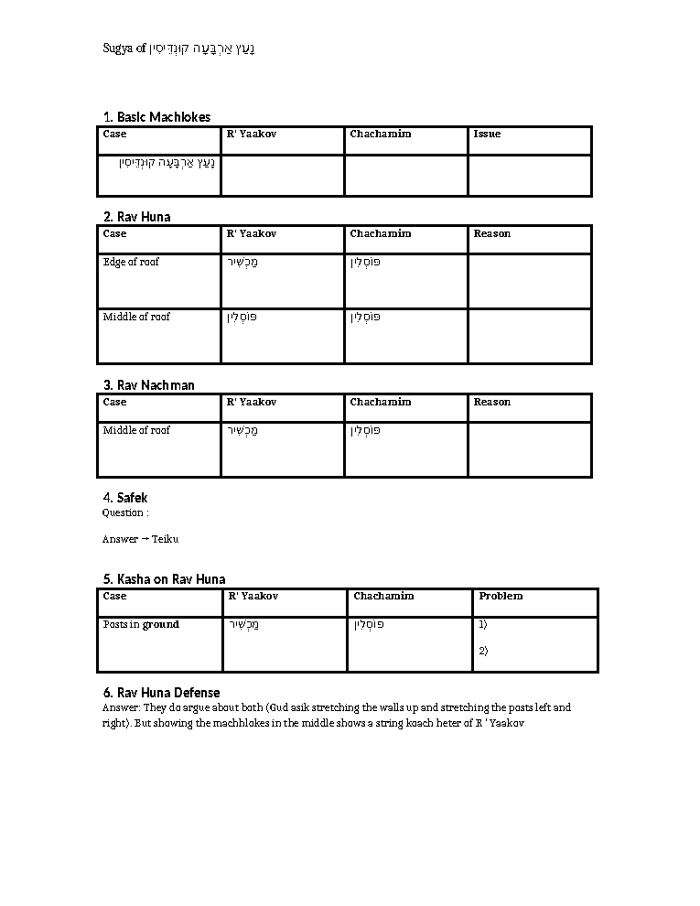
Dofen Akuma vs. Lavud; Gud Asik on a Pillar
The sugya
The shiur opens with the Gemara's kasha on why the itztaba case allows less than 4 amos while the chakak case requires less than 3 tefachim. The teirutz: where there is already a wall, dofen akuma lets you move it; where you need to make a wall, you need lavud. The shiur then moves to the next case, a sukkah higher than 20 amos with an amud 10 tefachim high that has the hechsher sukkah. Abaye wants to use gud asik mechitzasa, and Rava rejects it because we need mechitzos hanikaros. The Rebbi frames Rava's point as the requirement of dira and contrasts the amud with the itztaba.
Step by step (shakla v’tarya)
- KashaThe Gemara asks: what is the difference between the itztaba case, where we said less than 4 amos, and here, where we said less than 3 tefachim?
- TeirutzThere, the wall already exists, so less than 4 amos is enough. This is the special din of dofen akuma: you just move or bend the existing wall.
- TeirutzHere, the point is to make a wall (l'shavuyei l'dofen). Less than 3 tefachim, yes; if not, no.
- A vort said after yesterday's shiur: lavud is like glue. It is universal, used by a house, a mechitza, Shabbos and eiruvin, for any two items less than 3 tefachim apart.
- The RebbiThe Rebbi: lavud is used all the time, but here the Gemara is saying something special by sukkah. You need a wall, and to make a wall with the 'glue' it must be within 3 tefachim.
- ChazarahReview of yesterday. The ditch must be within 3 tefachim of the walls, otherwise you would not need lavud.
- ChazarahEven with all the tricks of lavud and dofen akuma, the sukkah still needs dira. That is why Rava told Abaye that schach dangling into the sukkah does not work even if it is sparse: your head brushes against it and you cannot live there. You must be able to live there shivas yamim.
- GemaraLine six: the sukkah was higher than 20 amos, and he built in it an amud 10 tefachim high with the hechsher sukkah on top.
- The RebbiThis is not called an itztaba but an amud, a pillar. It is 10 tefachim high and only 7 by 7 tefachim, so it is tall and narrow, unlike the long itztaba.
- The RebbiHere there are no walls that can be bent in, so dofen akuma does not apply.
- ShitahTwo approaches to why dofen akuma does not help. Rashi seems to say it is because the walls are so far away. Other meforshim say that something 10 tefachim high is its own reshus, even if the walls were within 4 amos.
- The RebbiThe Gemara used an elongated sukkah in the itztaba case to show a clever use of the walls. Technically, in a small 7 by 7 sukkah that is too high, simply building an amud would be fine.
- A question was raised whether sitting on a pillar counts as dira. The Rebbi said they are onto something and left it to be seen.
- The RebbiIt is called an amud because it is 10 tefachim high, not just a little platform. It is pashut that the top is 7 by 7, the hechsher sukkah.
- ShitahAbaye wanted to say gud asik mechitzasa: stretch and lift the walls.
- DechiyahRava said to him: we need mechitzos hanikaros, recognizable partitions, and they are not there. This is the same kind of Abaye/Rava exchange as before.
- The RebbiAbaye is not stretching the outside walls. He is pulling up the 10 tefachim of the pillar's own sides. Gud asik is a din used in Eiruvin and Shabbos.
- The RebbiGud asik only works if there are 10 tefachim below to pull up.
- The RebbiPractical case: a man alone in a huge sukkah with only a few pieces of wood, far from the walls. He puts a 7 by 7 board on four pieces of wood 10 tefachim high and sits on top. Those 10 tefachim come up around him, so he sits in a 7 by 7 sukkah with 10 tefachim walls, with schach under 20 amos.
- A talmid's case: a deck 15 tefachim high with no railing, with four sticks and schach on top. According to Abaye that is gud asik even with no walls, provided there is something solid beneath to stretch and pull.
- The RebbiGud asik is a real rule that is used. But Rava is the same Rava who says: use all the tricks you want to make a sukkah, but a sukkah needs an element of dira.
- The RebbiRava's pshat: there may well be a halachic mechitza here, but nobody lives like that. It is like the sparse schach, which does not count. The Rebbi said he does not think Rashi says this, but he saw it as the pshat in Rava.
- The RebbiGud asik takes the subsurface, as long as it is 10 or more, because a mechitza is 10.
- KashaA talmid asked why Rava does not say the same thing by lavud, since people also do not live in a house whose roof is removed from the walls.
- MaskanaSummary: the amud is better than the itztaba because gud asik can be used, and worse because dofen akuma cannot. You can only sit on top of it. No one says the rest of the sukkah is kosher.
- When you learn the Gemara, find all these distinctions.
Kashas
- Why does the itztaba case allow less than 4 amos, while the chakak case requires less than 3 tefachim?
- A talmid's question: why does Rava not raise the dira objection by lavud as well? (No clear answer recorded.)
Teirutzim
- There, the wall exists, so less than 4 amos suffices through dofen akuma. Here, a wall must be created, which requires less than 3 tefachim (lavud).
Rashi & Tosafos
- Rashi: Seems to say that dofen akuma cannot be used for the amud because the walls are so far away.
- other rishon: Other meforshim: something 10 tefachim high is its own reshus, even if the walls were within 4 amos.
- Rashi: The Rebbi does not think Rashi says that Rava's objection is about dira, but he saw this pshat elsewhere.
Mareh mekomos
- Eiruvin and Shabbos: gud asik is a din used there.
- Lavud is used by a house, a mechitza, Shabbos and eiruvin (from the vort said after yesterday's shiur).
- The earlier Abaye/Rava exchange on schach dangling into the sukkah (dira sruchah): you must be able to live there.
The Rebbi’s chiddushim
- Lavud is universal, but here the Gemara teaches its special role by sukkah: creating a wall requires within 3 tefachim.
- The Gemara used a long sukkah for the itztaba case to show a clever use of the walls. In a small, very high sukkah, building an amud alone would suffice.
- Practical illustration: a man alone builds a 7 by 7 platform 10 tefachim high and sits on it. The platform's sides come up around him as walls.
- Rava's objection is the theme of dira: all the tricks are allowed, but a sukkah must be lived in. Nobody lives like that.
- The amud versus the itztaba: better because of gud asik, worse because there is no dofen akuma.
Unclear in recording
- Which meforash was cited about the part of the ditch not by the wall (sounds like 'rizvah') and what he said is unclear in recording.
- Exactly what was attributed to Rashi regarding gud asik is unclear in recording.
- The discussion of whether gud asik must reach the schach, and whether it is an invisible wall, is unclear in recording.
- The answer to the lavud question is unclear in recording.
- The remark about sleeping in a 7 by 7 sukkah and whose shita that is ('Rebbi', 'we happen to be passing like him') is unclear in recording.
- The closing statement on Rashi and the other meforshim ('even if your walls would be close, you're sitting on it') is unclear in recording.
Drafted from the recording of the shiur, for chazarah. Torah terms follow the Rebbi’s own words; anything that could not be made out is marked “unclear in recording”. Tap a time to hear that point. Corrections welcome.