Rav Huna's defense; R' Yaakov's dyumdin; source for ten
The sugya
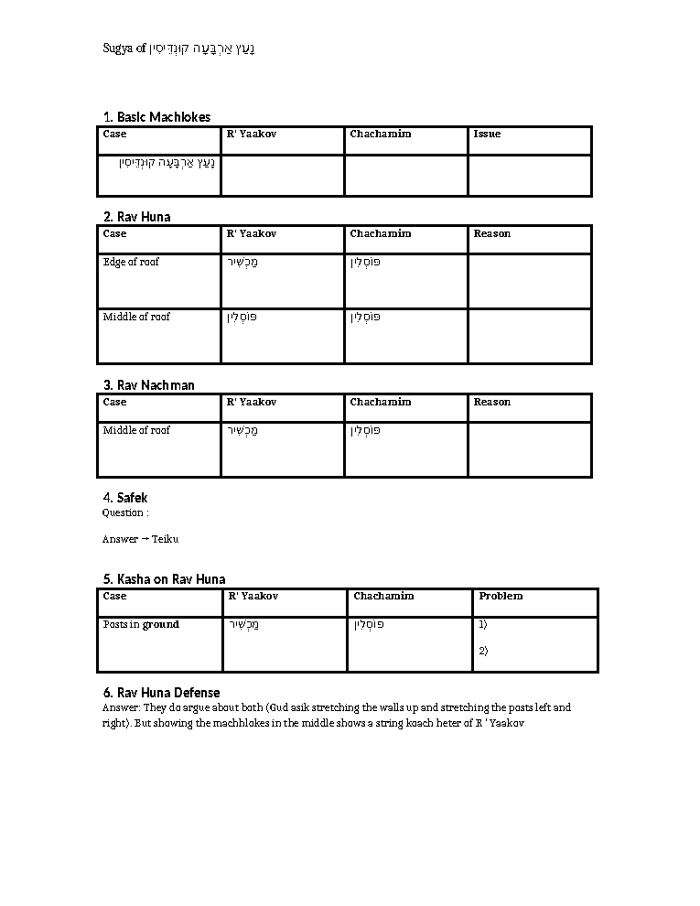
The shiur opens with Rav Huna's answer to the second kasha: the machlokes between R' Yaakov and the Chachamim about a sukkah on poles applies both in the middle and at the edge of the roof. The Braisa mentions the middle of the roof to show the strength of R' Yaakov's position. The Rebbi then explains the Braisa showing that R' Yaakov's mechanism is dyumad, and that the Chachamim require two walls k'hilchasan and a third of a tefach. He then begins the Gemara's search for the source that a mechitza must be ten tefachim. The recording breaks off after about six minutes, just as the four Amoraim are introduced.
Step by step (shakla v’tarya)
- TeirutzAmar lach Rav Huna: they argue in the middle of the roof, and the same halachah applies at the edge of the roof. Rav Huna is saying, in effect: don't make any diyukim from my words. The machlokes goes the whole way through.
- MachlokesR' Yaakov and the Chachamim argue about a sukkah made of just poles. They argue about it whether it stands in the middle of the roof or at the edge.
- TeirutzWhy does the Braisa present the machlokes only in the middle of the roof? To show the strength of R' Yaakov (l'hodiacha kocho). It shows how revolutionary his psak is: even with just poles in the middle of a roof, the sukkah is kosher.
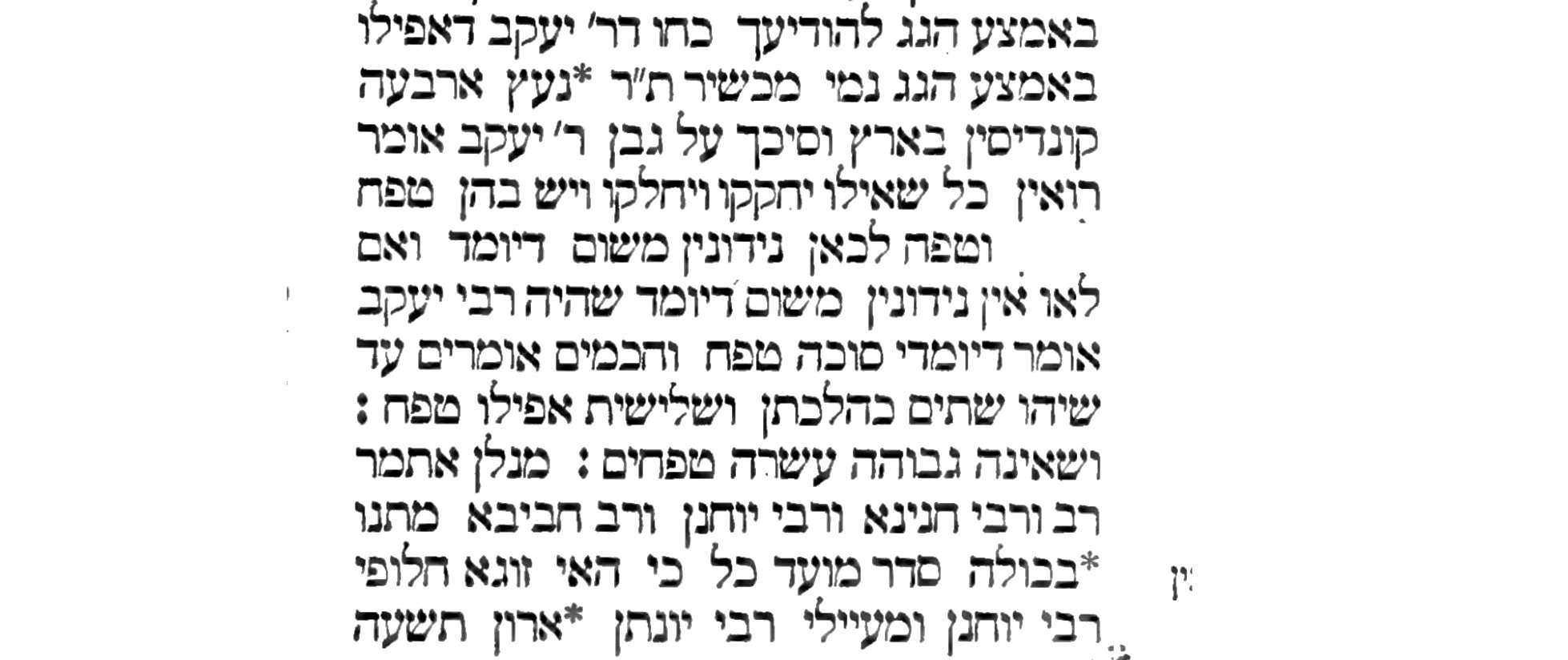
- GemaraTanu Rabbanan: this Braisa will explain what R' Yaakov uses to make the sukkah kosher. Case: four poles inserted in the ground, with schach on top.
- ShitahR' Yaakov says we view it this way: if the pole were carved and split so that there is a tefach this way and a tefach that way, it is judged as a dyumad. That double pillar gives the four walls. If there isn't enough wood to do that, even theoretically, it is not judged as a dyumad.
- ShitahR' Yaakov said: dyumdei sukkah tefach. The concept of dyumdin is already known from elsewhere, and by sukkah you need only a tefach.
- ShitahThe Chachamim say: there must be two walls k'hilchasan, and the third may be even a tefach. This will be discussed later.
- The RebbiThe Chachamim do not accept using dyumdin by sukkah. The Rebbi said he thinks he saw somewhere: not even if it is an ammah, because dyumdin is specifically for Shabbos, not sukkah.
- The RebbiEveryone holds that when we say a sukkah has three walls, we mean two k'hilchasan and a third of a tefach. That is the sugya later on.
- ChazarahNew topic: what is wrong with a mechitza under ten? Anything under ten is not a mechitza. For over twenty, the three reasons were already discussed.
- ChazarahReview of the earlier case of digging out a ditch to complete the ten. It can only work through lavud. The principle that lets you take a wall from there and bring it here requires an actual wall. A wall chopped up as seven and three is no wall, so lavud is needed.
- GemaraLine 35: Minalan? Where do we learn that a mechitza has to be ten?
- GemaraItmar: four Amoraim (Rav, R' Chanina, R' Yochanan, Rav Chaviva) will teach where ten comes from. They were like a group.
- The Gemara diverts briefly for a technical point about the names of these Amoraim. The recording breaks off here.
Kashas
- If Rav Huna holds the machlokes applies everywhere, why does the Braisa present it only in the middle of the roof?
- What is wrong with a mechitza under ten, and where is the source for ten (Minalan)?
Teirutzim
- Rav Huna: they argue in the middle of the roof, and the same applies at the edge.
- The middle of the roof is mentioned to show the strength of R' Yaakov: even there he is machshir.
Mareh mekomos
- Braisa (Tanu Rabbanan): four poles in the ground with schach on top. R' Yaakov judges them as dyumdin of a tefach; the Chachamim require two walls k'hilchasan and a third of a tefach. Cited to explain R' Yaakov's reasoning.
- The Rebbi recalls seeing somewhere that dyumdin is specifically a Shabbos concept and does not apply to sukkah, not even with an ammah. Source not named.
The Rebbi’s chiddushim
- Rav Huna is effectively saying: don't make diyukim from my words; the machlokes goes the whole way through.
- R' Yaakov's psak is revolutionary: a sukkah of just poles, even in the middle of a roof, is kosher.
- Splitting each pole to a tefach in each direction makes it a double pillar, and that is what supplies the walls.
- All agree that the three walls of a sukkah means two k'hilchasan plus a third of a tefach.
- Moving a wall from one place to another works only on a real wall. A wall broken up as seven and three is no wall, so the ditch case requires lavud.
Unclear in recording
- The Rebbi's references for where dyumdin is known from (something like 'by the well' and another word) are unclear in recording.
- The name of the principle that lets you take a wall from there and bring it here is garbled ('kuma'); unclear in recording.
- A short passage repeating earlier words about lavud appears here; unclear in recording.
- Comments on the word 'masnu' and on the names of the Amoraim are unclear in recording.
- From about 6:00 to the end, nothing can be made out. The rest of the shiur, including the source for ten, is unclear in recording.
Drafted from the recording of the shiur, for chazarah. Torah terms follow the Rebbi’s own words; anything that could not be made out is marked “unclear in recording”. Tap a time to hear that point. Corrections welcome.