Shiur summary (draft from the recording)
Source for Sukkah's Ten-Tefach Minimum Height
ושאינה גבוהה עשרה טפחים
Sukkah 5a · Friday, May 15, 2026
The sugya
The Gemara asks for the source of the ten-tefach shiur of a sukkah. It learns it from the Aron (9 tefachim) plus the Kapores (1 tefach), above which Hashem spoke to Moshe, together with R' Yosi's statement that the Shechina never came below ten tefachim. The Gemara challenges R' Yosi from several pesukim and answers each one with 'above ten' or 'below ten.' The shiur then reached the source that the Aron was 9 tefachim and the Kapores 1 tefach, and the start of the discussion of tafasta merubah.
Step by step (shakla v’tarya)
- GemaraMinalan: what is the source for the ten-tefach shiur of a sukkah?
- GemaraRav, R' Chanina, R' Yochanan and Rav Chaviva taught all of Seder Moed. Wherever this group appears, take out R' Yochanan and put in R' Yonasan.
- Ra'ayahThe Aron was nine tefachim and the Kapores one tefach, which makes ten. The pasuk says v'noadti lecha sham v'dibarti itcha me'al hakapores: Hashem spoke to Moshe Rabbeinu from above the Kapores.
- The RebbiThis is the first place we see that ten tefachim makes a separate domain (reshus).
- Ra'ayahTanya, R' Yosi: the Shechina never came down lemata, and Moshe and Eliyahu never went up lemarom. Here the proof ends.
- RashiRashi: ten tefachim is a cut-off, a new reshus.
- TosafosTosafos (the last Tosafos on the amud): Shabbos is also learned from here, not only Sukkah.
- Ra'ayahR' Yosi's pasuk: hashamayim shamayim laHashem v'ha'aretz nasan livnei adam. The Gemara now begins its challenges.
- KashaThe Shechina did not come down? But it says vayered Hashem al Har Sinai.
- TeirutzIt was above ten tefachim.
- KashaBut it says v'amdu raglav bayom hahu.
- TeirutzAbove ten tefachim.
- KashaMoshe and Eliyahu did not go up? But it says u'Moshe alah el haElokim.
- TeirutzBelow ten: he went up but stayed separated by ten tefachim.
- KashaBut it says vaya'al Eliyahu bas'arah hashamayim.
- TeirutzThe same answer: he went all the way up but was held back ten tefachim.
- KashaThe pasuk me'achez pnei kisei parshez alav anano, and R' Tanchum: Hashem spread from the ziv of His Shechina and His cloud upon Moshe. This sounds as if Moshe was right up there.
- TeirutzBelow ten tefachim; there was still a ten-tefach distance.
- KashaBut it says me'achez pnei kisei: Moshe held the Kisei.
- TeirutzIshtarbuvei: the Kisei dangled down to within ten tefachim, and Moshe grasped it.
- KashaLine 15: the whole proof works only if the Aron and Kapores together were ten tefachim. How do we know that?
- Ra'ayahBishlama the Aron was nine: amasayim vachetzi orko, v'amah vachetzi rachbo, v'amah vachetzi komaso. An amah is six tefachim, so an amah and a half is nine.
- KashaLine 17: Kapores tefach minalan? The Torah gives its length and width but not its thickness.
- Ra'ayahR' Chanina: for all the keilim Moshe made, the Torah gave length, width and height. For the Kapores it gave length and width but not height (line 21).
- Ra'ayahTzei ulmad mipachos shebakeilim (line 22): the pasuk v'asisa lo misgeres tefach saviv, the rim of the Shulchan. Mah l'halan tefach, af kan tefach.
- KashaWhy not learn it from the keilim themselves, rather than from the rim of a keli?
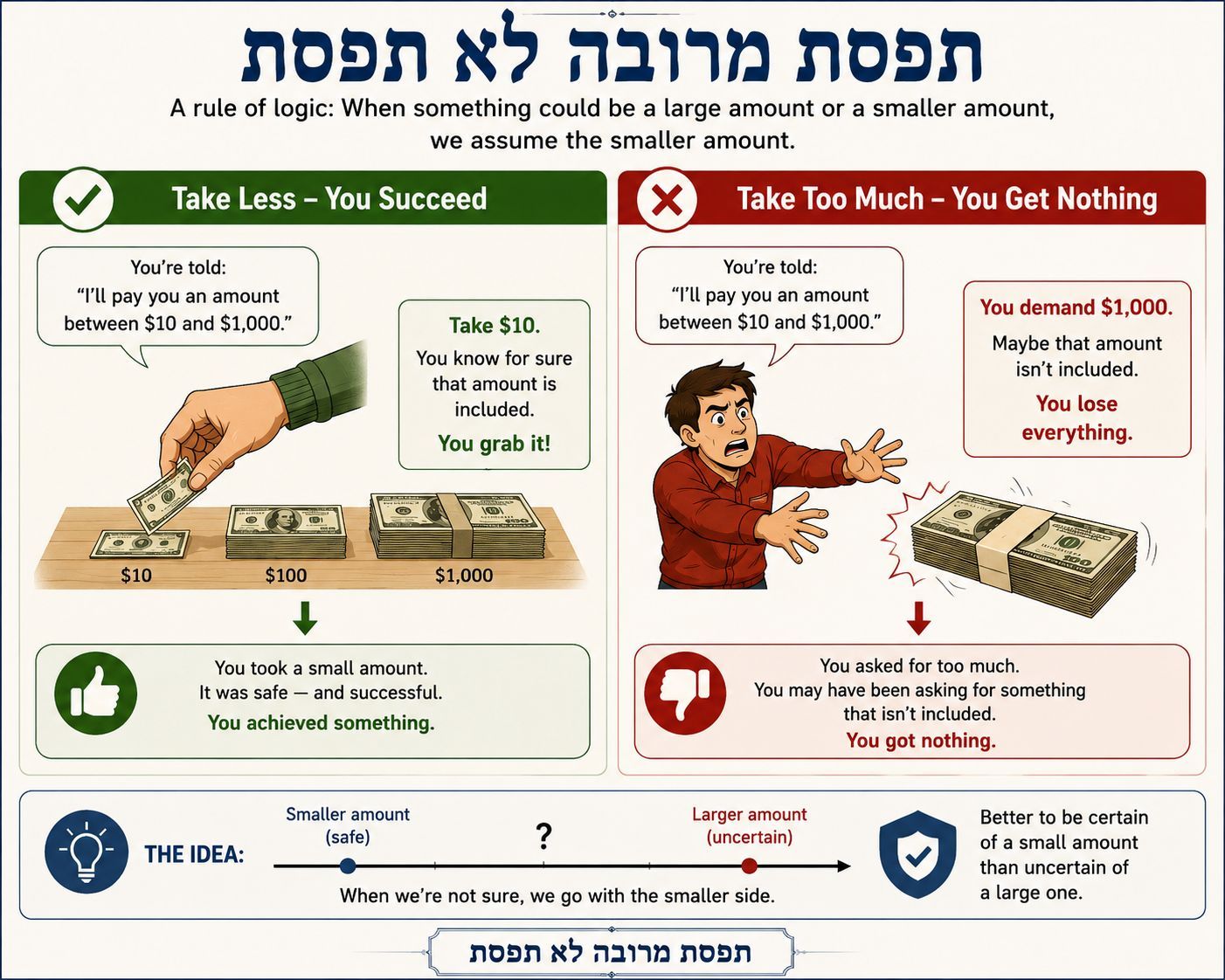
- TeirutzTafasta merubah lo tafasta, tafasta mu'at tafasta: you may only take the smallest measurement.
- Discussion: the smallest measurement of a keili itself would be an amah and a half or perhaps an amah, while the misgeres is an accessory. The Rebbi says it is the smallest measurement said regarding a keili, and that this will become clearer further on.
Kashas
- Minalan: the source for the ten-tefach shiur.
- Vayered Hashem al Har Sinai: so the Shechina did come down.
- V'amdu raglav bayom hahu al Har Hazeisim.
- U'Moshe alah el haElokim: so Moshe did go up.
- Vaya'al Eliyahu bas'arah hashamayim.
- Parshez alav anano (R' Tanchum): Moshe seems to have been right there.
- Me'achez pnei kisei: he held the Kisei.
- How do we know the Aron and Kapores together were ten?
- Kapores tefach minalan?
- Why not learn from the keilim themselves?
Teirutzim
- Har Sinai: above ten tefachim.
- Raglav: above ten tefachim.
- Moshe: below ten tefachim.
- Eliyahu: below ten tefachim.
- Parshez alav anano: below ten tefachim.
- The Kisei dangled down to within ten and Moshe grasped it.
- Aron: an amah and a half tall, which is nine tefachim.
- Kapores: learned from the misgeres of the Shulchan, a tefach, the smallest of the keilim.
- Tafasta merubah lo tafasta; tafasta mu'at tafasta.
Rashi & Tosafos
- Rashi: Ten tefachim is a cut-off, a separate reshus.
- Tosafos: Last Tosafos on the amud: Shabbos is also learned from here, not only Sukkah.
Mareh mekomos
- V'noadti lecha sham v'dibarti itcha me'al hakapores: Hashem spoke to Moshe from above the Kapores.
- Hashamayim shamayim laHashem v'ha'aretz nasan livnei adam: R' Yosi's source.
- Vayered Hashem al Har Sinai: challenge to R' Yosi.
- V'amdu raglav bayom hahu: challenge to R' Yosi.
- U'Moshe alah el haElokim: challenge to R' Yosi.
- Vaya'al Eliyahu bas'arah hashamayim: challenge to R' Yosi.
- Me'achez pnei kisei parshez alav anano, with R' Tanchum's derashah.
- Amasayim vachetzi orko... v'amah vachetzi komaso: the height of the Aron.
- V'asisa lo misgeres tefach saviv: the rim of the Shulchan.
The Rebbi’s chiddushim
- On the swap of R' Yochanan for R' Yonasan: the names differ only by a ches versus a nun and saf. The Rebbi suggests the mix-up came from hearing the Gemara said over when Ravina and Rav Ashi were writing it.
- The Aron and Kapores are the first place we see that ten tefachim makes a separate reshus.
- Raglav: a talmid suggested the feet hovered and were not on the ground. The Rebbi agreed, adding that the Gemara asks from this pasuk cleverly because it says 'feet.'
- 'Below ten' does not mean Moshe rose only ten tefachim. He went all the way up and was held back ten tefachim short.
- This was physical: Moshe was up there for 40 days without eating or drinking.
- A talmid objected that the ten tefachim seems arbitrary, since we do not know where Shamayim begins. The Rebbi answered that wherever it is, Moshe went up physically and was held back ten tefachim. He rejected the idea that it was only Moshe's neshama or consciousness.
- Ziv means shine.
- The Kapores and the keruvim were one piece of gold. The Aron was about the size of a teacher's desk; Moshe Rabbeinu stood behind the paroches and Hashem's voice was heard.
- The misgeres was a rim on the Shulchan that held the lechem hapanim, like the rim of a pool table or air-hockey table. The picture shows it on top of the legs.
- Tafasta mu'at: if the Kapores must have some measurement, you may only take it from the smallest; anything else would be an arbitrary choice. The phrase is used today as an expression for 'hold your horses.'
Unclear in recording
- The opening wording of the question about 'higher than 10' is unclear in recording.
- The exact wording of the Rashi quoted is unclear in recording.
- A side discussion about when Eliyahu went up (what event it follows) is unclear in recording.
- The pasuk reference for the Kapores's measurements is unclear in recording.
- An exchange about learning 'the other way around' and the ikar of ten is unclear in recording.
- A remark that the Kapores was not a lid but rested on top as an open box is unclear in recording.
Drafted from the recording of the shiur, for chazarah. Torah terms follow the Rebbi’s own words; anything that could not be made out is marked “unclear in recording”. Tap a time to hear that point. Corrections welcome.