Kapores a tefach: miskeres, tzitz, zer, panim
The sugya
The shiur continues the Gemara's search for the source that the kapores was a tefach, which completes the ten tefachim (aron nine, kapores one) for the height of a sukkah. It reviews the distinction between keili, tachshit and heksher keili. It then goes through why we cannot learn from the tzitz or the zer, settling on davar shenasna bo Torah midah from the miskeres. It then begins Rav Huna's alternative source from 'al pnei hakapores' (ein panim pachos mitefach), through the gezeirah shavah pnei-pnei and the question of learning from pnei Elohim.
Step by step (shakla v’tarya)
- ChazarahThree categories. A keili is the vessel itself; the miskeres can count as a keili if it structurally holds the shulchan together. A heksher keili is an accessory, like the crowns (zer). A tachshit is an adornment, like the tzitz.
- ChazarahThe tzitz is an adornment with no measurement. It belongs to the bigdei kehunah, not to the keilim of Terumah. Unlike a crown, it is standalone and not attached to a keili.
- ChazarahThe kapores is certainly a keili, so its missing measurement must be learned from a keili, not from an accessory or adornment. That means the shulchan's miskeres, if the miskeres was underneath; if it was on top, it is like a crown.
- The crown was attached to the miskeres. If the miskeres was on top of the tabletop, the crown was small, since it only had to rise above the tabletop. If the miskeres was below, the crown started from the miskeres and so was higher.
- KashaThe Gemara proposes learning from the tzitz. It was a strip of gold two etzbaos wide, going from ear to ear, with yud-hei on the upper line and kodesh lamed on the lower line, read as kodesh la-Shem.
- GemaraR' Eliezer b'R' Yosi said he saw it in Rome, written in one line.
- KashaThe point of the question: we learn from the smallest of the keilim, and the tzitz is smaller. Then aron and kapores would be nine tefachim and two etzbaos, and a sukkah would be kosher at less than ten tefachim.
- TeirutzDannin keili mikeili v'ein dannin keili mitachshit: the tzitz is just jewelry.
- KashaThen learn from the zer, since zer mashehu, which could be as little as one etzba.
- TeirutzDannin keili mikeili v'ein dannin keili mehechsher keili: a crown is an accessory.
- KashaThe miskeres is also a heksher keili.
- TeirutzThe miskeres was below the tabletop, so it was part of the structure of the shulchan.
- KashaThat works for the one who holds the miskeres was below. But it is a machlokes, and according to the one who holds it was above, it too is a heksher keili.
- MaskanaRather, dannin davar shenasna bo Torah midah from davar shenasna bo Torah midah. The kapores was given a measurement, though one dimension is missing, and the miskeres was given a measurement of a tefach. Al yochichu tzitz v'zer, not because they are adornment or accessory, but because the Torah gave them no measurement at all.
- Answering an earlier question about the tzitz having a measurement: that measurement came from the Rabbanan, not from the Torah.
- ChazarahRecap: ten tefachim is the minimum height of a sukkah because the aron was nine and the kapores one. This whole amud deals with the kapores' tefach, which is ultimately learned from the miskeres tefach.
- ShitahRav Huna brings a different source for the kapores being a tefach. This is not because anything was wrong with the first source, which comes from Rabbi Chanina (line 18).
- Ra'ayahThe pasuk in Acharei Mos says the Kohen Gadol on Yom Kippur sprinkles 'al pnei hakapores kedmah', toward the front (east) of the kapores. The word pnei is extra: it could have said al hakapores or lifnei hakapores.
- GemaraV'ein panim pachos mitefach: there is no face in the world less than a tefach.
- KashaThere are many small creatures with faces. The Gemara first suggests maybe the face is like that of the bar yochni, a huge bird.
- RashiRashi brings the story that a yochni's egg once cracked and flooded 60 cities, or something like that.
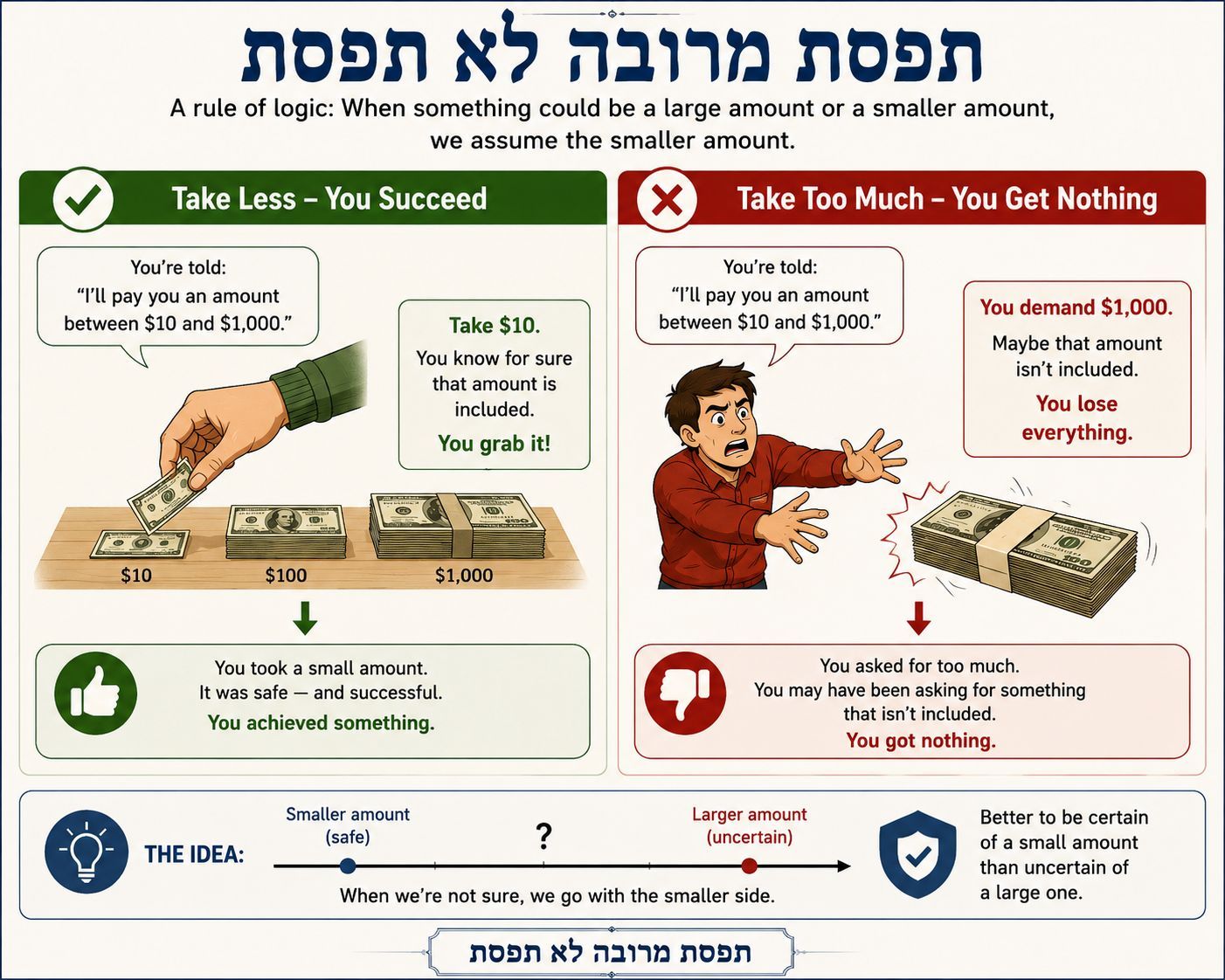
- TeirutzTafasta merubah lo tafasta, tafasta muat tafasta: you must go after the small faces.
- KashaThen say it is like the face of a tziparta d'zutar tuva, a very small bird.
- TeirutzRav Acha bar Yaakov: Rav Huna learned pnei-pnei, a gezeirah shavah. 'El pnei hakapores' is learned from 'me'es pnei Yitzchak aviv', said when Esav left Yitzchak, and a human face is a tefach.
- The RebbiA gezeirah shavah must be mufneh. Both pasukim could have managed without the word pnei; it was added to teach that the face of the kapores is like Yitzchak's face.
- KashaThen learn instead from panim shel maalah: 'kiros pnei Elohim vatirtzeini', said by Yaakov after his encounter with the malach. An angel's face is big.
- TeirutzDiscussed in the chabura: the gezeirah shavah could go to either Yitzchak's face or the angel's face. We go after the smaller one, the human face (tafasta muat).
- The RebbiFirst the Gemara used panim as a standalone definition: find any face. That got stuck on the small bird, since the smallest face might be a fly. With the gezeirah shavah we need a scriptural word pnei, so only faces mentioned in pesukim count.
Kashas
- Learn the kapores' height from the tzitz, the smallest keili. Then aron and kapores would be nine tefachim and two etzbaos, and a sukkah under ten tefachim would be kosher.
- Learn from the zer, which is mashehu.
- The miskeres is also a heksher keili.
- According to the one who holds the miskeres was above, it is a heksher keili.
- Many creatures have faces smaller than a tefach. Say it is like the face of the bar yochni.
- Say it is like the face of a very small bird.
- Learn the gezeirah shavah from pnei Elohim, the angel's face.
Teirutzim
- Dannin keili mikeili, not from a tachshit.
- Dannin keili mikeili, not from a heksher keili.
- The miskeres was below and was part of the structure of the shulchan.
- Dannin davar shenasna bo Torah midah from something the Torah gave a measurement; the tzitz and zer have no Torah measurement at all.
- Tafasta merubah lo tafasta, tafasta muat tafasta.
- Rav Huna learned it from a gezeirah shavah, pnei-pnei, from pnei Yitzchak aviv.
- Go after the smaller face, the human face rather than the angel's.
Rashi & Tosafos
- Rashi: The story of the yochni's egg cracking and flooding 60 cities, or something like that.
Mareh mekomos
- Pasuk in Acharei Mos, 'al pnei hakapores kedmah': Rav Huna's source that the kapores is a tefach.
- The Yom Kippur Mussaf avodah, where we count achas, achas, and so on: the sprinkling of the par's blood seven times.
- 'Me'es pnei Yitzchak aviv': the other side of the gezeirah shavah pnei-pnei.
- 'Kiros pnei Elohim vatirtzeini': Yaakov after his encounter with the malach, proposed as panim shel maalah.
- Chumash says the miskeres was a tefach.
The Rebbi’s chiddushim
- An accessory (heksher keili) is attached to the keili, like the crown. An adornment (tachshit) is standalone jewelry, like the tzitz.
- Al yochichu tzitz v'zer: the final reason they are rejected is not their category but that the Torah gave them no measurement.
- The tzitz's two etzbaos is a measurement from the Rabbanan, not from the Torah.
- 'Gamar' means a gezeirah shavah. We now need the actual word pnei elsewhere in a pasuk, not just any creature with a face.
- Panim as a definition fails because the smallest face could be a fly. The gezeirah shavah limits us to faces written in pesukim.
Unclear in recording
- A source mentioned regarding the crown starting from the miskeres is garbled and could not be made out.
- Whether a rishon (possibly Tosafos) is cited as saying pnei Elohim does not refer to Hashem.
- The exchange about whether the bird is larger or smaller.
Drafted from the recording of the shiur, for chazarah. Torah terms follow the Rebbi’s own words; anything that could not be made out is marked “unclear in recording”. Tap a time to hear that point. Corrections welcome.