Rav Huna's source: Kapores is a tefach
The sugya
The sugya continues looking for the source that the aron and kapores together were ten tefachim, specifically that the kapores was a tefach. Rav Huna learns it from 'al pnei hakapores' together with the rule that there is no face less than a tefach. The Gemara asks from a bird's face, from the face of an angel and from the keruvim, and concludes with Rav Acha bar Yaakov's mesorah that the face of a keruv is not less than a tefach. Rav Huna's source is this same idea. The shiur ended with a short review and the start of 'U'mai keruv' on line 11.
Step by step (shakla v’tarya)
- GemaraRav Huna: the source that the aron and kapores were ten tefachim is the pasuk 'al pnei hakapores kedmah', said when the Kohen Gadol sprinkled the blood in front of the kapores, eastward. There is no 'panim' less than a tefach.
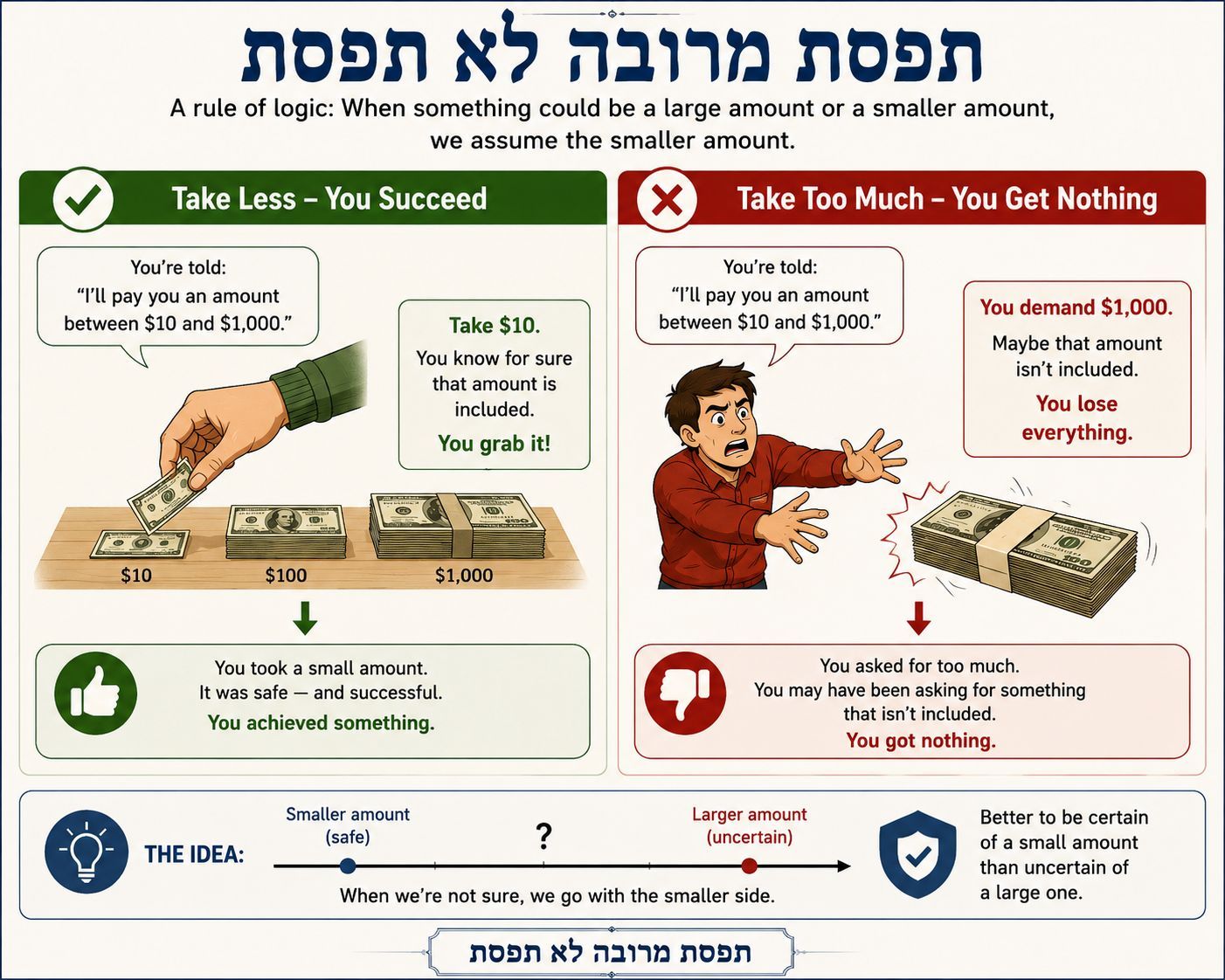
- The RebbiThe Rebbi's framing: Rav Huna is heading off a challenge of 'tafasta merubah'. He is saying that no panim is less than a tefach.
- KashaSay it is like the face of the yuchni bird, which is huge.
- TeirutzTafasta merubah lo tafasta, tafasta muat tafasta. If you grab too much you have not grabbed; if you grab a little, you have.
- KashaThen say it is like the face of a small bird, which is very small.
- The RebbiThe Rebbi left this as an open question. Perhaps the Gemara uses birds because the largest and smallest faces are found among birds. But why not an insect? Perhaps an insect is not called a 'face', since a face needs a tzurah with eyes and a nose. He was not sure.
- GemaraRav Acha bar Yaakov: Rav Huna learns 'pnei pnei'. 'Gamar' refers to a gezeirah shavah. The pasuk says 'el pnei hakapores', and in Parshas Toldos it says 'mipnei Yitzchak aviv'. That is a human face, which is never less than a tefach.
- KashaLearn it instead from the face of a heavenly being: 'kiros pnei Elokim vatirtzeni'. The Rebbi explained this as Yaakov saying he survived, Hashem allowed him to survive and wanted him.
- TeirutzTafasta merubah lo tafasta. We are therefore left with the smallest human face.
- The RebbiThe rule of tafasta merubah also shapes a gezeirah shavah. When the gezeirah shavah could point to either a big face or a small face, tafasta merubah decides it.
- KashaLearn it from the keruv: 'el hakapores yihyu pnei hakeruvim'. Its face could be even smaller.
- The RebbiThe keruvim were hammered out (mikshah) of the kapores. They did not face each other but faced down toward the kapores. Many artists never depict their faces.
- In discussion it was mentioned that the keruvim had the faces of children.
- The RebbiEven a baby's face is a tefach. But the keruvim were not human beings; they were decorative, molded by an artist. So maybe their faces were smaller. That fits tafasta muat, and then the kapores could be half a tefach and a sukkah mechitzah only nine and a half tefachim.
- TeirutzRav Acha bar Yaakov: 'gemiri' (we have a mesorah) that the face of a keruv is not less than a tefach.
- The Rebbi'Gemiri' means a tradition passed down. The same term is used for halacha l'Moshe miSinai. When the Gemara uses it, the matter is not arguable.
- Maskana'V'Rav Huna nami mehacha gamir': Rav Huna's gezeirah shavah was also from the keruvim.
- The RebbiFrom 'pnei' by the kapores there were three places to go: pnei Yitzchak, pnei Elokim and pnei keruvim. The Rebbi suggested (with a 'maybe') that the keruvim are the better gezeirah shavah. With Yitzchak we rely on the general claim that a human face is not less than a tefach; with the keruvim we know it for sure from the mesorah.
- A talmid asked whether Rav Huna uses the gezeirah shavah twice. The Rebbi was not sure and said to check Rabbeinu Chananel.
- ChazarahReview: the last question was that keruvim have faces too and could be very small. The answer is that a keruv's face is not less than a tefach, and that is exactly Rav Huna's gezeirah shavah. We know the kapores was a tefach from 'pnei pnei'.
- GemaraLine 11, 'U'mai keruv': what does keruv mean? It is a real word, 'k'ravya', like a child.
Kashas
- Maybe it is like the face of the huge yuchni bird.
- Maybe it is like the face of a very small bird.
- Learn it from the face of a heavenly being: 'kiros pnei Elokim'.
- Learn it from the keruvim: 'el hakapores yihyu pnei hakeruvim'. They could be smaller.
- The Rebbi's question: why does the Gemara use a bird and not an insect?
Teirutzim
- Tafasta merubah lo tafasta, tafasta muat tafasta.
- Rav Huna learns 'pnei pnei' as a gezeirah shavah from pnei Yitzchak, a human face, which is not less than a tefach.
- Against pnei Elokim: tafasta merubah lo tafasta.
- Gemiri: the face of a keruv is not less than a tefach, and Rav Huna also learned from here.
- The Rebbi's suggestion: maybe something without a tzurah with eyes and a nose is not called a face.
Mareh mekomos
- 'Al pnei hakapores kedmah': the sprinkling of the blood in front of the kapores, used as Rav Huna's source.
- 'Mipnei Yitzchak aviv' (Parshas Toldos): the other side of the gezeirah shavah, a human face.
- 'Kiros pnei Elokim vatirtzeni' (Yaakov): the suggestion to learn from the face of a heavenly being.
- 'El hakapores yihyu pnei hakeruvim' (Parshas Terumah): the keruvim faced the kapores.
- Rabbeinu Chananel: the Rebbi said to check whether Rav Huna learns from both or only from the keruvim.
The Rebbi’s chiddushim
- Rav Huna's statement 'ein panim pachos mitefach' preempts a tafasta merubah challenge.
- Tafasta merubah also governs which way a gezeirah shavah goes.
- Keruvim were not human but decorative works of an artist, so one might have thought their faces were less than a tefach.
- Maybe the keruvim are the better gezeirah shavah because their size is known for certain through mesorah.
- 'Gemiri' signals an established tradition that is not open to argument.
- Perhaps a 'face' requires a tzurah with eyes and a nose.
Unclear in recording
- A remark about the requirements of a gezeirah shavah (that it must be available, an extra word) is partly unclear in recording.
- The talmid's question about whether Rav Huna uses the gezeirah shavah twice is partly unclear in recording.
- The recording breaks off after the start of 'U'mai keruv'.
Drafted from the recording of the shiur, for chazarah. Torah terms follow the Rebbi’s own words; anything that could not be made out is marked “unclear in recording”. Tap a time to hear that point. Corrections welcome.