Three or four walls; where the tefach goes
The sugya
The shiur continued the machlokes between the Rabbanan, who hold a sukkah needs two walls k'hilchasan plus a third of a tefach, and R' Shimon, who holds three k'hilchasan plus a fourth of a tefach. It finished the Gemara's four ways of learning the machlokes from 'bsukkos' and brought Rav Masna's reason for R' Shimon from the pasuk in Yeshaya. It then began 'v'oso tefach heichan ma'amido': Rav says k'neged hayotzei, Rav Kahana and Rav Assi ask why not k'neged rosh tor, Rav is silent, and Shmuel in the name of Levi and the beis medrash follow Rav. It ended with a preview of placing the tefach within three tefachim of the wall using lavud.
Step by step (shakla v’tarya)
- ChazarahReview: Rabbanan say a sukkah needs three walls, the third being a tefach. R' Shimon says four walls, the fourth being a tefach. The Gemara gives four ways to learn this from the words 'bsukkos'.
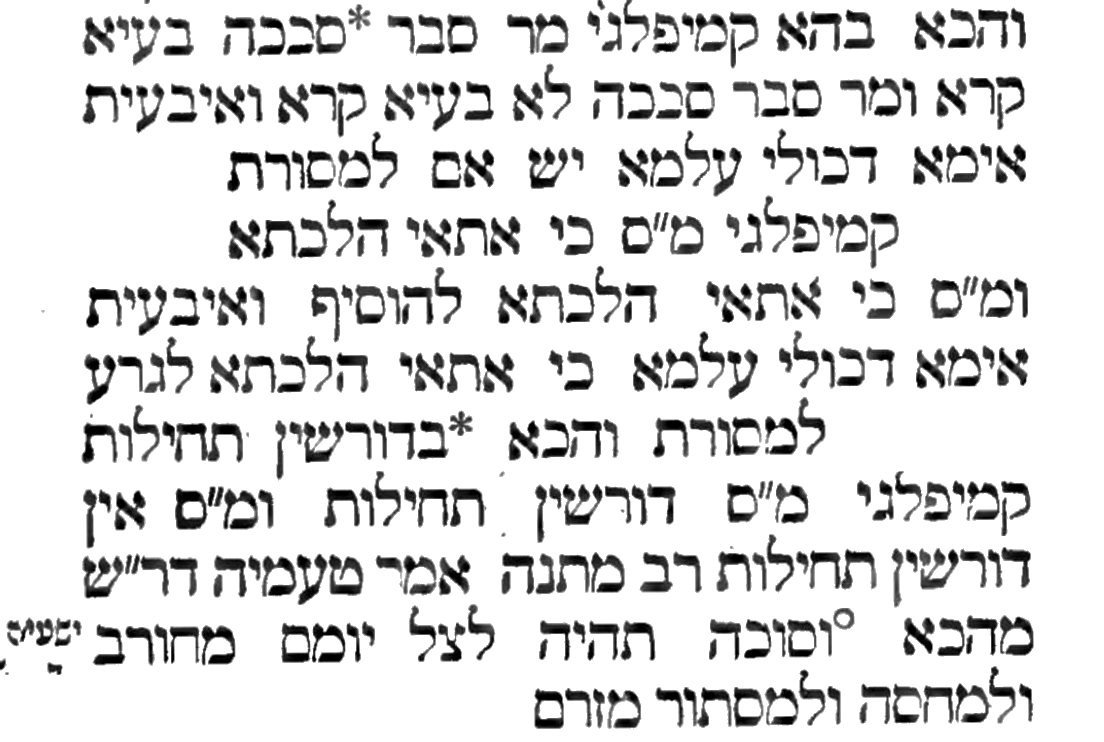
- MachlokesSecond ibaayis aima (line 22): everyone holds yesh em l'mikra, so the reading is two, two and two. One is taken away l'gufei, which leaves four.
- ShitahLine 24: the Rabbanan hold sechachah ba'ei kra, so one word is used for schach. Three are left, and one of them is a tefach.
- ShitahLine 25: R' Shimon holds schach does not need its own pasuk; it is included in the word used l'gufei. Four are left, and one of them can be a tefach.
- MachlokesThird ibaayis aima: everyone holds we go by the way it is written. The Rabbanan hold the halacha comes l'gera, reducing a wall to a tefach (two plus one). R' Shimon holds the halacha comes l'hosif, adding a tefach to the three (three plus one).
- MachlokesFourth ibaayis aima: everyone holds the halacha comes l'gera and yesh em l'masores. Singular, singular and plural make four; one is needed l'gufei, which leaves three. The machlokes is whether dorshin techilos.
- ShitahR' Shimon holds dorshin techilos: the word needed l'gufei can also be used for a wall. That gives four, and one is reduced to a tefach. The Rabbanan hold ein dorshin techilos, exactly like the first approach: the word that tells you to sit in a sukkah is reserved for that and cannot be used for anything else.
- GemaraLine 32: Rav Masna says R' Shimon's reason is from the pasuk in Yeshaya: 'v'sukkah tihyeh l'tzel yomam mechorev u'l'machseh u'l'mistor mizerem u'mimatar'.
- GemaraLine 34: 'v'oso tefach heichan ma'amido', where do we stand up that tefach?
- ShitahRav: ma'amido k'neged hayotzei. The two walls k'hilchasan form an L, a right angle, which has two ends (yotzeis). The tefach is placed opposite one of them, and it does not matter which end.
- KashaRav Kahana and Rav Assi said to Rav: let him place it k'neged rosh tor, on the diagonal. Placed that way it faces the inside corner, makes a kind of triangle and gives more of an enclosure.
- Shasik Rav: Rav was silent. Rashi does not say why.
- Ra'ayahItmar nami: Shmuel in the name of Levi says ma'amido k'neged hayotzei.
- MaskanaV'chein morin b'bei midrasha k'neged hayotzei: the beis medrash paskened like Rav, as opposed to the challenge of Rav Kahana and Rav Assi.
- Preview for tomorrow: take the tefach and stand it less than three tefachim from the wall. Lavud joins it to the wall, so together they make four tefachim, next to two full walls of seven tefachim each.
Kashas
- Rav Kahana and Rav Assi to Rav: why not place the tefach k'neged rosh tor (diagonal), which gives more of an enclosure?
Teirutzim
- No answer is given: Rav was silent (shasik Rav). Shmuel in the name of Levi and the beis medrash rule k'neged hayotzei.
Rashi & Tosafos
- Rashi: Rashi has diagrams showing k'neged hayotzei. If the walls are, for example, east and north, the tefach goes opposite an end. Rashi sometimes writes 'k'zeh' when referring to a diagram.
- Rashi: Rashi does not say why Rav was silent. It could mean he agreed with them or that he ignored them.
- Rashi: Rashi explains rosh tor as related to the way they would plow fields.
Mareh mekomos
- Yeshaya: 'v'sukkah tihyeh l'tzel yomam mechorev u'l'machseh u'l'mistor mizerem u'mimatar'. Rav Masna's source for R' Shimon. The same pasuk was used earlier with R' Zeira regarding the 20 amos, and with the chuppah/sukkah discussion.
- Parshas Vayera: the malachim who visited Avraham each had only one shlichus and could not do two things. Brought as a comparison to whether one word can be used for two drashos.
- One of the mefarshim: Rav Masna's pasuk is the motivation behind R' Shimon's shita rather than a primary source.
The Rebbi’s chiddushim
- Techilos means the first time the word appears. Everyone uses it for the mitzvah of sitting in a sukkah; the only question is whether, since the Torah is giving extra words, it can also be used as a wall.
- The point of Rav Masna's pasuk is that the purpose of a sukkah is shelter. Two walls and a small tefach misses the most basic function of a sukkah. The pasuk is not the primary source of the halacha, but it shows what a sukkah is supposed to be and motivates shitos such as needing shade or four walls.
- No one holds a sukkah needs four full walls, not even R' Shimon, since the halacha l'Moshe miSinai reduces one. But three plus a tefach looks more protective and shelter-like than two plus a tefach.
- The halacha l'Moshe miSinai teaches gud, lavud and dofen akumah, and also that one wall can be a tefach. The cases that follow are attempts to place the tefach in the most sukkah-like, sheltered way, as close as possible to the pasuk.
- Rav's view, k'neged hayotzei, is the most liberal use of the tefach. It mainly tells us that the two walls being used meet at a right angle.
- Rosh tor is an agricultural term: fields were plowed in squares with a diagonal. A tefach on the diagonal, facing the inside corner, makes a triangle and creates an enclosure, so it looks and feels like four walls. A tefach placed to continue a square gives no enclosure at all.
- Morin is related to mora, a teacher, and hora'ah; the Rebbi suggested they are probably the same shoresh.
- The diagrams printed in the Gemara likely reflect drawings found in the Rishonim.
Unclear in recording
- Which earlier daf the Yeshaya pasuk was used on is unclear in recording.
- The explanation of why the others argued on R' Zeira's use of the pasuk is unclear in recording.
- A source mentioned regarding Rav's silence is unclear in recording.
- Who learns the diagonal 'somewhere in the middle', and who proposes the next option, is unclear in recording.
Drafted from the recording of the shiur, for chazarah. Torah terms follow the Rebbi’s own words; anything that could not be made out is marked “unclear in recording”. Tap a time to hear that point. Corrections welcome.