Rabbanan vs. R' Shimon: How Many Sukkah Walls
The sugya
The Gemara gives four explanations of the machlokes between the Rabbanan and R' Shimon. The Rabbanan require two full walls and a third of a tefach. R' Shimon requires three full walls and a fourth of a tefach. The Rebbi went through all four explanations: yesh eim l'masores vs. yesh eim l'mikra; whether schach needs its own pasuk; whether the halacha l'Moshe miSinai comes l'gera or l'hosif; and doreshin techilos. He spent time on why a whole word is taken for gufei and on the logic of doreshin techilos, and plans a worksheet to review tomorrow.
Step by step (shakla v’tarya)
- ChazarahThe Gemara will bring four possibilities for the machlokes of R' Shimon and the Rabbanan: does a sukkah need two walls and a little bit, or three and a little bit? There is a halacha l'Moshe miSinai that the last wall can be a tefach. Yesterday only the first explanation was learned, which showed how a machlokes can rest on singular and plural words.
- GemaraBaraisa: the Rabbanan say two walls must be regular walls (k'hilchasan) and the third can be even a tefach. R' Shimon says three regular walls plus a tefach.
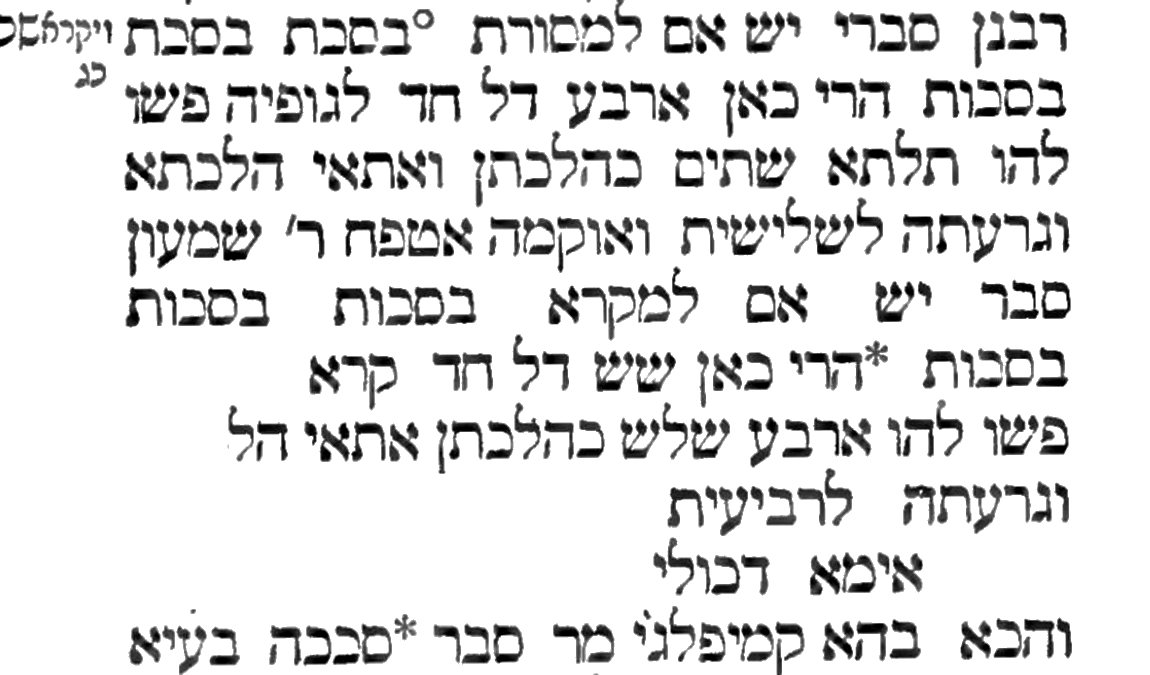
- ShitahExplanation 1, Rabbanan (line 15): yesh eim l'masores, primacy to the written way. Written, the pasuk has two singular and one plural basukkos, which makes four. Dal chad l'gufei: one is taken to teach that you must sit in a sukkah. Three remain: two are full walls, and the halacha comes and eats away (gor'ya) at the third and sets it at a tefach.
- ShitahExplanation 1, R' Shimon (line 18): yesh eim l'mikra, primacy to the way it is pronounced. Read, it is basukkos three times, each meaning two, which makes six. One whole word is taken l'gufei, leaving four: three full walls, and the halacha reduces the fourth to a tefach.
- A note at the bottom of the page says the word 'kra' was added in the Gemara. The reason is that for l'gufei we cannot take away one sukkah; we must take away one whole word.
- The RebbiAcross all the explanations the din never changes: Chachamim hold two plus a tefach, R' Shimon holds three plus a tefach.
- ShitahExplanation 2: everyone holds yesh eim l'mikra, so there are six. Mar savar (the Rabbanan) holds that schach needs a pasuk, so one of the remaining four is used to teach that you must sit under schach. That leaves three, and the last is a tefach. R' Shimon holds that schach needs no pasuk because it is built into the word sukkah, so four remain and the last is a tefach.
- The Rebbi noted that here the Gemara switches from 'Rabbanan' to 'mar'.
- KashaA talmid asked: why is a whole word taken for gufei, while for schach we split a word?
- TeirutzWhen teaching the basic din that you must sit in a sukkah, you cannot split a word, even if it sounds like two; it must have its own meaning. According to R' Shimon there is no sukkah without schach, so schach is included in the word already taken away. The Rebbi said he also has to think about it further.
- There are four teirutzim. The goal for now is to understand them in general and know how to read them; they will be reviewed tomorrow with a worksheet.
- ShitahExplanation 3 (line 25): everyone holds yesh eim l'masores, so there are four. One is always taken l'gufei (the first, which is written singular), leaving three.
- MachlokesExplanation 3, the machlokes: the Rabbanan hold the halacha l'Moshe miSinai comes l'gera, reducing the third wall to a tefach. R' Shimon holds it comes l'hosif, adding a tefach on top of three full walls.
- The RebbiThere is a halacha l'Moshe miSinai floating around that involves a tefach. The question is whether it lets you reduce your last whole wall, or requires you to add a tefach on top of your walls.
- ShitahExplanation 4 (line 28): everyone holds the halacha comes l'gera and yesh eim l'masores, so everyone is in the lane of the original Rabbanan. They argue about doreshin techilos: can we darshen the first occurrence of the word?
- The RebbiUntil now, all three teirutzim required leaving one sukkah untouched. Explanation 4 asks whether the word used l'gufei can also be used for a drasha.
- MachlokesThe Rebbi noticed that the attribution seemed flipped from how he first read it. R' Shimon holds doreshin techilos: the first word is also used as a wall, so there are four. The Chachamim hold ein doreshin techilos: the first, introductory word teaches that you need a sukkah, and you cannot double dip.
- ChazarahReview of explanation 4: written, there are four, and the halacha takes one wall down to a tefach. The first word teaches that you must sit in a sukkah and not on cotton candy. The question is whether it can also serve as a wall.
- The RebbiLogic of doreshin techilos: because the Torah says sukkah three times, the extra words show there is something to learn, so we darshen them all, including the first. Had the word appeared only once there would be no machlokes about doreshin techilos. Similarly, the first time esrog is mentioned it simply teaches that you need an esrog.
Kashas
- Why, in explanation 2, is a whole word taken for gufei while a word is split for schach?
Teirutzim
- The basic din of sitting in a sukkah requires a word with its own meaning, so it cannot be split. According to R' Shimon schach is inherent in the word sukkah, so it is included in the word taken away. The Rebbi said this needs more thought.
Rashi & Tosafos
- Rashi: The Rebbi remarked that there is nothing in Rashi that settles the question of splitting the word for schach (wording somewhat unclear in recording).
Mareh mekomos
- The pasuk's three occurrences of basukkos, as quoted in the Gemara: counted as four by the written form, or six by the pronunciation.
- A note at the bottom of the page says the word 'kra' was added in the Gemara, to show that a whole word is taken l'gufei (the commentator's name is unclear in recording).
- Halacha l'Moshe miSinai that the last wall can be a tefach.
The Rebbi’s chiddushim
- The din never changes across the four explanations; only the reasoning differs.
- Framing of explanation 3: does the halacha l'Moshe miSinai of a tefach reduce the last full wall, or add a tefach on top of the full walls?
- The first three teirutzim all leave one sukkah untouched for gufei; the fourth asks whether that word can double as a wall.
- Doreshin techilos makes sense only because the repetition of sukkah shows the Torah is giving us words to darshen; a word appearing once, like the first mention of esrog, just teaches the basic din.
Unclear in recording
- The name of the commentator cited for the addition of the word 'kra'.
- Parts of the back-and-forth with talmidim about splitting words in explanation 2.
- The exact question a talmid asked about the difference regarding the first word.
- The esrog example at the end is only partly clear.
Drafted from the recording of the shiur, for chazarah. Torah terms follow the Rebbi’s own words; anything that could not be made out is marked “unclear in recording”. Tap a time to hear that point. Corrections welcome.