Shiur summary (draft from the recording)
Sukkah built like a mavui: tefach versus pas arba'ah
סוכה העשויה כמבוי
Sukkah 7a · Monday, June 8, 2026
The sugya
The shiur continues the sugya of the third wall. Rav Yehuda holds that a sukkah made like a mavui (two parallel walls) is kosher with a tefach placed on any side. R' Simon (or R' Yehoshua ben Levi) requires a pas of four tefachim and a bit, placed within three tefachim of the wall. The Gemara asks why a tefach shochek is enough by an L-shaped sukkah but a pas arba'ah is needed by a mavui. The Rebbi then opened Rava's first version, that it is only permitted with tzuras hapesach, and closed with a line-by-line review.
Step by step (shakla v’tarya)
- Plan: over today and tomorrow reach line 25, then a thorough chazarah. The goal is to own this sugya like the second perek everyone knows well.
- ChazarahReview of the machlokes. Rabbanan: two walls kehilchasan and the third even a tefach. R' Shimon: three kehilchasan and the fourth even a tefach.
- ChazarahRav and Shmuel require two walls kehilchasan, meaning kemin gam, like an L. The tefach then goes opposite one side or the other.
- ShitahRav Yehuda is even more lenient: a sukkah asuyah k'mavui (like an open lane) is kosher, and the tefach may be placed on any side he wants.
- ShitahR' Simon (some say R' Yehoshua ben Levi) pushes back, just as on Rav and Shmuel. He requires a pas arba'ah u'mashehu, a board of four tefachim and a bit, standing less than three tefachim from the wall, since anything within three is k'lavud.
- The Rebbi wondered why the Gemara repeats the lavud line, since we already know lavud. His answer: it is telling us this is the only way it will work.
- Comparison to the earlier pushback: there R' Simon / R' Yehoshua ben Levi take the halacha l'Moshe miSinai and are more machmir with it. Here they say a tefach will not work at all.
- KashaU'mai shna hasam: why did they say a tefach shochek suffices there, but here a pas arba'ah is needed? Hasam is the right-angle (L) case and hacha is the mavui with parallel walls.
- TeirutzLine 15. There, where there are two walls kehilchasan (attached like a right angle), a tefach shochek is enough. The upgrade is just that small piece of wood made into lavud, giving rov of a wall.
- TeirutzHere, where there are not two walls kehilchasan: if there is a pas arba'ah, yes; if not, no. The aleph after 'dofnos' stands for kehilchasan.
- The RebbiThe Gemara's answer does not really give a reason. If you start out properly with an L, you may expand the tefach within three; he described the result as 'seven, seven, and four'. If you start with a mavui, the third wall must be closed with a pas arba'ah plus lavud.
- The RebbiIn the view of R' Simon / R' Yehoshua ben Levi, the basic halacha l'Moshe miSinai of simply placing the tefach does not apply. Instead there is a sliding scale of chumra: the less you start with, the more is required.
- KashaThe Rebbi's question: in a sukkah asuyah k'mavui, must the two walls be within seven tefachim of each other? Could they be nine apart, or even a hundred feet? How would the far wall relate to the sitter, since lavud only goes so far?
- TeirutzProbably they must be within seven. In most of these Gemaras you are forced to say the walls are only seven, because otherwise none of this works.
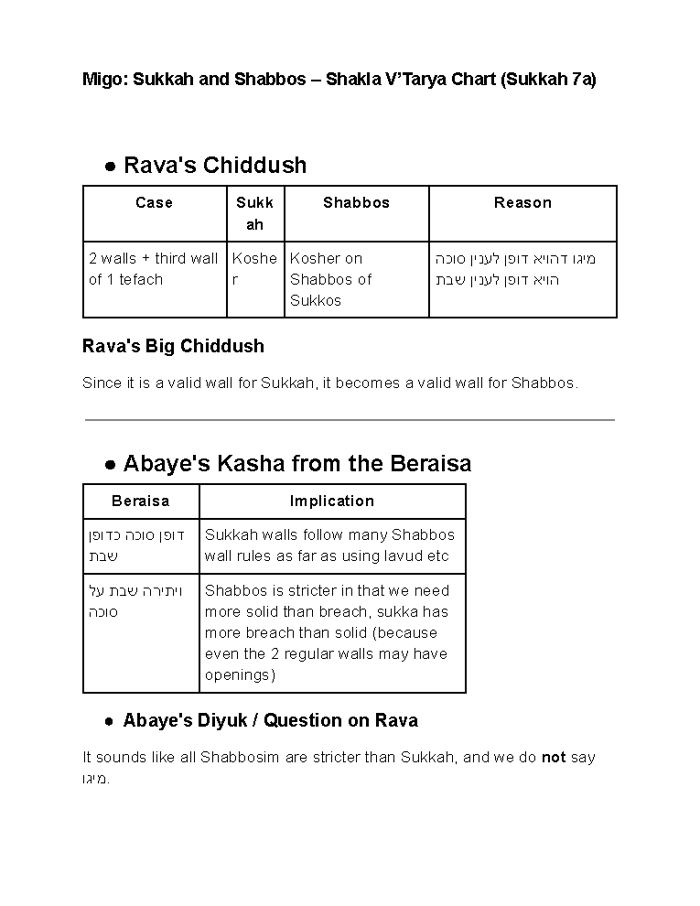
- ShitahRava, first of three versions: none of this works. Einah nesteres ela b'tzuras hapesach: it is permitted only with the form of an entranceway.
- The RebbiPractically: take the tefach of wood and slice it in half to make two lechayim, with a kaneh (rod) on top. The halacha l'Moshe miSinai is not a cooking instruction but an ingredient. This already gets into Eruvin a little.
- Rava is going on 'shlishis afilu tefach'. In answer to a question, the Rebbi agreed he is arguing on everybody.
- The RebbiIt is all attached: a skeleton wall.
- ChazarahReview of lines 13-15. Draw an L over hasam and two parallel lines for the mavui. Add kehilchasan for the aleph. Read 'in' (yes), not 'ein': if there is a span of four, good; ilay, if not, no.
- ChazarahRava: einah nesteres ela. Here 'ela' means 'only': it is not mutar unless you add tzuras hapesach, the look of an entranceway.
Kashas
- Why is a tefach shochek enough by two walls in an L, while by a mavui R' Simon / R' Yehoshua ben Levi require a pas arba'ah?
- The Rebbi's question: in a sukkah like a mavui, must the walls be within seven tefachim of each other, or could they be farther apart (nine, or a hundred feet)?
Teirutzim
- Where there are two walls kehilchasan, a tefach shochek suffices. Where there are not, a pas arba'ah is needed, and without it the sukkah is pasul.
- Probably the walls must be within seven; in most of these Gemaras one is forced to say the walls are only seven.
Rashi & Tosafos
- Rashi: The top rod of the tzuras hapesach does not have to be part of that tefach. You cannot slice the tefach in three; it is half a tefach and half a tefach, and then a separate rod. The attribution (heard as 'Rashi Antaisa') is partly unclear in recording.
The Rebbi’s chiddushim
- The repetition of 'kol pachos mishlosha samuch l'dofen k'lavud dami' tells us this is the only way it works.
- Hasam and hacha are relative terms: if I am here, you are there. Hasam is the L (kemin gam); hacha is the mavui with parallel walls.
- The Gemara's answer is not really a reason. Starting with a proper L earns a leniency; starting with a mavui requires the third wall closed with a pas arba'ah and lavud.
- For R' Simon / R' Yehoshua ben Levi there is a sliding scale of chumra: the less you start with, the more you need.
- The halacha l'Moshe miSinai of the tefach is not a cooking instruction but an ingredient: per Rava, the tefach of wood itself is cut in half and used for the tzuras hapesach.
- The tzuras hapesach is all attached: a skeleton wall.
Unclear in recording
- A source cited for the comparison with the earlier pushback (heard as 'Sefach HaMas') is unclear in recording.
- Whether Rava is arguing on all the previous shitos, and the later remark 'Rava could even be going on the...', are cut off. Unclear in recording.
- He listed three basic shitos here, but only Rava is audible; the other two are unclear in recording.
- Some details of the punctuation and review instructions are garbled.
Drafted from the recording of the shiur, for chazarah. Torah terms follow the Rebbi’s own words; anything that could not be made out is marked “unclear in recording”. Tap a time to hear that point. Corrections welcome.