Shiur summary (draft from the recording)
Daytime sleep, tefillin, and meals in the sukkah
Sukkah 9b · Monday, August 3, 2026
The sugya
The shiur covers how long one may sleep by day, when tefillin must be removed before sleeping, and the halachos of a newlywed and of one who was meshamesh while wearing tefillin. It then moves to the Mishnah about tasting food outside the sukkah and the k'beitza shiur. The second half covers R' Eliezer's 14 meals in the sukkah, the Rabbanan's view, and R' Eliezer's answers to two questions: one about a man who eats only one meal a day, and one about a man with two wives and two sukkos.
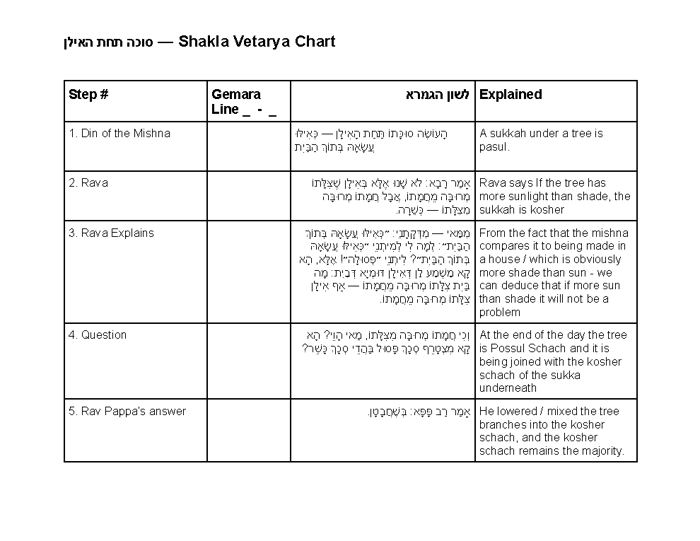
Step by step (shakla v’tarya)
- GemaraRav: a person may not sleep by day more than shinas hasus, the sleep of a horse. The stated reason is unclear in recording.
- GemaraHow long is a horse's sleep? Sixty breaths.
- GemaraAbaye: a chain of Amoraim whose daytime sleep was like Rav's, Rav's like Rabbi's, Rabbi's like Dovid's, and Dovid's like a horse's, sixty breaths. The first link of the chain is unclear in recording.
- GemaraAbaye would doze for the time it takes to go from Pumbedisa to Bei Kubi. Rav Yosef applied to him the pasuk 'until when will the lazy one lie down, when will you rise from your sleep?'
- GemaraTanu Rabbanan: one who goes to sleep by day may remove his tefillin or leave them on as he wishes. Since it is daytime and he is only going to sleep, there is no concern of anything else happening.
- GemaraAt night he must remove them and may not leave them on, because even if he intends a shinas arai it may lead to shinas keva.
- GemaraA statement brought in Rav Yosef's name: young married men must always remove the tefillin when going to sleep, because they are accustomed to seeing keri.
- KashaDoes Rav Yosef then hold that a baal keri may not put on tefillin?
- TeirutzAbaye (as heard): we are dealing with newlyweds who are with their wives. The rest of the answer is unclear in recording.
- GemaraTanu Rabbanan: one who forgot and was meshamesh while wearing tefillin may not hold them by the strap or by the bayis until he washes his hands, because the hands are busy.
- MishnahThe Mishnah's ma'aseh: food was brought to taste, and they said to bring it up to the sukkah.
- GemaraChisurei mechsera, words are missing from the Mishnah. It should read: if he wants to be machmir on himself he may, and there is no concern of yuhara.
- MishnahRabbi Tzadok was given less than a k'beitza. He took it in a cloth, ate it outside the sukkah, and did not make a bracha afterward.
- KashaThis implies that a k'beitza would require a sukkah. That contradicts the earlier statement (Rav Yosef / Abaye) that two or three beitzim make a meal, and anything less is arai.
- TeirutzThe Mishnah's 'less than a k'beitza' does not refer to sukkah but to netilas yadayim and the bracha: less than a k'beitza does not need them, while a k'beitza does. The exact words are partly unclear in recording.
- MishnahOne who missed the first night makes it up on the last night of Chag, Shemini Atzeres. Chachamim say it cannot be made up.
- Ra'ayahOn this they say: 'what is crooked cannot be straightened, and what is missing cannot be counted.'
- GemaraReason of R' Eliezer, who requires 14 meals: teshvu k'ein taduru. Just as at home one has one meal by day and one by night, so too in the sukkah.
- ShitahRabbanan: k'dira, like the way one lives in his house.
- KashaIf so, the first night should also be optional.
- Teirutz'Fifteen' is said by Sukkos and 'fifteen' by Chag HaMatzos, and Sukkos is learned from there. The details are unclear in recording.
- GemaraBefore R' Eliezer retracted, someone asked him: since I eat only one meal a day, am I patur?
- GemaraR' Eliezer answered: every day you make delicacies for your own honor, and now you won't make one extra meal for the honor of your Creator?
- GemaraA second question: I have two wives in two cities and a sukkah by each. May I go from one sukkah to the other and be yotzei?
- GemaraHe answered no. The sukkah for the seven days must be the same sukkah, and one who goes from one sukkah to another is not yotzei his obligation.
Kashas
- Does Rav Yosef hold that a baal keri may not put on tefillin?
- The Mishnah implies a k'beitza requires a sukkah, contradicting the statement that two or three beitzim make a meal and less is arai.
- According to the Rabbanan's k'dira, the first night should also be optional.
Teirutzim
- We are dealing with newlyweds who are with their wives. The rest is unclear in recording.
- The k'beitza shiur in the Mishnah refers to netilas yadayim and the bracha, not to sukkah.
- Learned from 'fifteen' by Chag HaMatzos. The details are unclear in recording.
Mareh mekomos
- Pasuk 'until when will the lazy one lie down, when will you rise from your sleep?', applied by Rav Yosef to Abaye's dozing.
- Pasuk 'what is crooked cannot be straightened, and what is missing cannot be counted', cited on the view that a missed first night cannot be made up.
- Teshvu k'ein taduru, the source for R' Eliezer's one meal by day and one by night.
- 'Fifteen' by Sukkos and 'fifteen' by Chag HaMatzos, used to make the first night obligatory.
The Rebbi’s chiddushim
- By day there is no concern in sleeping with tefillin because he is only going to sleep. At night a planned short sleep may turn into shinas keva.
- The answer to the k'beitza kasha shifts the Mishnah's shiur away from sukkah to netilas yadayim and the bracha.
Unclear in recording
- The reason given for the prohibition of sleeping by day more than a horse's sleep.
- The first name in Abaye's chain of sleep.
- The end of the answer about newlyweds.
- Most of the Mishnah's ma'aseh about the food brought to taste (the section around 02:14 to 02:45 is missing).
- The section between 04:18 and 04:44.
- How the 'fifteen / fifteen' limud was completed, and the section between 06:13 and 07:44.
- The identity of the questioner and the names of the two cities in the second question.
Drafted from the recording of the shiur, for chazarah. Torah terms follow the Rebbi’s own words; anything that could not be made out is marked “unclear in recording”. Tap a time to hear that point. Corrections welcome.