Space between sukkos; R' Yehudah's ein diyurin
The sugya
The Rebbi reviewed the three shitos on how much space between two layers of schach makes it a sukkah on top of a sukkah, which would make the bottom one pasul: Rav Huna says a tefach, Rav Chisda and Rabbah bar Rav Huna say four, and Shmuel says ten. He then learned the Gemara's kasha on Shmuel from R' Yehudah in the Mishnah, 'im ein diyurin ba'elyonah.' He went through Rav Dimi's explanation in the name of Eretz Yisrael, that the bottom sukkah must be able to hold the karim and kesasos of the top one. The Gemara concludes that the difference between them is where it can hold them only al yedei hadechak.
Step by step (shakla v’tarya)
- ChazarahQuick chazarah of the three shitos on how much space between the two sukkos is needed for the bottom one to be pasul.
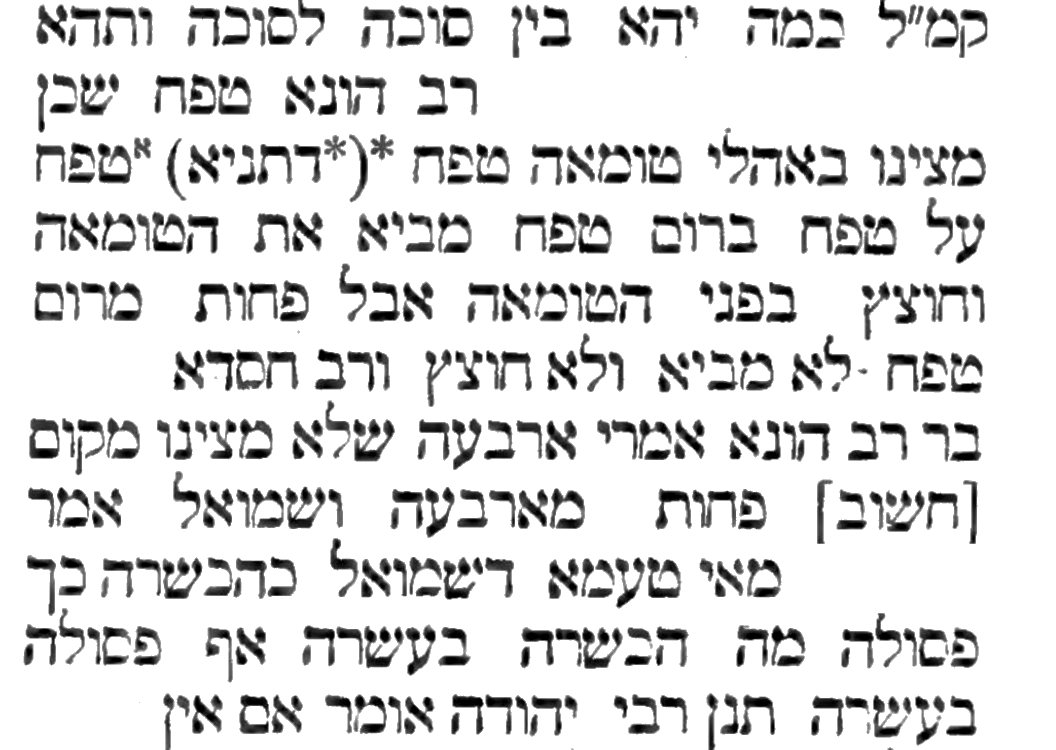
- GemaraLine 9: Kamma yehei bein sukkah l'sukkah. How much space must there be between the two sukkos for the bottom one to be pasul?
- ShitahRav Huna says a tefach, since we find a tefach by ohalei tumah.
- Ra'ayahTefach al tefach berum tefach is mevi es hatumah and chotzetz bifnei hatumah. The main point here is the height of a tefach.
- GemaraIf it is less than the height of a tefach, it neither brings the tumah nor separates. For Rav Huna, schach works like ohel tumah: whatever counts as an ohel counts here.
- ShitahRav Chisda and Rabbah bar Rav Huna say four tefachim, since we do not find a makom chashuv of less than four.
- ShitahShmuel says ten. The reason is kehechshera kach pesula: just as a sukkah is validated with ten, so it is invalidated with ten.
- Discussion with the chabura: according to Shmuel, could one keep layering schach at three-tefach intervals, even up to twenty? The Rebbi said why not, since it is considered one conglomerate.
- MishnahLine 19, the end of our Mishnah: R' Yehudah says if there are no dwellers (ein diyurin) in the top sukkah, the bottom one is kosher.
- The chabura asked whether this means simply that nobody is upstairs right now. The Rebbi noted that if R' Yehudah says this, we must ask what the Chachamim hold.
- KashaLine 20: Mai ein diyurin? If it means literal dwellers, atu diyurin ka garmi? Do people cause it to be pasul?
- GemaraRather it must mean kol she'einah re'uyah l'dirah, which is d'lo gavoha asarah: the top is not ten high.
- KashaMiklal: this implies the Tanna Kamma holds that even if the top is not fit for dwelling (less than ten), the bottom is pasul. That is a kasha on Shmuel.
- The Gemara revisits the meaning of ein diyurin. The whole kasha was built on the presumption that ein diyurin means re'uyah l'dirah, which is ten.
- TeirutzLine 24: Ki asa Rav Dimi, amri b'maarava. If the bottom sukkah cannot hold the karim and kesasos of the top one, the bottom is kosher.
- KashaThis still implies that the Tanna Kamma holds the bottom is pasul even if its roof cannot hold them. So it is still the same kasha on Shmuel.
- MaskanaIka beinaihu: the difference between the Tanna Kamma and R' Yehudah is where the roof can hold the bedding only al yedei hadechak.
Kashas
- If ein diyurin means literal dwellers, atu diyurin ka garmi? Can the presence of people make a sukkah pasul?
- If ein diyurin means not ten high, then the Tanna Kamma holds the bottom is pasul even when the gap is less than ten. That is a kasha on Shmuel.
- Even with Rav Dimi's explanation, the Tanna Kamma would seem to say the bottom is pasul even if its roof cannot hold the bedding. That is still a kasha on Shmuel, who requires ten.
Teirutzim
- Ein diyurin means kol she'einah re'uyah l'dirah, which is d'lo gavoha asarah.
- Rav Dimi in the name of Eretz Yisrael: ein diyurin means the bottom cannot hold the karim and kesasos of the top. The Rebbi said this is meant as an answer for Shmuel, though the Gemara does not spell it out.
- Ika beinaihu yecholah l'kabel al yedei hadechak. The machlokes is only where the roof can hold the bedding with difficulty.
Mareh mekomos
- Tefach al tefach berum tefach mevi es hatumah v'chotzetz (ohalei tumah), as the source for Rav Huna's shiur of a tefach.
- A Mishnah he referred to about the Har HaBayis being built kipin al gabei kipin (arches upon arches) to separate any tumah underneath, illustrating how an ohel separates tumah. Which Mishnah he meant is unclear in recording.
- Reshus harabim, where four tefachim is considered a makom chashuv, as a parallel to the shita of four.
The Rebbi’s chiddushim
- For Rav Huna, layers of schach less than a tefach apart are just one layer. This could be a clever way of engineering better schach.
- Literal dwellers cannot be the measure. Whether someone is sitting or walking up there is not hard science; it is no measuring tool.
- Read this way, R' Yehudah is very sensible: if the top is not fit to live in (not ten), it is not a sukkah on top of a sukkah. This fits Shmuel.
- Rav Dimi often brings messages from Eretz Yisrael. It is called maarava (the west) because Bavel is to the east.
- The schach of the bottom sukkah is the floor of the second sukkah. The question is whether it is too flimsy to handle the bedding of the people on top.
- According to Rav Dimi, it is a question of weight and sustainability, not size. Even a crawl space, like the sleeping bunk on top of a trailer, would count.
- The machlokes is not binary, and the gap of ten is no longer the make-or-break factor. To R' Yehudah the bottom roof must be very strong to hold the top sukkah. The Tanna Kamma call it pasul even if it holds the bedding only with difficulty, flimsy and shaky ('you might end up in the chicken soup').
Unclear in recording
- Which Mishnah he cited regarding kipin al gabei kipin.
- Back-and-forth over whether the kasha is on Shmuel or on the first two shitos. He settled on it being a kasha on Shmuel.
- The summary of what R' Yehudah and the Chachamim each hold is garbled.
- The exact statement of R' Yehudah's ruling in the al yedei hadechak case is garbled.
Drafted from the recording of the shiur, for chazarah. Torah terms follow the Rebbi’s own words; anything that could not be made out is marked “unclear in recording”. Tap a time to hear that point. Corrections welcome.