Lulav Agad; Source for Schach's Two Criteria
The sugya
The shiur finishes the sugya of whether a lulav needs agad. The Gemara links the machlokes to R' Yehudah and the Rabbanan, gives R' Yehudah's gezeirah shavah, and explains the Braisa of 'lulav mitzvah le'ogdo' through zeh Keili v'anvehu. It then moves to the Mishnah's zeh haklal: Reish Lakish learns schach's two criteria from 'v'eid ya'aleh min ha'aretz'. The Gemara asks that this only works for the view that the sukkos were ananei hakavod (R' Eliezer), not for R' Akiva's sukkos mamash. The shiur stopped there, before the Gemara's next answer.
Step by step (shakla v’tarya)
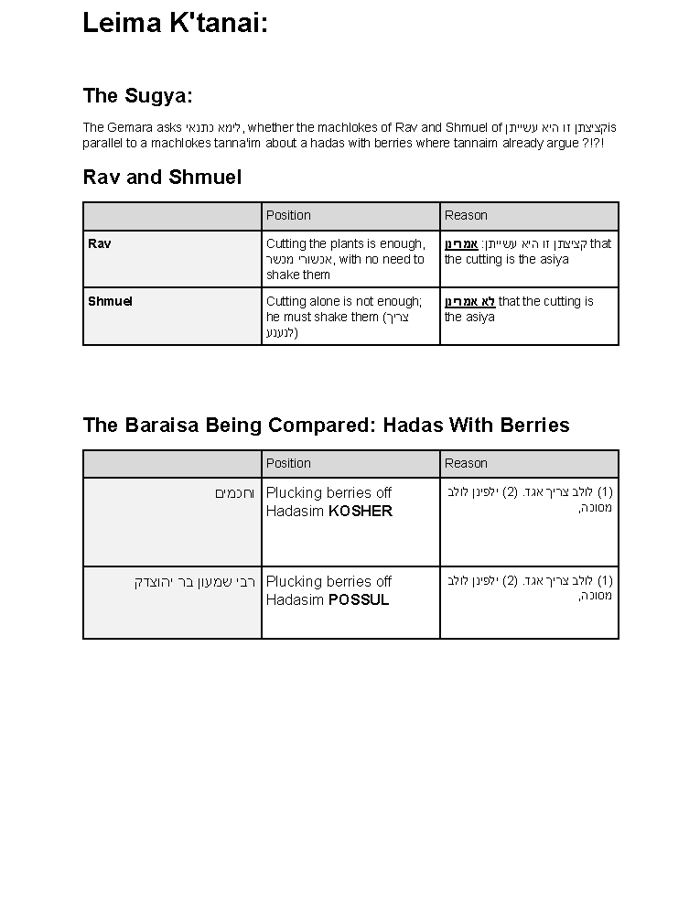
- ChazarahReview: u'vi'fluggta d'hani Tanna'i. The machlokes of the earlier Tanna'im is not about ketzisasan zu hi asiyasan. It is about agad, and it depends on another machlokes Tanna'im.
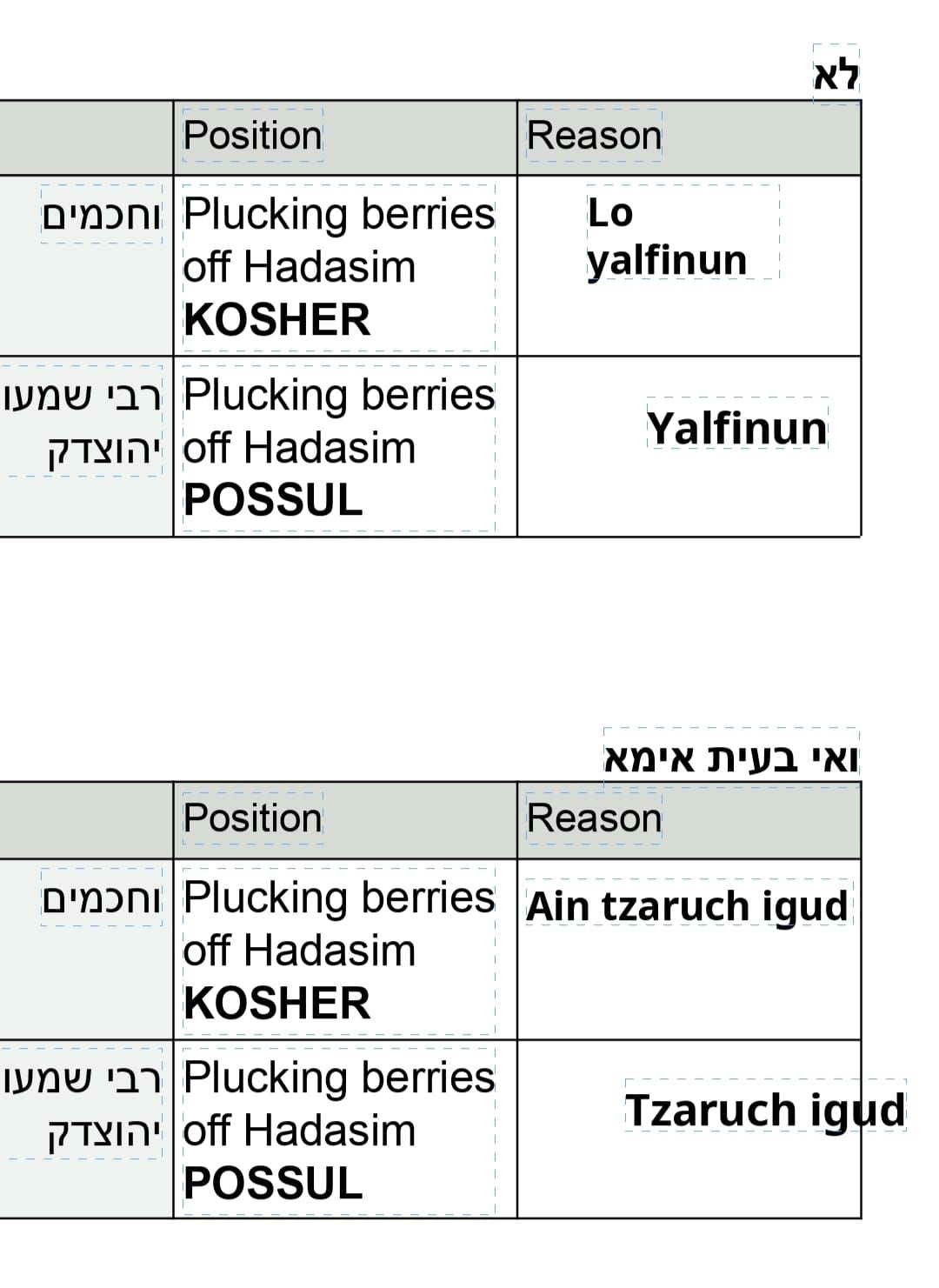
- MachlokesBraisa: a lulav, whether agud or not agud, is kasher. R' Yehudah says agud is kasher and she'eino agud is pasul.
- The Rebbi lines up which side of the earlier machlokes matches R' Yehudah and which matches the Chachamim. The exact pairing is garbled and self-corrected (unclear in recording).
- Gemara(Line 40) What is R' Yehudah's reason? He learns a gezeirah shavah lekicha-lekicha from agudas eizov. In Mitzrayim the pasuk says 'ulekachtem agudas eizov', with the word agudah. Here it says 'ulekachtem lachem bayom harishon', without it. Just as there it is with an agudah, so too here.
- ShitahThe Rabbanan do not learn this gezeirah shavah: lekicha mi'lekicha lo yalfinan.
- GemaraA Braisa seems to fit no one: lulav mitzvah le'ogdo, but if he did not tie it, it is kasher. Ke'man azla? The trigger word is 'mitzvah'.
- KashaIf it is R' Yehudah, why is it kasher when not tied? If it is the Rabbanan, why call it a mitzvah if you don't need it?
- TeirutzIt is really the Rabbanan. It is a mitzvah in a different category: zeh Keili v'anvehu. You beautify yourself before Him by doing mitzvos nicely.
- MishnahThe Mishnah ended with a (double) rule, zeh haklal. Schach must be davar she'eino mekabel tumah and gidulo min ha'aretz. A suggested third criterion ('detached') was set aside: just two.
- GemaraGemara: mena hani mili? Where do we know schach needs these criteria?
- Ra'ayahReish Lakish learns it from the pasuk 'v'eid ya'aleh min ha'aretz'. Eid (with an aleph) is a cloud, from the six days of Bereishis, describing how vegetation would grow. A cloud is not mekabel tumah and comes up from the ground. So too the sukkah, which commemorates the ananei hakavod, must be made of something not mekabel tumah and gidulo min ha'aretz.
- The chabura noted this sounds like a bit of a stretch. The Rebbi pointed out that the Targum on Sukkos refers to clouds.
- Kasha(Line 48) This works well for the one who says the sukkos in the Midbar were ananei hakavod. But according to the one who says sukkos mamash asu lahem (real sukkos), what can we say?
- GemaraThe Braisa on 'ki vasukkos hoshavti es Bnei Yisrael': R' Eliezer says they were ananei kavod; R' Akiva says sukkos mamash asu lahem.
- KashaThe Gemara asks again by name: for R' Eliezer we found the source, but according to R' Akiva what is there to say? We need a different source that works for actual schach.
- The shiur ended here; the next Mishnah was not reached today.
Kashas
- On the Braisa 'lulav mitzvah le'ogdo, v'im lo agdo kasher': if R' Yehudah, why kasher without agad? If Rabbanan, why is it a mitzvah?
- Reish Lakish's source (eid) works for the view that the sukkos were ananei hakavod, but what about the view of sukkos mamash?
- According to R' Akiva, who holds sukkos mamash, what is the source for schach's criteria?
Teirutzim
- The Braisa is the Rabbanan. The mitzvah of agad is because of zeh Keili v'anvehu: beautifying oneself before Hashem in mitzvos.
- The Rabbanan don't need agad because they do not learn lekicha mi'lekicha.
Rashi & Tosafos
- Rashi: Kabbalas tumah applies only to things like food, drink and people; a cloud is not one of those.
Mareh mekomos
- 'Ulekachtem agudas eizov' (Mitzrayim): source of the word agudah for R' Yehudah's gezeirah shavah.
- 'Ulekachtem lachem bayom harishon': the lulav pasuk, which lacks the word agudah.
- 'Zeh Keili v'anvehu': source for the mitzvah of agad according to the Rabbanan.
- 'V'eid ya'aleh min ha'aretz' (Bereishis): Reish Lakish's source for schach's two criteria.
- Targum on Sukkos: refers to clouds.
- 'Ki vasukkos hoshavti es Bnei Yisrael': basis of the machlokes R' Eliezer and R' Akiva.
The Rebbi’s chiddushim
- A gezeirah shavah takes what is written in one place and brings it to the other (or the reverse).
- How can one glorify Hashem? Hashem is Hashem. You glorify before Him by doing mitzvos in a way that is nice for Him. The Rebbi said he thinks the Gemara asks this there.
- The sukkah (schach) is representative of the cloud: zecher l'ananei hakavod. So it must share the cloud's properties.
- The 'mai ika l'meimar' is not rejecting Reish Lakish's source. Every opinion needs its own source, and this one didn't cover everyone.
- 'Mamash' means 'for real': according to R' Akiva the sukkos in the Midbar were not a miraculous entity. The famous kasha is then what the nes was, so it must be connected to some nes.
Unclear in recording
- Exactly how the Rebbi paired R' Shimon ben Yehotzadak and the Chachamim with R' Yehudah and the Rabbanan.
- The remark that the Mishnah's zeh haklal 'was not coming off the halacha we just said' / double rule.
- Chabura discussion of whether a cloud/water relates to kabbalas tumah; not resolved.
- Discussion of what the miracle was according to sukkos mamash.
Drafted from the recording of the shiur, for chazarah. Torah terms follow the Rebbi’s own words; anything that could not be made out is marked “unclear in recording”. Tap a time to hear that point. Corrections welcome.