Source that schach must be non-tamei and grown
The sugya
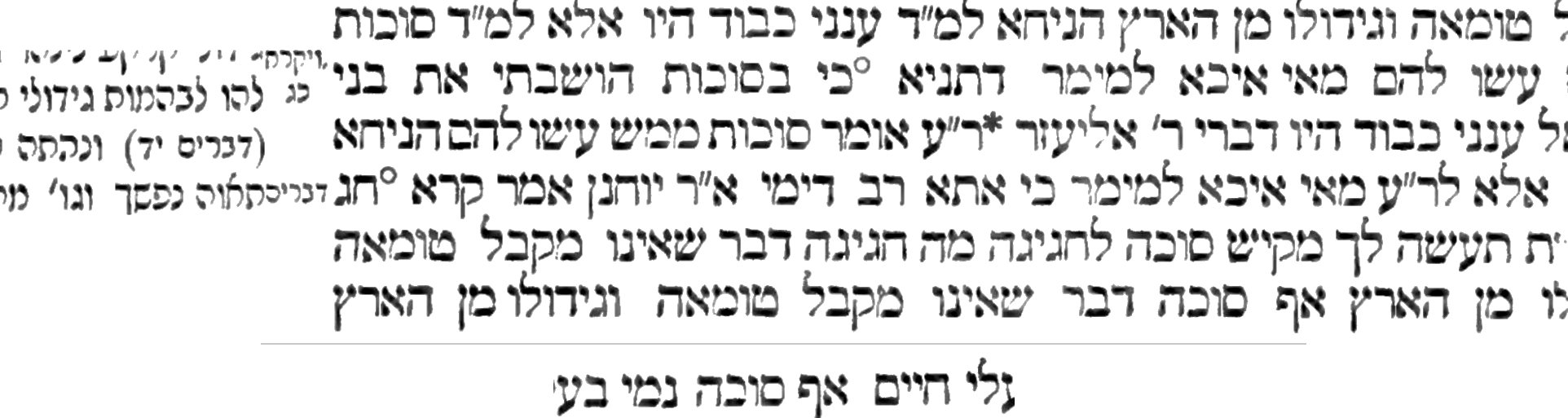
The Mishnah's klal is that schach must be something that is not mekabel tumah and whose growth is from the ground. The Gemara looks for the source. Reish Lakish learns it from 'v'ed ya'aleh min ha'aretz', but that only fits R' Eliezer (ananei hakavod), not R' Akiva (sukkos mamash). Rav Dimi brings R' Yochanan's hekesh of sukkah to chagigah, which is pushed off because chagigah is ba'alei chaim. Ravin brings R' Yochanan's derashah of 'b'ospecha migornecha umiyikvecha' (pesoles goren v'yekev). R' Zeira's proof is undone by R' Yirmiyah's challenge, and the final answer is left for tomorrow.
Step by step (shakla v’tarya)
- MishnahThe Mishnah ended with the klal: schach must be a davar she'eino mekabel tumah and gidulo min ha'aretz. The Gemara asks where we see these two requirements.
- GemaraReish Lakish learns it from the pasuk in Bereishis 'v'ed ya'aleh min ha'aretz'. The ed (cloud/mist) is just water vapor, so it is not a keli and not mekabel tumah. It also rises from the ground, so its growth is from the ground. So too, sukkah (schach) must have both qualities.
- KashaLine 48: this works for the one who holds the sukkos were ananei hakavod. But according to the one who holds they were real sukkos, why compare schach to a cloud?
- MachlokesBraisa on 'ki vasukkos hoshavti es Bnei Yisrael': R' Eliezer says they were ananei hakavod; R' Akiva says sukkos mamash asu lahem.
- Side discussion: according to R' Akiva, maybe there were not individual sukkos and the whole camp sat in one huge sukkah. What exactly are we commemorating? The Rebbi noted the wording 'asu lahem' sounds like it was made for them, and said this is not the place for that.
- KashaLine 50: the Gemara repeats the question a third time. Reish Lakish's source is fine for R' Eliezer, but what does R' Akiva say? We need another source, since this one is one-sided.
- GemaraWhen Rav Dimi came (from Eretz Yisrael to Bavel), he said in the name of R' Yochanan: 'chag hasukkos ta'aseh lecha'. Underline 'chag' and 'sukkos'. This is a hekesh of sukkah to chagigah.
- RashiThe korban chagigah is a live animal, so it is not mekabel tumah. It is called gidulo min ha'aretz because, as Rashi says, its nourishment comes from the ground. So too, sukkah.
- KashaThe Gemara asks a stronger question: if so, just as chagigah is ba'alei chaim, sukkah should also be ba'alei chaim. The Rebbi understood this to mean you could put live animals (e.g. goats) on the sukkah as schach.
- GemaraWhen Ravin came, he said in the name of R' Yochanan: the end of the same pasuk, 'b'ospecha migornecha umiyikvecha'. The pasuk is speaking of pesoles goren v'yekev.
- The RebbiPshat in the pasuk: we come into the sukkah with abundance, having brought in the harvest for the winter. The derashah: schach is made from the waste of the grain and wine, e.g. wheat stalks and the vines, not the grain or wine themselves.
- KashaWhy say pesoles? Say goren itself and yekev itself, i.e. the grain and the wine.
- TeirutzR' Zeira: it says 'yekev', and it is impossible to be mesakech with that, since yekev is the wine itself, a liquid. So it must mean the pesoles.
- DechiyahR' Yirmiyah challenges: say it refers to yayin karush (congealed wine) that comes from Snir, which is similar to round pressed fig cakes (iguli d'veilah).
- R' Zeira: we had this matter in hand, and R' Yirmiyah came and threw a nargah (axe handle) into it, like 'throwing a wrench in it'.
- MaskanaThat answer does not stick. The final answer will be learned tomorrow.
Kashas
- Reish Lakish's source from the cloud fits only the view that the sukkos were ananei hakavod. What about R' Akiva, who holds they were sukkos mamash?
- If sukkah is learned from chagigah, then just as chagigah is ba'alei chaim, sukkah should also be ba'alei chaim (live animals as schach).
- Why pesoles goren v'yekev? Say the grain and wine themselves.
- R' Yirmiyah: maybe yekev means congealed wine from Snir, which is like round pressed fig cakes and could be used as schach.
Teirutzim
- Rav Dimi in the name of R' Yochanan: a hekesh of sukkah to chagigah from 'chag hasukkos ta'aseh lecha'.
- Ravin in the name of R' Yochanan: 'b'ospecha migornecha umiyikvecha' refers to pesoles goren v'yekev.
- R' Zeira: 'yekev' means actual wine, which cannot be used as schach, so the pasuk must mean the pesoles.
Rashi & Tosafos
- Rashi: An animal is called gidulo min ha'aretz because its nourishment comes from the ground.
Mareh mekomos
- Pasuk in Bereishis 'v'ed ya'aleh min ha'aretz': Reish Lakish's source.
- Braisa on 'ki vasukkos hoshavti es Bnei Yisrael': machlokes R' Eliezer (ananei hakavod) and R' Akiva (sukkos mamash).
- Pasuk 'chag hasukkos ta'aseh lecha': R' Yochanan's hekesh of sukkah to chagigah.
- Earlier sugya regarding the walls of the sukkah, where there was also a connection between sukkah and chagigah.
- End of the same pasuk, 'b'ospecha migornecha umiyikvecha': Ravin's source.
The Rebbi’s chiddushim
- The ed is just water vapor, not a keli, so it is not mekabel tumah. It rises from the ground, so its growth is from the ground.
- Gidulo min ha'aretz includes animals and people, since ultimately everything gets its growth from the ground. This is as opposed to things like fish or mushrooms and fungus, which the Rebbi described as growing from the air.
- The Torah has specific words for the peels, stems and sediment of grapes. Yekev is the juice itself, which you cannot pour on as schach.
- Iguli comes from 'igul' (round): pressed figs were made in round molds.
- Nargah is an Aramaic word for an axe handle. R' Zeira's expression is like our 'threw a wrench in it'.
Unclear in recording
- Exactly which source the Rebbi cited on the wording 'sukkos mamash asu lahem' (made for them vs. they made them).
- The details of the earlier connection to chagigah by the walls.
- Attribution of the explanation about animals vs. fish and fungus.
- The discussion about animal skins as schach and whether they are mekabel tumah.
- The remark about something later in the masechta leading to a smell.
Drafted from the recording of the shiur, for chazarah. Torah terms follow the Rebbi’s own words; anything that could not be made out is marked “unclear in recording”. Tap a time to hear that point. Corrections welcome.