Staggered beams: Ro'in vs. Chavot Rami
The sugya
The shiur continues the sugya of chavot rami and Rabbah's requirement that a beam be a tefach. It covers the braisa of two korahs mutaamos (two beams together making the shiur to be matir a mavoi), then R' Yosi b'R' Yehuda's din of ro'in when one beam is above and one below. That din seems to say chavot rami without a tefach, which is a kasha on Rabbah. The Gemara answers 'taritz v'eima hachi': the beams must be within less than three tefachim of each other, but at three or more, since they lack a tefach, we do not say chavot rami.
Step by step (shakla v’tarya)
- ChazarahThe Rebbi looked up the braisa of the Tanna Kamma and Rashbag in Eruvin. There are many machlokes rishonim there, e.g. whether the Tanna Kamma's tefach must be smuchos, as Rashi says here.
- Our tafkid is to understand the words and the pshat of the Gemara on the way to the sugya of chavot rami, without getting bogged down in the Eruvin sugyos.
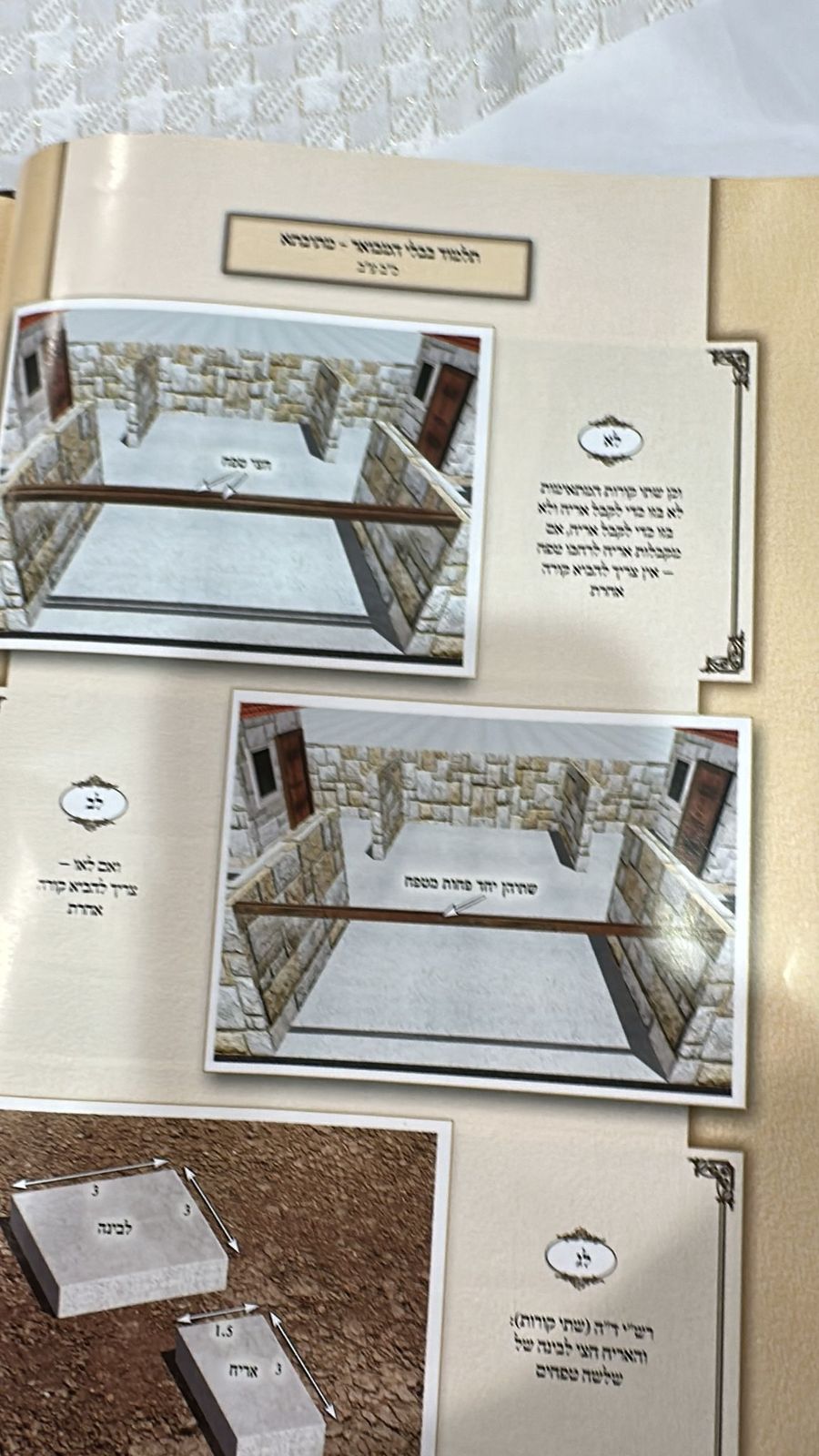
- GemaraTwo korahs mutaamos: neither beam alone can hold an ariach. If together they hold the width of the brick, a tefach, there is no need to bring another beam; otherwise you must bring another korah.
- RashiRashi learns that the two beams are right together.
- RashiOn Rashbag (holding the brick lengthwise), Rashi says it is a kula, even though there will be air space between the beams.
- ChazarahBackground: the Mishnah in Eruvin (the Rebbi thinks the fourth mishnah of the first perek) says a korah, to be matir a mavoi, must be mekabel an ariach. The Gemara there explains what that means.
- ChazarahThe purpose of all this is to address chavot rami, which Rabbah said requires a tefach.
- GemaraLine 10: one beam is above and one is below, not on the same level.
- ShitahR' Yosi b'R' Yehuda: ro'in. We view the upper beam as if it were below and the lower one as if it were above, i.e. we pretend they are together.
- The RebbiThis is a little different from chavot rami because it goes both ways; it is like a reverse chavot rami as well.
- GemaraProviso: the upper beam may not be above 20 amos and the lower may not be below 10 tefachim. This parallels the heights for a sukkah and a mavoi.
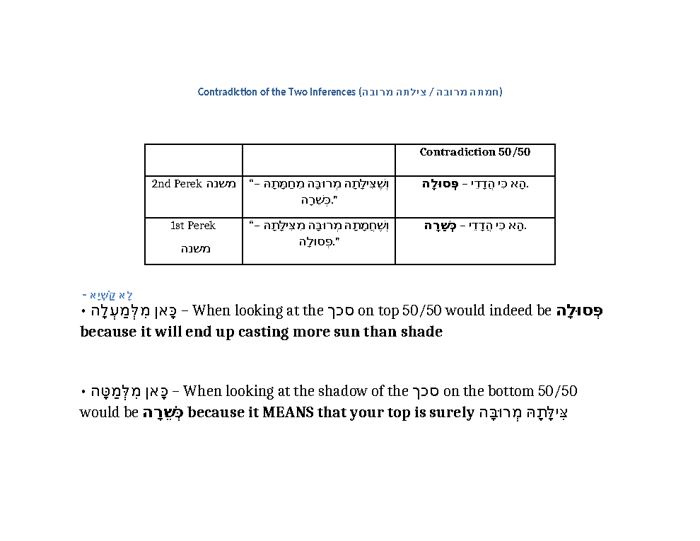
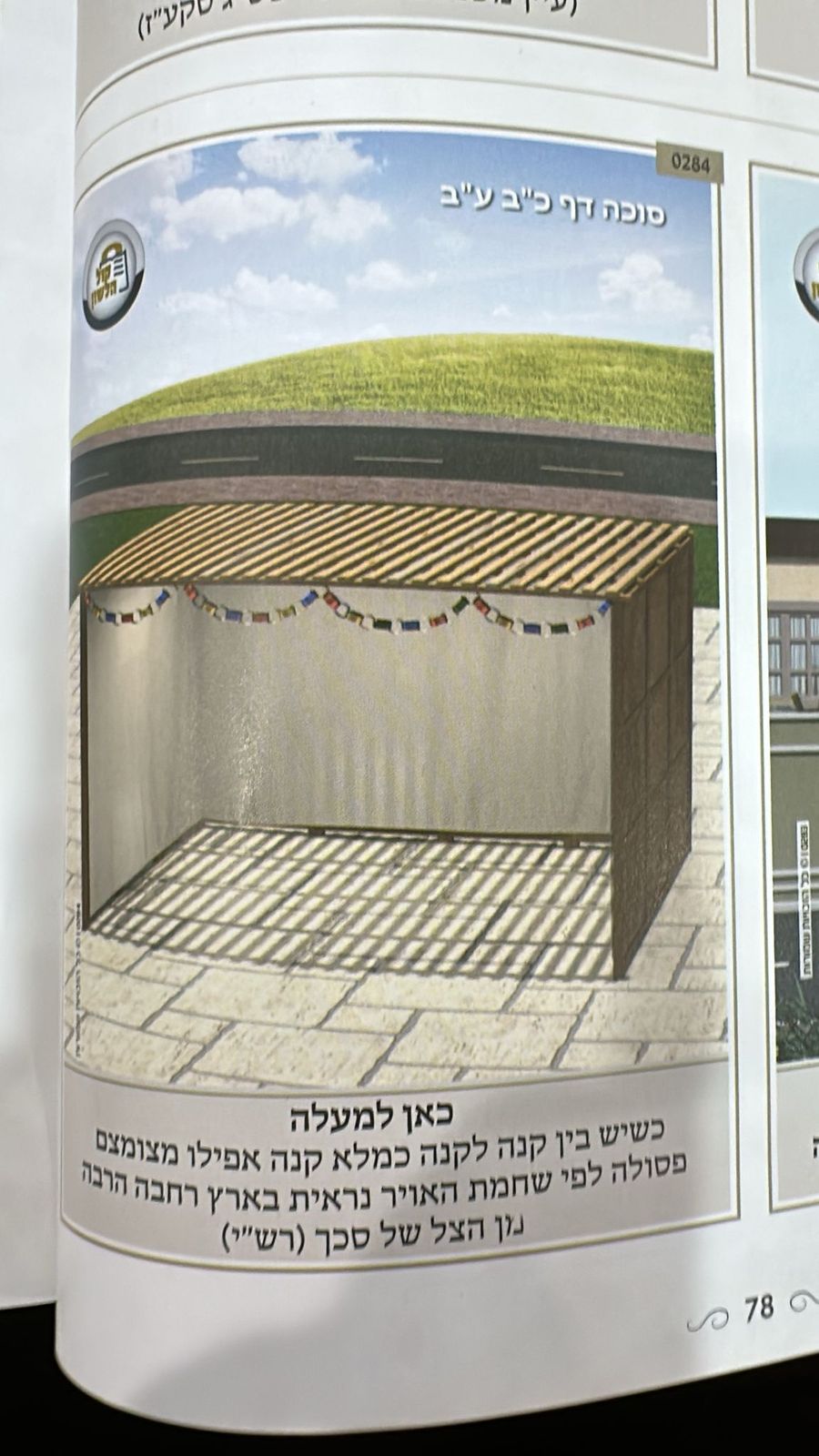
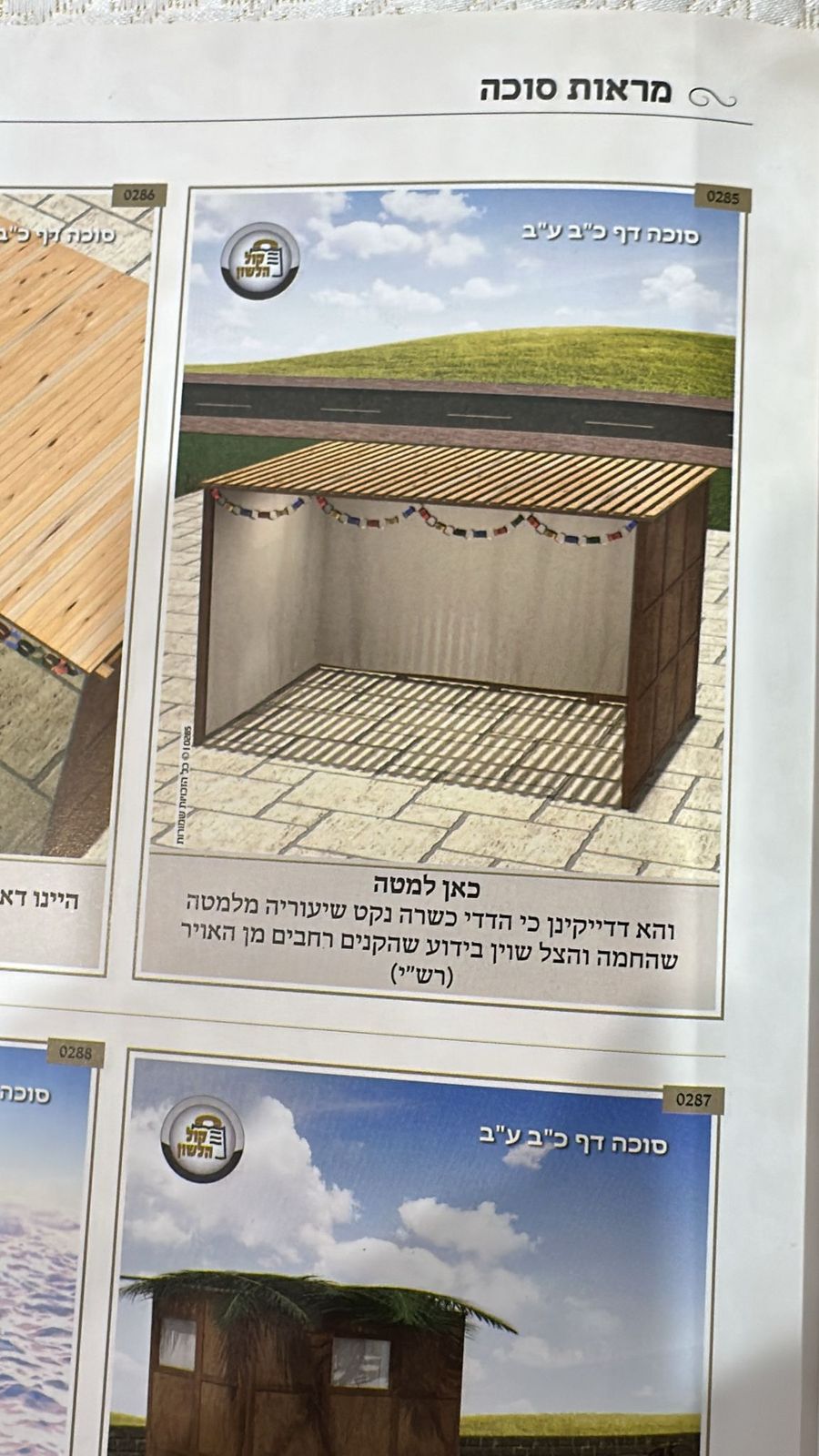
- KashaImplied: if both are within 20, we say chavot rami even though the beam lacks a tefach.
- KashaThis is a problem for Rabbah, who said chavot rami only works with a tefach; with less, it does not form one ohel.
- Spoiler: the Gemara will say this ro'in is not chavot rami at all; the beams must be within three.
- The kasha arose in a discussion between Rav Ashi and Rav Kahana about whether Rabbah really needs a tefach to say chavot rami.
- TeirutzTaritz v'eima hachi: the Gemara reinterprets the proviso of R' Yosi b'R' Yehuda.
- TeirutzThe upper beam may not be above 20 but must be within 20, and the lower must be close to it, within less than three tefachim.
- TeirutzAlternatively (i nami), the lower may not be below 10 but must be above 10, and the upper must be close to it, within less than three.
- The RebbiAbove 20 amos or below 10 tefachim a beam is 'out of play'. Both must be in play, and even then they must be within three of each other.
- MaskanaBut at three or more, since the beams have no tefach, we do not say chavot rami. Rabbah stands.
- The RebbiThis is not necessarily a proof for Rabbah but a way to keep him intact. It is not checkmate; Rabbah was put in check, and this is a move.
Kashas
- From R' Yosi b'R' Yehuda: within 20 amos we say chavot rami even without a tefach. This contradicts Rabbah, who requires a tefach for chavot rami.
Teirutzim
- Taritz v'eima hachi: the beams must be within 20 amos (or above 10 tefachim) and within less than three tefachim of each other. At three or more, lacking a tefach, we do not say chavot rami, so Rabbah stands.
Rashi & Tosafos
- Rashi: The Tanna Kamma's tefach must be smuchos; the two beams are right together.
- Rashi: Rashbag's shiur (brick lengthwise) is a kula, even though there is air space between the beams.
Mareh mekomos
- Braisa in Eruvin of the Tanna Kamma and Rashbag on two korahs mutaamos, with many machlokes rishonim there.
- Mishnah in Eruvin, first perek (the Rebbi thinks the fourth mishnah): a korah to be matir a mavoi must be mekabel an ariach.
- First Mishnah in Sukkah, and the same in Eruvin: the limits of 20 amos and 10 tefachim, used for the proviso of R' Yosi b'R' Yehuda.
The Rebbi’s chiddushim
- Ro'in goes both ways, unlike chavot rami, which only pushes down; it is also a reverse chavot rami.
- Taritz means the Gemara is putting words into R' Yosi b'R' Yehuda's mouth that he did not explicitly say.
- Uvilvad (providing) is probably from the same root as isolating something.
- A beam above 20 amos or below 10 tefachim is out of play. Both beams must be in play and also within three of each other.
- If the beams were a tefach we would not need this at all, since one tefach is good enough.
- The teirutz is not a proof for Rabbah but keeps him intact: not checkmate, just check, and this is a move.
Unclear in recording
- Exact shiur mentioned for Rashbag's lengthwise case ('two tefachim, three tefachim'): unclear in recording.
- Explanation of why the ariach is a tefach and a half (cement on each side) and how it relates to the beam's tefach: unclear in recording.
- Discussion with a talmid about chavot rami going the other way and a case of tumah hanging between floors. The Rebbi called it a good thought and said he did not know; details unclear in recording.
- Which Amora said 'taritz v'eima hachi' to whom: the Rebbi said Rav Kahana answered Rav Ashi, but the attribution in the recording is somewhat confused.
- Closing point about a possible pshat in what R' Yosi b'R' Yehuda meant (ro'in only within three) and a question about a proof: unclear in recording.
Drafted from the recording of the shiur, for chazarah. Torah terms follow the Rebbi’s own words; anything that could not be made out is marked “unclear in recording”. Tap a time to hear that point. Corrections welcome.