Using a live animal as a sukkah wall
The sugya
The Rebbi reviewed the machlokes about a sukkah built on top of an animal. R' Yehuda holds it pasul because a sukkah must be fit for seven days, while R' Meir holds it kosher mid'oraisa and treats the problem as only a gezeirah of the Rabbanan. The Gemara then flips the machlokes for an animal used as a wall: R' Meir is posul and R' Yehuda is machshir. R' Meir's general rule is that anything with ruach chaim cannot serve as a dofen, lechi, pasin or golel, and R' Yosi HaGlili adds that one may not write gittin on it. The shiur ended with Abaye (shema tamus) and R' Zeira (shema tivrach) explaining R' Meir, with the details left for next week.
Step by step (shakla v’tarya)
- ChazarahReview: one who builds a sukkah on top of an animal (two animals with plywood as a floor). R' Meir says kosher. R' Yehuda says pasul, not good for any of the days.
- GemaraLine 22, mai ta'ama d'Rabbi Yehuda: the pasuk says chag hasukkos ta'aseh lecha shivas yamim. A sukkah ra'uya l'shiv'ah is called a sukkah; one not ra'uya l'shiv'ah is not called a sukkah.
- The RebbiThe pasuk is not necessarily talking about the sukkah itself but about the Yom Tov; still, we darshen it.
- TeirutzR' Meir: mid'oraisa this sukkah is also fit (mechzah chazya). It is the Rabbanan who made a gezeirah on it.
- The RebbiR' Yehuda reckons with the outside rules about getting into the sukkah: if a rule prevents you from getting in, it is not a good sukkah at all. R' Meir says that is a separate issue.
- Now the Gemara almost flips R' Meir and R' Yehuda. The topic moves from the floor of the sukkah to its walls.
- The RebbiIntroduction: the walls of a sukkah can be made of almost anything. With a live animal it may not work, because you might not keep the measurement of a proper wall.
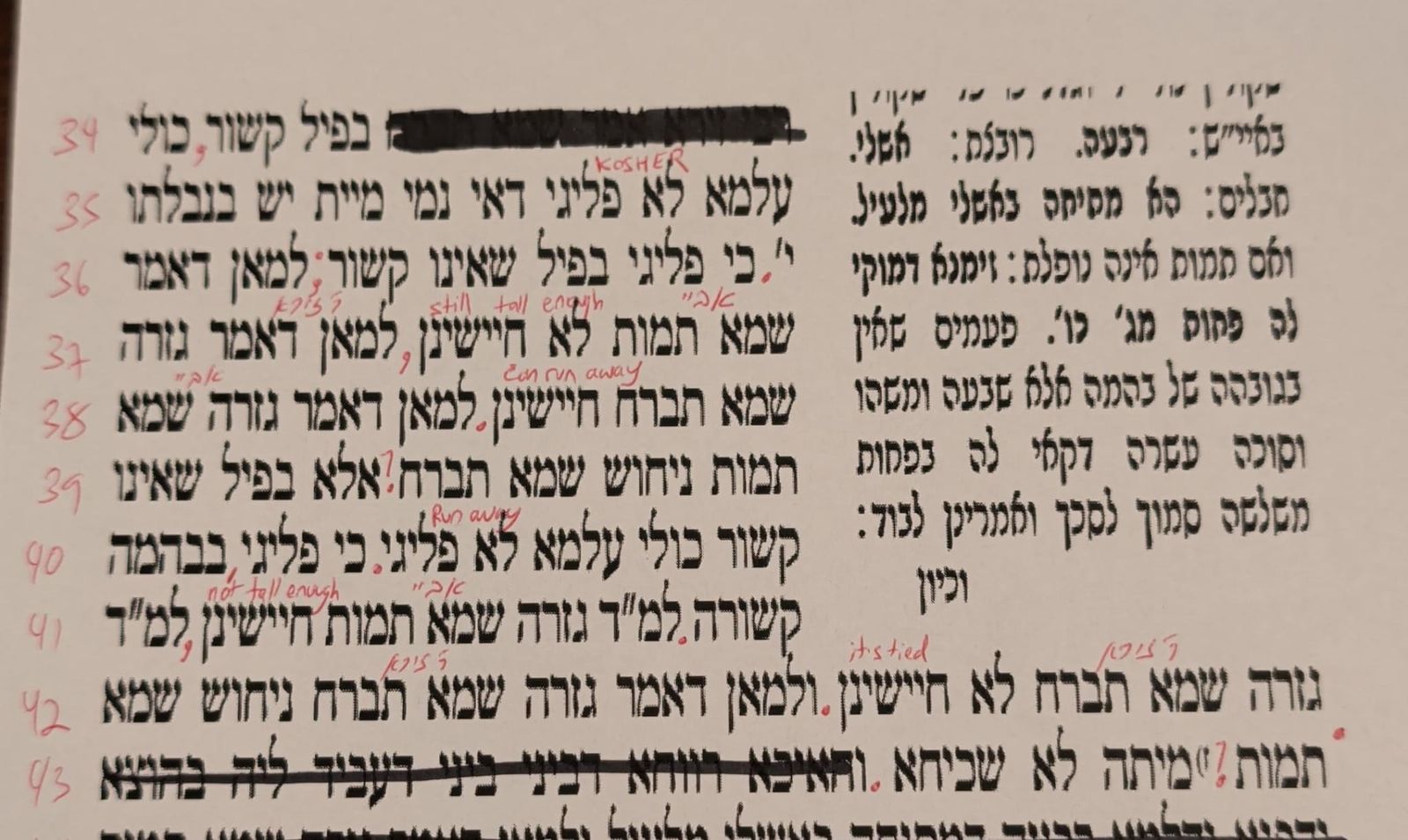
- MachlokesLine 27: one who made an animal a dofen for a sukkah. R' Meir posul, R' Yehuda machshir.
- An impractical, theoretical case (perhaps on a farm, using your cow as a wall to eat quickly). The Gemara is Torah, and we ask whether it works l'maaseh.
- ShitahR' Meir's general shitta: kol davar sheyesh bo ruach chaim, any living creature, cannot be used for the halachic things that need partitions.
- GemaraCase 1 (line 30): not as a dofen for a sukkah.
- GemaraCase 2: not as a lechi for a mavoi (an alleyway). A lechi, a vertical post at the side of the alley's entrance, does the same job as the korah (crossbeam) learned last week, which is needed to carry in the alleyway. Today's eruv pipe is an example.
- GemaraCase 3: not as pasin for be'eros (wells). Travelers going up to the Beis HaMikdash for aliyah l'regel had to water their animals in reshus harabim. A deep well is a reshus hayachid, so drawing from it to an animal in reshus harabim is an issur d'oraisa. As a special kula, four L-shaped posts around the well were enough, without fencing off the whole area. An animal cannot form one of these posts.
- GemaraCase 4: not as a golel for a kever. The seal of a grave has the tumah status of the meis itself, the highest degree of tumah. An animal used to seal a kever would not have that status.
- GemaraR' Yosi HaGlili adds a fifth case: one may not write gittin for women on an animal. The pasuk requires a sefer, but one might have thought an animal works, for example if you ran out of paper.
- KashaLine 33, mai ta'ama d'Rabbi Meir: why can an animal not serve as a wall for a sukkah, when R' Yehuda allows it? The Rebbi chose to learn it specifically regarding a dofen for a sukkah.
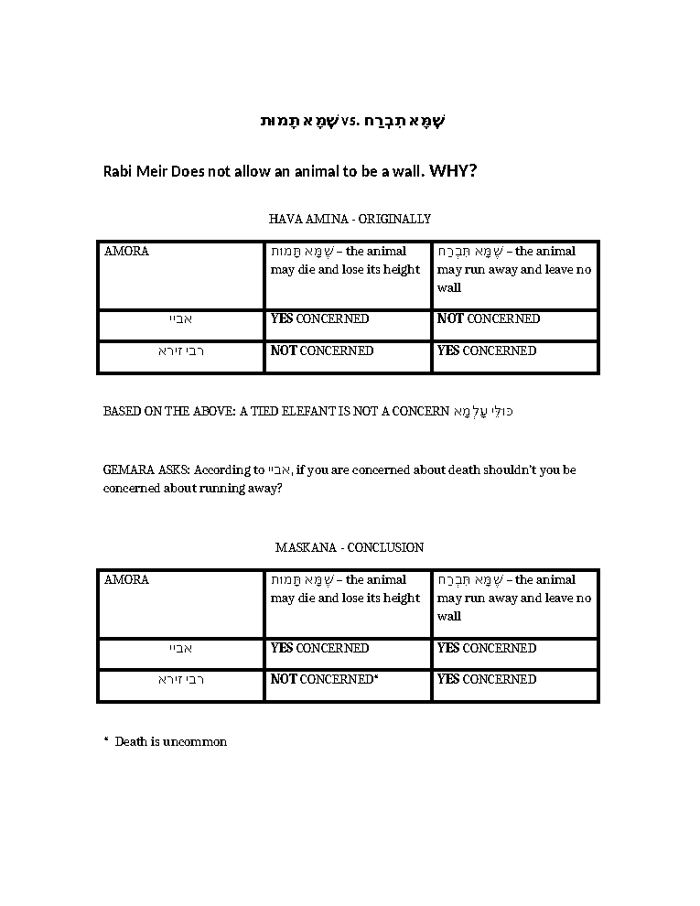
- TeirutzAbaye: shema tamus, maybe it will die.
- TeirutzR' Zeira: that is not the reason. Shema tivrach, maybe it will flee, so it is not a reliable wall.
- The RebbiAbaye's concern is not smell or tumah. When the animal dies it rots and shrinks, so you lose the shiur of the sukkah wall.
- ChazarahReview read-through of lines 27 to 34.
- The RebbiGolel comes from the word 'roll', as Yaakov rolled the stone in Parshas Vayeitzei. Rolling a stone was the most common way to seal a kever; today concrete is poured.
Kashas
- How will R' Meir answer R' Yehuda's derashah of ra'uya l'shiv'ah?
- What is R' Meir's reason for not allowing an animal as a wall for a sukkah?
- (Talmid's question) What about a slaughtered animal hanging in a cold storehouse that will not rot? Can it serve as a sukkah wall? The Rebbi said 'let's see' and left it for next week.
Teirutzim
- R' Meir: mid'oraisa the sukkah on an animal is fit; the problem is only a gezeirah of the Rabbanan.
- Abaye: shema tamus. When it dies it rots and shrinks, losing the shiur of the wall.
- R' Zeira: shema tivrach. It may flee and you will not have a wall.
Mareh mekomos
- Pasuk 'chag hasukkos ta'aseh lecha shivas yamim', R' Yehuda's source that a sukkah must be fit for seven days.
- The first Mishnah in Shabbos, cited for the issur d'oraisa of carrying from reshus hayachid to reshus harabim.
- The pasuk requires a sefer for a get, the background to R' Yosi HaGlili's case.
- Parshas Vayeitzei, Yaakov rolling the stone, cited to explain the word golel.
The Rebbi’s chiddushim
- The pasuk of shivas yamim refers to the Yom Tov rather than the sukkah, yet we darshen it about the sukkah.
- R' Yehuda treats outside rules that prevent entering the sukkah as invalidating the sukkah; R' Meir sees them as a separate issue.
- Regarding walls, the machlokes of R' Meir and R' Yehuda is flipped.
- A lechi serves the same function as the korah of a mavoi; the pipe of today's eruv is an example.
- Pasin l'be'eros was a special kula for olei regel: four L-posts were enough recognition of a private domain, without roping off the whole area.
- Abaye's concern is not smell or tumah but that a dead animal rots and shrinks, losing the shiur of the wall.
- Golel means roll, since rolling a stone was the common way to seal a kever.
Unclear in recording
- A remark after the summary of R' Meir and R' Yehuda (about some practice that could make the sukkah possible) is unclear in recording.
- Part of the explanation of golel is unclear in recording: the Eretz Yisrael custom of a cement slab poured before the stone, its name, and what 'it actually says' about it.
- A talmid's comment about the kever and the Rebbi's reply are unclear in recording.
Drafted from the recording of the shiur, for chazarah. Torah terms follow the Rebbi’s own words; anything that could not be made out is marked “unclear in recording”. Tap a time to hear that point. Corrections welcome.