Shiur summary (draft from the recording)
Using an animal as a wall for the sukkah
עשאה לבהמה דופן לסוכה
Sukkah 23a · from line 27 · Monday, November 24, 2025
The sugya
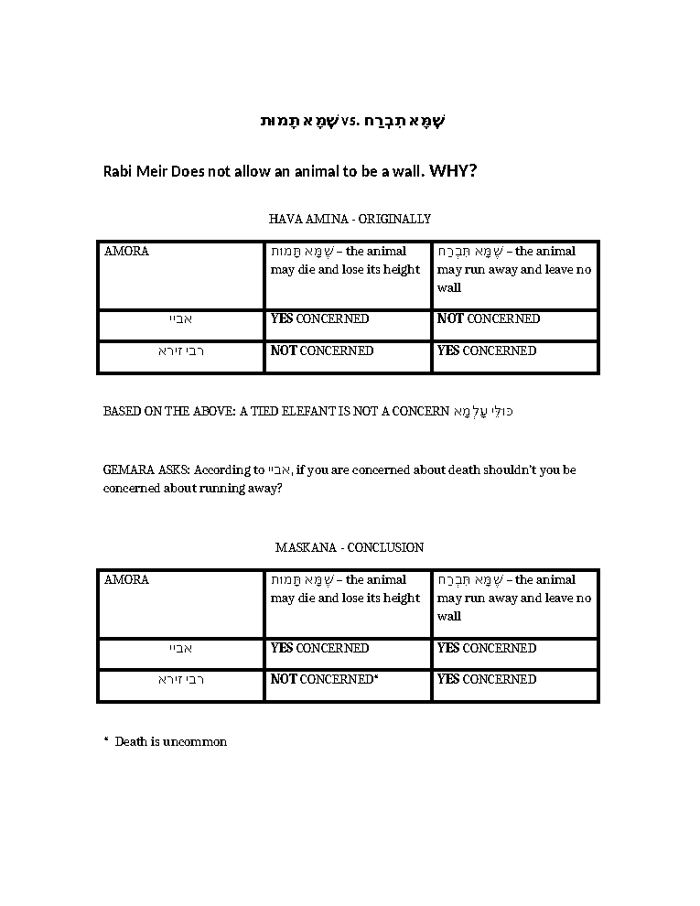
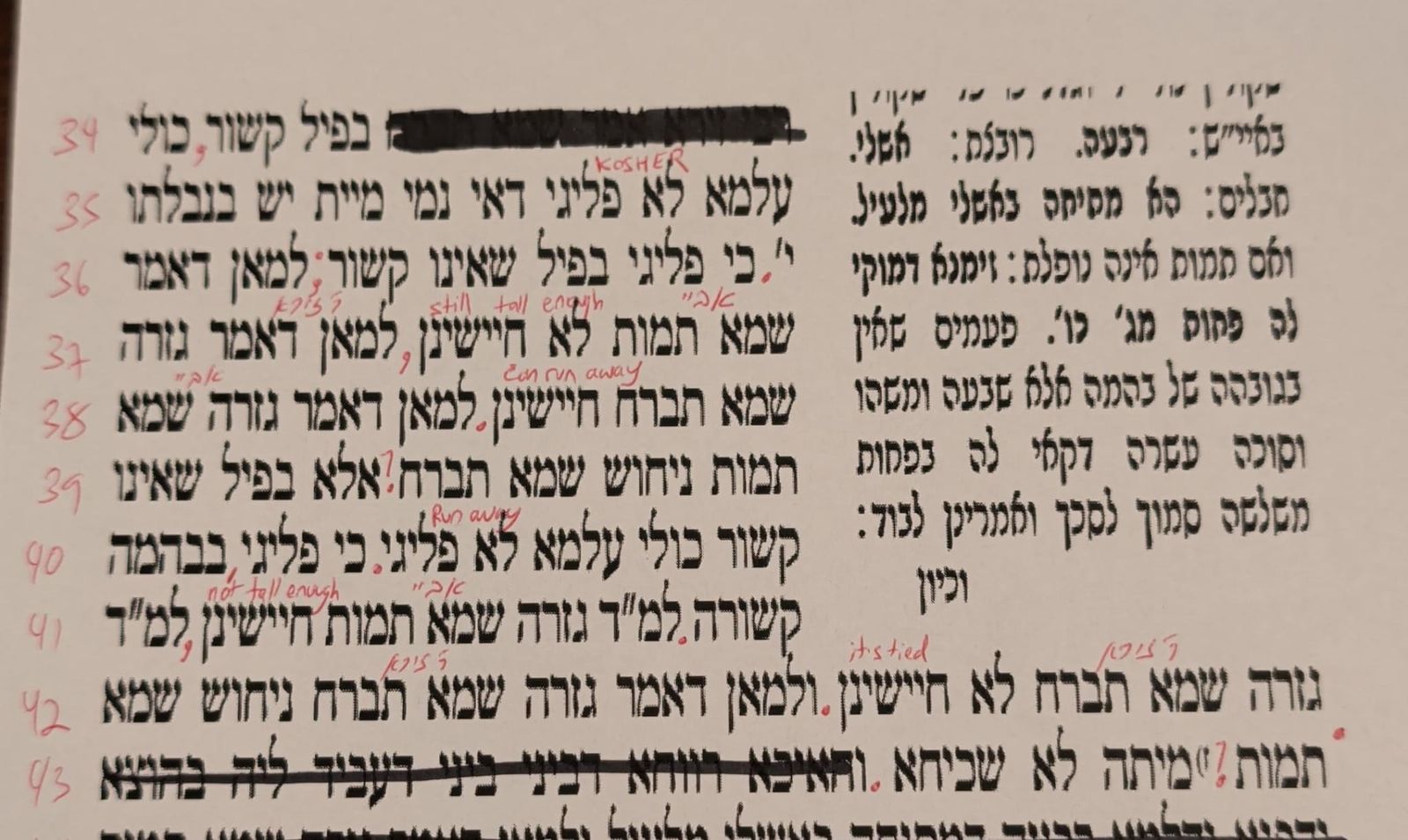
The sugya is the machlokes R' Meir and R' Yehuda about making an animal a wall of a sukkah. R' Meir pasuls it, and the Gemara brings two reasons: Abaye says shema tamus and R' Zeira says shema tivrach. The Gemara tries to define the case where they argue. A tied elephant and an untied elephant both fail, so it settles on a tied behemah, and answers that misah lo shechicha.
Step by step (shakla v’tarya)
- MachlokesIf one made a behemah a wall of a sukkah, R' Meir says it is pasul and R' Yehuda says it is kosher. The Rebbi called this a flipped machlokes, since R' Meir and R' Yehuda are reversed from the previous case.
- ShitahR' Meir used to say that anything with ruach chaim cannot be used for four things: a dofen for a sukkah, a lechi for a mavoi, the pasin around wells, or a golel for a kever.
- ShitahIn the name of R' Yosi HaGlili they said that one also may not write a get on a living animal.
- ShitahAbaye gives the reason for R' Meir as shema tamus. If the animal dies it shrinks, and the wall loses its shiur.
- ShitahR' Zeira gives the reason as shema tivrach. The animal may run away, and then there is no sukkah at all.
- GemaraWith a peil kashur, a tied elephant, everyone agrees it is kosher. It cannot run away, and even if it dies its carcass is still ten tefachim, enough for the wall.
- MachlokesThe Gemara first suggests they argue by an untied elephant. According to shema tamus, lo chayshinan, because the carcass still has ten. According to the gezeirah of shema tivrach, chayshinan.
- KashaAccording to the one who says shema tamus, why not also suspect that it will run away?
- DechiyahSo the Gemara flips it. By an untied elephant, everyone agrees it is pasul, because it may run away.
- MachlokesThey argue by a behemah kashurah, a tied ordinary animal. According to shema tamus, chayshinan, because a regular animal that dies will shrink. According to shema tivrach, lo chayshinan, because it is tied.
- KashaAccording to R' Zeira, who says shema tivrach, why not also be concerned that it will die?
- TeirutzMisah lo shechicha: death is not common.
- MaskanaA tied regular animal therefore works only according to R' Zeira. According to Abaye it may still die and shrink. A tied elephant works according to everyone.
Kashas
- According to the one who says shema tamus, why not also suspect shema tivrach, which is more likely?
- According to the one who says shema tivrach, why not also suspect that it will die?
Teirutzim
- The first kasha is answered by flipping the case: by an untied elephant, everyone agrees it is pasul, and the machlokes is by a tied behemah.
- Misah lo shechicha: death is uncommon, so R' Zeira need not be concerned for it.
The Rebbi’s chiddushim
- Abaye's concern is not that the dead animal will smell. It is that once the ruach chaim leaves, the animal shrinks and the wall is no longer the required shiur. The Rebbi said the smell point is only a side reason.
- R' Zeira's concern of fleeing is the more common-sense reason one would have expected.
- In this sugya, lo chayshinan is best translated as 'we are not concerned,' even though chayish literally means to suspect.
- A talmid objected that R' Meir spoke about a behemah, not an elephant. The Rebbi answered that the Amoraim may clarify the Tanna's reason: once the reason is known, if that problem is removed, the psul is removed.
- The question works only in one direction. If you worry about death, you should surely worry about fleeing, which is more common. But if your concern all along is fleeing, you do not have to worry about death, which is rare. So R' Zeira can say, don't pin both concerns on me, while Abaye has no such answer.
Unclear in recording
- The Rebbi mentioned that R' Meir's statement is famous and appears in another place, possibly 'Arachin'; the reference is unclear in recording.
- The closing remarks, from about 19:21 to the end, are unclear in recording.
Drafted from the recording of the shiur, for chazarah. Torah terms follow the Rebbi’s own words; anything that could not be made out is marked “unclear in recording”. Tap a time to hear that point. Corrections welcome.