Achilas arai and sheinas arai outside the sukkah
The sugya
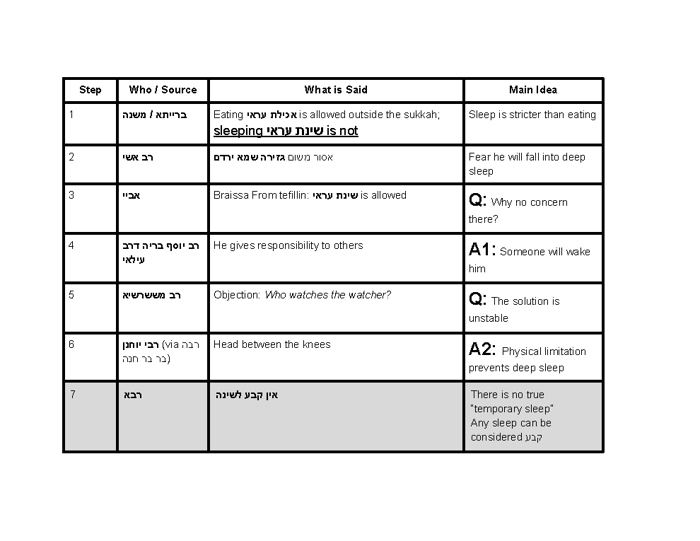
The shiur briefly covered the shiur of achilas arai: Rav Yosef says two or three beitzim, and Abaye says as much as a yeshiva student tastes before going in to the shiur. It then turned to the Baraisa that one may eat but not sleep casually outside the sukkah. Rav Ashi explains it as a gezeirah lest he fall into a deep sleep. Abaye challenges this from the Baraisa allowing sheinas arai in tefillin, and the Gemara gives three answers: moser sheinaso l'acherim (challenged as arvecha arva tzarich), head between his knees, and Rava's ein keva l'sheinah.
Step by step (shakla v’tarya)
- ChazarahYesterday we began the Gemara about sleeping. The Mishnah discusses only eating, not sleeping, but the Baraisa does discuss sleeping.
- The RebbiThere is a mashma from the Mishnah that sleeping outside the sukkah is not allowed at all, since otherwise the Mishnah would have told us one may sleep a little.
- GemaraLine 41: what is considered achilas arai? Rav Yosef says two or three beitzim.
- DechiyahAbaye objects that a person is often satisfied with that amount, which would make it a seudas keva.
- See the flow entry at t=71 for Abaye's own shiur.
- ShitahAbaye: achilas arai is the amount a yeshiva student tastes before he goes in to the shiur.
- RashiRashi does not read the word as eggs but as two or three bites. On the line across from line 27 there is an old French word meaning morsels, and the side note explains it as pieces and bites. On either reading, Abaye's shiur is less than Rav Yosef's.
- In answer to a question, the Rebbi said that beitzim refers to food made with flour, such as bread. Halacha l'maaseh one may eat as much chicken as he wants outside the sukkah; a seudah means eating with something like bread, wraps or cake.
- GemaraLine 46, the Baraisa: one may eat achilas arai outside the sukkah, but one may not sleep sheinas arai outside the sukkah. The Mishnah did not mention sleeping because it is never allowed.
- ShitahLine 48, Rav Ashi: a short nap should really be like a snack, but there is a gezeirah lest he fall into a deep sleep.
- KashaAbaye asks from a Baraisa in hilchos tefillin: a man may sleep sheinas arai in tefillin but not sheinas keva. The concern there is guf naki, i.e. passing gas while wearing tefillin.
- KashaLine 50, 'lichush shema yeradem': why are we not worried about a deep sleep there too? The two halachos are unrelated, but the contradiction stands: are we worried a person will doze off into a deep sleep or not?
- TeirutzRav Yosef brei d'Rav Ilai: the tefillin case is where he was moser sheinaso l'acherim, i.e. he told someone to wake him up. This is an ukimta.
- The RebbiOn this answer, the problem is the same in both places. Even in sukkah, if someone said he would sleep only 15 minutes and asked to be woken up, it would be allowed. The difference lies only in the circumstance.
- DechiyahRav Mesharshiya is maskif, a stronger kind of challenge: arvecha arva tzarich, your guarantor needs a guarantor. What if the one who is supposed to wake him also falls asleep?
- TeirutzLine 53, Rabbah bar bar Chana in the name of R' Yochanan: the case is where he rests his head between his knees. In that position he cannot fall into a deep sleep; the blood rushes to his head and he is forced to wake up.
- The RebbiThis is a separate ukimta, but not a whole new approach. The sleep problem of sukkah and of tefillin is still the same, namely dozing off into a deep sleep. The first two answers simply show how that problem is avoided.
- TeirutzRava: ein keva l'sheinah. We are not worried about dozing off at all. For tefillin one may nap with no precautions, since passing gas only happens in a deep sleep. For sukkah, even a small nap does the job, so it is not allowed outside the sukkah under any circumstance.
- RashiIn a lengthy Rashi: a person can doze off a little and that is enough for him. It is real sleep, so it is forbidden outside the sukkah.
- MaskanaThree answers in total. The first two place the difference in the circumstance (he did something to prevent deep sleep). Rava places it in the nature of a nap: tefillin is only a concern if he falls into a deep sleep, while in sukkah even a little nap counts as sleep.
- ChazarahReview from line 46 through Rava.
- The RebbiRava's answer explains the earlier observation that the Baraisa gives no shiur for sheinas arai. Rava's answer is therefore more meduyak.
Kashas
- Abaye asks Rav Ashi: if we fear a deep sleep in sukkah, why does the Baraisa permit sheinas arai in tefillin? Lichush shema yeradem.
- Rav Mesharshiya asks: arvecha arva tzarich. The one who is supposed to wake him may himself fall asleep.
Teirutzim
- Rav Yosef brei d'Rav Ilai: the tefillin case is where he was moser sheinaso l'acherim.
- Rabbah bar bar Chana in the name of R' Yochanan: the case is where he rests his head between his knees.
- Rava: ein keva l'sheinah. For tefillin there is no concern of dozing off, but for sukkah even a short nap is real sleep.
Rashi & Tosafos
- Rashi: Two or three is bites, not eggs. Rashi uses an old French word meaning morsels, explained on the side as pieces and bites.
- Rashi: A person can doze a little and that satisfies him, so it is real sleep and forbidden outside the sukkah. The Rebbi described this as a lengthy Rashi explaining Rava.
Mareh mekomos
- Baraisa in hilchos tefillin: a man may sleep sheinas arai in tefillin but not sheinas keva. Abaye uses it as the source of the contradiction.
The Rebbi’s chiddushim
- Mashma from the Mishnah's silence that sleeping outside the sukkah is never allowed.
- Achilas arai concerns food like bread or mezonos. Halacha l'maaseh, chicken may be eaten outside the sukkah without limit.
- According to the first answer, even in sukkah a short nap would be permitted if one asked someone to wake him.
- The first two answers share one framework (the concern is deep sleep). Rava's is a whole new approach.
- Ein keva l'sheinah is like a power nap: unlike eating, where a snack does not replace a meal, a short sleep gives a person what he needs. The Rebbi told a story of his Rebbe, who napped briefly in the car and woke up refreshed.
- Ein keva l'sheinah means there are no shiurim of arai and keva for sleep: whatever you slept gives you what you need.
- Rava's answer explains why no shiur is given for sheinas arai, and so it is more meduyak.
Unclear in recording
- Tosafos' view on the reading of beitzim and the size of the shiur (whether one mouthful equals one beitzah) is unclear in recording.
- Part of the opening-line discussion is unclear in recording.
- A comment about a sort of shiur for sleep (possibly half an hour, in connection with morning brachos) is unclear in recording.
- A student's comparison of arvecha arva tzarich to another case is unclear in recording.
- Whether Rashi explains that the waker falls asleep or forgets is unclear in recording.
Drafted from the recording of the shiur, for chazarah. Torah terms follow the Rebbi’s own words; anything that could not be made out is marked “unclear in recording”. Tap a time to hear that point. Corrections welcome.