Shiur summary (draft from the recording)
Sleeping Arai Outside the Sukkah and in Tefillin
ישן אדם בתפילין
Sukkah 26a · Wednesday, January 7, 2026
The sugya
The shiur reviewed the braisa that one may eat achilas arai outside the sukkah but may not sleep shinas arai outside it. It covered Rav Ashi's reason (gezeirah shema yeradem), Abaye's kasha from tefillin, the two teirutzim and the objection to the first, and Rava's shita of ein keva l'sheina with Rashi. The new Gemara of the day was the three conflicting braisos about sleeping in tefillin, which the Gemara reconciles by setting each one in a different case.
Step by step (shakla v’tarya)
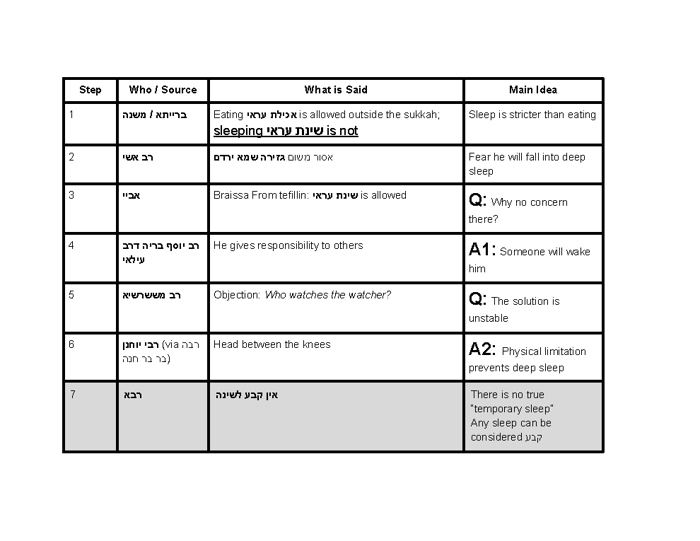
- GemaraBraisa: ochlin achilas arai chutz lasukkah, but ein yeshenim shinas arai chutz lasukkah. Main idea: sleep is stricter than eating.
- TeirutzRav Ashi gives the reason: gezeirah shema yeradem. We fear he will fall into a deep sleep. Once unconscious he cannot control himself, which is why sleep differs from eating.
- KashaAbaye asks from a braisa that yashen adam shinas arai b'tefillin but not shinas keva. Why is there no concern there of shema yeradem?
- TeirutzAnswer 1, Rav Yosef brei d'Rav Ilai: b'moser shinaso l'acherim. He taps the man next to him and says 'wake me up in 20 minutes.'
- DechiyahRav Mesharshiya objects (line 52): arvecha arva tzarich. Who guarantees the guarantor, or who wakes the waker? The solution is unstable because there is no guarantee the other man will actually wake him.
- TeirutzAnswer 2 (line 53), Rabbah bar bar Chana in the name of R' Yochanan: b'maniach rosho bein birkav. He sleeps in a physical position that prevents deep sleep, so he will wake up.
- ChazarahSteps one through three bring the contradiction. The following steps answer it in a very practical way.
- ShitahRava: ein keva l'sheina. There is no concept of keva by sleep, since a minute does it for you. The Rebbi acknowledged that reading the word 'keva' this way is a bit of a stretch.
- RashiRashi: there is no chiluk between keva and arai. A person does not set himself for sleeping; sometimes he dozes a little and that is enough for him. This is unlike a small bite of food, after which he knows he still needs more.
- RashiThe rest of Rashi: by tefillin the concern is passing gas, a physical thing that happens only once one is well into the sleep (he said about 30 minutes).
- The RebbiRava is not giving another practical answer. He concedes that someone will wake you, even with 700 guarantors, and says it is still sleep. The earlier answers missed the boat about what shinas arai is.
- The Rebbi stated that by tefillin there is a straight halacha: you may sleep a little but not a lot. The surrounding discussion is unclear in recording.
- GemaraThe Gemara pivots to tefillin and quotes three braisos with three different halachos. Braisa 1: yashen adam b'tefillin shinas arai but not shinas keva, the one Abaye brought.
- GemaraBraisa 2 (tanya idach): bein keva bein arai. Full permission to sleep.
- KashaBraisa 3: lo keva v'lo arai. This makes a three-way stira: one says sleep freely, one says no sleep at all, and the middle one compromises. How do we reconcile them?
- TeirutzLo kashya: the three answers are ha d'nakit lehu b'yadei, ha d'manchi b'reishei, and ha d'paris sudra alayhu.
- TeirutzHolding the tefillin in his hands: he may never sleep, because even a moment of sleep will make the tefillin fall. The biggest concern for tefillin is that they not fall.
- TeirutzResting on his head (and arm), the simple case of wearing them: he may doze, arai but not keva, because he might pass gas.
- TeirutzSpread a sudra over them: the tefillin are off and next to him, covered with a handkerchief or sheet. He may sleep all he wants.
- The RebbiChiddush of the third case: they wore tefillin all day back then. Someone taking them off briefly is not required to wrap them up and put them away in a closet. He may cover them, like covering a sefer Torah, and go to sleep.
- ChazarahChazara: wearing them means arai only; in his hand means never; covered next to him means always. Note that the answers do not go in the same order as the braisos.
Kashas
- Abaye: a braisa permits shinas arai in tefillin. Why do we not worry there about shema yeradem?
- Rav Mesharshiya on answer 1: arvecha arva tzarich. Who guarantees that the one assigned to wake him will do it?
- Three braisos on sleeping in tefillin contradict each other: arai only; keva and arai; neither keva nor arai.
Teirutzim
- Rav Ashi: sleep outside the sukkah is forbidden because of gezeirah shema yeradem.
- Rav Yosef brei d'Rav Ilai: by tefillin it is a case of moser shinaso l'acherim, someone else will wake him.
- Rabbah bar bar Chana in the name of R' Yochanan: he puts his head between his knees, a position that prevents deep sleep.
- Rava: ein keva l'sheina. Any sleep counts, so there is no allowance for arai sleep outside the sukkah.
- Holding the tefillin in his hand: never sleep.
- Wearing them on his head: arai but not keva.
- Next to him, covered with a sudra: may sleep even keva.
Rashi & Tosafos
- Rashi: On ein keva l'sheina (across from line 38): a person does not set himself to sleep; a little doze is enough for him, unlike a small bite of food after which he still needs more.
- Rashi: The concern by tefillin is passing gas, which happens only once one is well into the sleep.
Mareh mekomos
- The principle that the Torah was not given to malachei hashares. We do not inconvenience a person by making him wrap up and put away his tefillin every time he sleeps.
The Rebbi’s chiddushim
- Main idea of the braisa: sleep is stricter than eating, because in sleep one cannot control oneself.
- Yeradem means going down, sinking deeper into sleep.
- Arvecha arva tzarich framed as 'who watches the watcher, who wakes the waker.' Answer 1 is an unstable solution.
- Rava concedes the practical answers but says they miss what shinas arai is. Even with 700 guarantors, it is still sleep.
- A three-way stira is the only possible kind here: one says sleep freely, one says never, and the middle compromises. No one would say keva but not arai.
- In the hand case, the tefillin will fall if he dozes even for a second, like holding a hundred-dollar bill out the window to stay awake while driving.
- Covered tefillin are like a sefer Torah: it may not be left open, but rolled up with its cover on top is good enough.
Unclear in recording
- The part of Rashi about the sukkah and passing gas is only partly audible.
- The discussion with participants about tefillin according to Rava, about 8:14 to 10:28, is unclear in recording.
- A side discussion about where 'tanya idach' appeared earlier in Sukkah (someone said the first perek) was not resolved.
Drafted from the recording of the shiur, for chazarah. Torah terms follow the Rebbi’s own words; anything that could not be made out is marked “unclear in recording”. Tap a time to hear that point. Corrections welcome.