
Sleeping with Tefillin: Day, Night, Bachurim
The sugya
The shiur finishes the review of shinas arai with tefillin: 100 amos, R' Yaakov and Chachamim, Rav on not sleeping by day more than the sleep of a horse, and Rav Yosef's mussar to Abaye. It then learns the braisa of one who goes to sleep by day or night with tefillin. R' Nassan gives a choice by day but requires removal at night. R' Yosi says yeladim must always remove them. The Gemara asks whether R' Yosi holds a baal keri may not wear tefillin, and Abaye answers that the concern is practical: married bachurim may come to tashmish. The shiur ends with the braisa that one who forgot and had tashmish in tefillin must wash his hands before touching them, because the hands are askaniyos.
Step by step (shakla v’tarya)
- ChazarahReview from line 55, still in the sugya of shinas arai: sleeping with tefillin on. It started from whether one may sleep shinas arai outside the sukkah.
- GemaraRami bar Yechezkel: shinas arai is the time it takes to walk 100 amos.
- GemaraBraisa: one who sleeps in tefillin and sees keri (a sign he got into a deeper sleep) holds the retzua when removing them, not the katzitza (the box). This is the view of R' Yaakov.
- MachlokesChachamim: this case will not arise, because a person may only sleep shinas arai in tefillin to begin with, and shinas arai is the time to walk 100 amos.
- GemaraRav: a person may not sleep by day more than the sleep of a horse, a very small nap. That is 60 breaths.
- GemaraAbaye: the sleep of Mar (Rabbah bar Nachmani) was like Rav's. Rav's was like Rebbi's, and so on down to the sleep of a horse, which is 60 breaths.
- GemaraAbaye himself would nap for the time it takes to go from Pumbedisa to Bei Kuvei. Rav Yosef gave him mussar with the pasuk 'ad masai atzel tishkav, masai takum mishnasecha'.
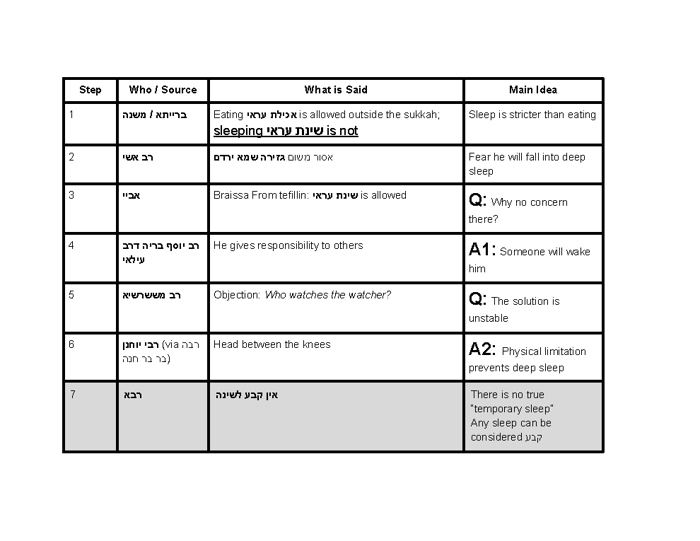
- Framing: from here to the Mishnah the Gemaras are not hard, but they are a series of separate statements rather than one flow reaching a conclusion. The Rebbi prepared a chart and hopes to reach a conclusion at the Mishnah.
- GemaraLine 11, braisa: one who goes to sleep by day may remove his tefillin if he wants, or leave them on if he wants. In those times a person wore tefillin all day, like tzitzis.
- The RebbiDiyuk in the word: maniach with a patach means leave them on, not put them on.
- The RebbiBy day we trust him not to get into such a deep sleep. There is no mention here of putting his head between his knees, a condition seen last week.
- ShitahAt night he must remove them and may not leave them on. These are the words of R' Nassan.
- The RebbiThe two concerns seen so far are passing gas and seeing keri. Night is when the body gets into a deeper sleep.
- ShitahR' Yosi: yeladim always remove their tefillin when going to sleep and may not leave them on, because they are regilin b'tumah, i.e. more likely to see keri.
- RashiRashi: yeladim means bachurim. Rashi also explains that hirhur is common among them, unlike more mature men.
- The RebbiAccording to R' Yosi, whether by day or at night, a bachur does not go to sleep with his tefillin.
- KashaLine 15, leima: if R' Yosi is concerned about keri, does he hold that a baal keri is assur to put on tefillin?
- The RebbiThe question was not asked last week on R' Yaakov's braisa (remove by the retzua, not the katzitza). Here R' Yosi's statement gives pause. It has large ramifications, like Takanas Ezra: every time a person sees keri he would need the mikveh before putting on tefillin again.
- TeirutzAbaye: R' Yosi did not mean that. He is speaking of yeladim whose wives are with them. The concern is shema yavo'u lidei hergel davar: they are used to tashmish more than older men.
- The RebbiThis is a very practical concern, not a dream and keri. That is why, even for a nap by day, bachurim may not sleep in tefillin, while others who wore tefillin all day could nap in them.
- GemaraLine 17, braisa: if one forgot and had tashmish with his tefillin on, he may not hold either the retzua or the katzitza until he washes his hands. Then he removes them.
- GemaraThe reason is that the hands are askaniyos, busy: they may have touched devarim temei'im, even zera.
- MaskanaIn the chazara: from R' Yosi, don't infer any halacha about a baal keri wearing tefillin.
- The RebbiDistinction from last week's Gemara: here the issue is only that his hands touch the tefillin when removing them. If he wants to put the tefillin back on, he must first wash off the zera.
Kashas
- Leima: does R' Yosi hold that a baal keri is assur to put on tefillin?
Teirutzim
- Abaye: R' Yosi speaks of yeladim whose wives are with them. The concern is that they may come to tashmish (hergel davar) while wearing tefillin, not a din about a baal keri.
Rashi & Tosafos
- Rashi: Yeladim means bachurim.
- Rashi: They are regilin b'tumah because hirhur is common among them.
- Rashi: On the leima: the emphasis is that we would then have to pasken like R' Yosi. Partly unclear in recording.
Mareh mekomos
- Pasuk 'ad masai atzel tishkav, masai takum mishnasecha', applied by Rav Yosef to Abaye's napping.
- Mesilas Yesharim, perek of zerizus: the Rebbi thinks this pasuk is brought there, that we are not here to sleep.
- Takanas Ezra (mikveh after keri): cited to show the ramifications if a baal keri could not wear tefillin.
- Shnayim ochazin b'talis: cited to explain the word ocheiz as grabbing.
The Rebbi’s chiddushim
- This section is a collection of separate statements (napping, being woken, sleeping with tefillin, seeing keri) rather than one shakla v'tarya. A chart will organize the parameters.
- Maniach with a patach means leaving the tefillin on, not putting them on.
- R' Nassan distinguishes day and night because night is when the body falls into a deeper sleep.
- Abaye turns R' Yosi's concern from a dream and keri into a practical worry about newlyweds with their wives.
- Yitol yadav and yitlem share the same shoresh: one means wash your hands, the other take off the tefillin.
- This is one of the reasons we wash our hands in the morning after sleeping: either a ruach rests on a person at night, or his hands may have touched devarim temei'im while sleeping.
- Netilas yadayim is called netilah, taking, like netilas lulav. Perhaps because you take your hands to the water.
Unclear in recording
- A side remark that yeladim could mean little kids, based on the age at which children wore tefillin in those days. Unclear in recording.
- An extended exchange with talmidim about why the kedusha is in the box, being a baal keri versus needing the mikveh, and how R' Yosi's statement relates to it. Largely unclear in recording.
- A remark about removing by the straps and washing off zera. Unclear in recording.
Drafted from the recording of the shiur, for chazarah. Torah terms follow the Rebbi’s own words; anything that could not be made out is marked “unclear in recording”. Tap a time to hear that point. Corrections welcome.