Tefillin while sleeping; R' Tzadok eating outside sukkah
The sugya
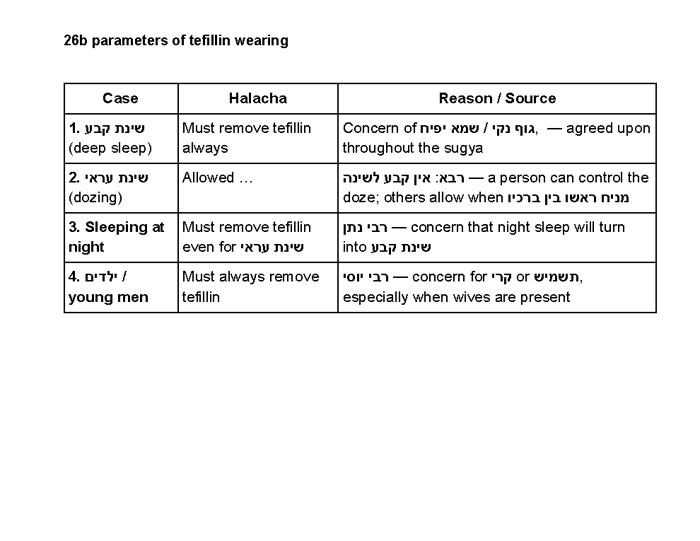
The shiur finished the braisos about tefillin and sleep: day versus night, R' Yosi on young men, and someone who had tashmish while wearing tefillin. It then learned the Mishnah of RYBZ and Rabban Gamliel, who had even small foods brought to the sukkah, and R' Tzadok, who ate less than a kebeitzah outside the sukkah. The Gemara asks 'maaseh l'stor' and answers 'chasurei mechsera': if one wants to be machmir he may, and there is no yuhara. It then asks from R' Tzadok on Rav Yosef and Abaye, and answers that the inference from less than a kebeitzah refers only to netilah and bracha, not to sukkah.
Step by step (shakla v’tarya)
- GemaraTanu Rabbanan: someone who goes to sleep by day may take off his tefillin or leave them on. We don't suspect he will fall into a deep sleep.
- GemaraAt night he must take them off and may not leave them on. These are the words of R' Nasan.
- ShitahR' Yosi: young men always take them off whenever they go to sleep and never leave them on, because they are more susceptible to tumah.
- KashaLine 15: shall we say R' Yosi holds a baal keri is assur to put on tefillin?
- TeirutzAbaye: we are dealing with young men whose wives are with them. Maybe they will forget they are wearing tefillin and come to tashmish.
- GemaraLine 17, Tanu Rabbanan: if he forgot and had tashmish while wearing tefillin, he may not hold either the retzuah or the box until he washes his hands. Only then may he take them off, because hands are busy (askaniyos).
- The RebbiContrast with the case learned last week. There he was not with his wife but fell into a deep sleep and saw keri, and he was allowed to take hold of the retzuah.
- ChazarahThis completes the sugya of shinas arai and shinas keva as it applies to sukkah, which was summarized in a chart the day before.
- MishnahThe new Mishnah continues the last case of the previous Mishnah, 'ochlin v'shosin arai chutz lasukkah', and expands on eating temporarily outside the sukkah.
- MishnahMaaseh: they brought RYBZ a tavshil just to taste. They brought Rabban Gamliel two dates (kosavos) and a pitcher (dli) of water. Both said: bring them up to the sukkah.
- MishnahWhen they gave R' Tzadok less than a kebeitzah, he took it with a napkin, ate it outside the sukkah and did not make a bracha acharonah.
- The RebbiThree points about R' Tzadok. He did not wash, though in those days they were careful to wash because of tumah. He ate outside the sukkah because it was less than a kebeitzah. He did not bench because it was not the shiur.
- ChazarahRYBZ and Rabban Gamliel were machmir to bring even a small amount of food to the sukkah. R' Tzadok was fine not going to the sukkah.
- KashaGemara: maaseh l'stor? The Mishnah just ended that one may eat arai outside the sukkah, yet it brings a story of Tannaim who went to the sukkah.
- TeirutzLine 26: chasurei mechsera v'hachi katani. If someone comes to be machmir on himself he may, and there is no issue of yuhara. Then 'u'maaseh nami': the Mishnah is re-quoted.
- The RebbiYuhara is haughtiness. In certain halachos a person may not be machmir because he looks like he is showing off as a tzaddik. Here we are told such a concern does not apply.
- The RebbiAn idea shown to the Rebbi: whenever the Gemara says chasurei mechsera, words were left out because mishnayos were learned with a tune, and words that broke the rhythm were dropped.
- KashaThe Gemara infers: R' Tzadok ate outside only because it was less than a kebeitzah. So a kebeitzah would need a sukkah?
- ChazarahReview from last week. Rav Yosef said achilas arai is two or three eggs. Abaye said that is a full meal and gave the measure as one egg.
- KashaLeima tehevei tiyuvtei: shall we say this is a question on Rav Yosef and Abaye? It is a strong question on Rav Yosef and a smaller one on Abaye, but still a question.
- TeirutzDilma: less than a kebeitzah needs no netilah or bracha, but a kebeitzah does need netilah and bracha. Sukkah is not part of the inference.
- ChazarahQuick review of the Mishnah and Gemara with punctuation.
- The RebbiSharpening of the kasha: R' Tzadok is a Tanna while Rav Yosef and Abaye are Amoraim, so how could they say not like this Tanna? Hence the Gemara answers: don't infer that much and drop the sukkah piece.
- RashiThe answer needs the small Rashi right before the next Mishnah: but regarding sukkah, even a kebeitzah also does not require it.
Kashas
- Does R' Yosi hold a baal keri is assur to put on tefillin?
- Maaseh l'stor: the Mishnah allows eating arai outside the sukkah, yet it brings a story of Tannaim who insisted on the sukkah.
- From R' Tzadok, a kebeitzah would need a sukkah. Is this a tiyuvta on Rav Yosef (two or three eggs) and Abaye (one egg)?
Teirutzim
- Abaye: it refers to young men whose wives are with them, lest they forget the tefillin and come to tashmish.
- Chasurei mechsera: if one wants to be machmir he may, and there is no yuhara. The story illustrates this.
- The inference from less than a kebeitzah refers only to netilah and bracha. For sukkah even a kebeitzah is not needed.
Rashi & Tosafos
- Rashi: The small Rashi just before the next Mishnah: regarding sukkah, even a kebeitzah also does not require it.
Mareh mekomos
- Pasuk v'achalta v'savata u'beirachta: benching requires eating and being satisfied, explaining why R' Tzadok did not bench on less than a kebeitzah.
- Earlier Gemara: Rav Yosef (two or three eggs) and Abaye (one egg) on the shiur of achilas arai outside the sukkah.
The Rebbi’s chiddushim
- The case of tashmish while wearing tefillin requires washing before touching even the retzuah. This differs from last week's case of seeing keri in a deep sleep, where taking hold of the retzuah was allowed.
- The Mishnah is really a continuation of 'ochlin v'shosin arai chutz lasukkah'. The breaks between mishnayos can differ, as one sees for example in Kehati.
- 'To taste the tavshil' means a real small taste, so it was certainly not a lot of food.
- Nowadays we pasken that benching applies to a kezayis, but R' Tzadok held the opinion that it requires a kebeitzah.
- The practice of holding bread with a napkin when one has not washed comes from this Mishnah.
- Yuhara: some halachos forbid being machmir because it looks like showing off as a tzaddik. Our Mishnah teaches that eating small amounts in the sukkah is not such a case.
- Chasurei mechsera reflects that mishnayos were learned with a tune, and words that broke the rhythm were left out.
- The kasha is sharpened because R' Tzadok is a Tanna and Rav Yosef and Abaye are Amoraim.
Unclear in recording
- The opening words naming the daf and amud are unclear in recording; only 'line 11' is clear.
- A remark about a halacha of washing off the keri is unclear in recording.
- A side discussion about why they said 'bring it up' to the sukkah (sukkah on the roof, or food brought to his room) is unclear in recording.
- A back-and-forth with talmidim about what the napkin teaches regarding washing is unclear in recording.
- The example of another halacha where yuhara applies is unclear in recording.
- Who showed the Rebbi the chasurei mechsera explanation, and the source, are unclear in recording. He said he forgot where it is.
- A talmid's question, why then bring it in the Mishnah, was left for chazarah.
- The closing exchange with talmidim is unclear in recording.
Drafted from the recording of the shiur, for chazarah. Torah terms follow the Rebbi’s own words; anything that could not be made out is marked “unclear in recording”. Tap a time to hear that point. Corrections welcome.