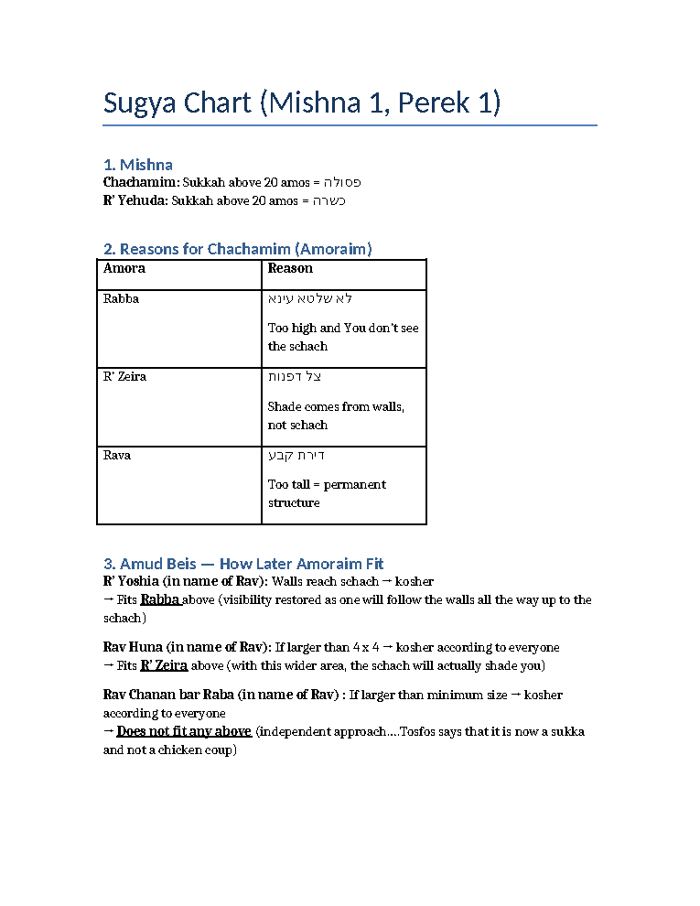
Sources for the pesul of a sukkah above 20 amos
The sugya
The shiur opened with a review of the Mishnah and of yesterday's Gemara: why the sukkah Mishnah says 'pasul' while the parallel mavui Mishnah gives a fix. It then learned the sources for the pesul of a sukkah higher than 20 amos. Rabbah learns it from 'lemaan yeidu doroseichem', and Rabbi Zeira learns it from the pasuk in Yeshayah 'v'sukkah tihyeh l'tzel yomam'. Abaye asks on Rabbi Zeira from a sukkah in Ashtaros Karnayim and is answered; the chabura discussed the answer at length, and the shiur ended with a quick review of both reasons.
Step by step (shakla v’tarya)
- MishnahMishnah: a sukkah higher than 20 amos is pasul, and Rebbi Yehuda says it is kosher. A sukkah not 10 tefachim high, without 3 walls, or with more sun than shade is pasul.
- ChazarahA similar Mishnah about a mavui: if the marker is higher than 20 amos it must be lowered, and Rebbi Yehuda says it need not be. It is the same machlokes, so why does the sukkah Mishnah say 'pasul' while the mavui Mishnah gives a fix?
- ChazarahAnswer one: sukkah is d'oraisa, so the Mishnah says flat out pasul. Mavui is d'rabbanan, so it gives an eitzah: fix it.
- ChazarahAnswer two: even by a d'oraisa one could teach a fix. But sukkah has many dinim (three walls, more shade than sun, etc.), so it says pasul in a final, definitive way (posik v'tani). Mavui has few conditions, since its whole din is just to have something recognizable, so it teaches the fix.
- Today's plan: to see two of the three reasons the Gemara gives for the pesul of higher than 20 amos. They are totally different reasons and will be discussed over the next few amudim.
- ShitahRabbah: the pasuk 'lemaan yeidu doroseichem ki vasukkos hoshavti es Bnei Yisrael'. We sit in the sukkah so our children should know that Hashem settled us in sukkos when we traveled in the midbar.
- ShitahRabbah reads 'yeidu' literally. Up to 20 amos a person knows he is living in a sukkah. Above 20 amos he does not know, because 'lo shalta bah eina': the eye does not take it in.
- ShitahRabbi Zeira learns it from a pasuk in Yeshayah, 'v'sukkah tihyeh l'tzel yomam mechorev'. The function of a sukkah, meaning the schach, is to give shade.
- ShitahUp to 20 amos a person sits in the shade of the sukkah. Above 20 amos he sits not in the shade of the sukkah but in the shade of the walls.
- KashaAbaye asks on Rabbi Zeira (this is not a separate reason): if so, a sukkah made in Ashtaros Karnayim should also not be a sukkah, since there the shade comes from the surroundings.
- TeirutzRabbi Zeira answers: there, if you remove Ashtaros Karnayim, there is shade of the sukkah. Here, if you remove the walls, there is no shade of the sukkah.
- The RebbiThe Rebbi's framing: the sukkah must itself be capable of giving shade from the schach. When the schach is too high, the sun comes in at angles and the schach does nothing, even if there were no walls.
- The RebbiIn discussion with the chabura: the pesul concerns the height of the schach, not the height of a wall. So a house, or even a very tall building, can serve as a wall as long as the schach is under 20 amos.
- ChazarahQuick review of Rabbah's and Rabbi Zeira's reasons, and of Abaye's kasha.
Kashas
- Why does the Mishnah about sukkah say 'pasul' while the Mishnah about mavui gives a fix (lower it), if both are the same?
- Abaye on Rabbi Zeira: according to you, a sukkah made in Ashtaros Karnayim, where the surroundings give shade, should also not be a sukkah.
Teirutzim
- Sukkah is d'oraisa, so the Mishnah says pasul. Mavui is d'rabbanan, so it gives a fix.
- Sukkah has many dinim, so the Mishnah states pasul definitively. Mavui has few conditions, so it teaches the fix.
- In Ashtaros Karnayim, remove the mountains and there is still shade of the sukkah. Here, remove the walls and there is no shade of the sukkah.
Mareh mekomos
- Pasuk 'lemaan yeidu doroseichem ki vasukkos hoshavti es Bnei Yisrael': Rabbah's source for the 20 amos pesul.
- Pasuk in Yeshayah 'v'sukkah tihyeh l'tzel yomam mechorev', a pasuk about the times of Moshiach: Rabbi Zeira's source.
The Rebbi’s chiddushim
- Simply, 'lemaan yeidu' is about passing emunah in Hashem to our children. But read literally, it also teaches a halacha: only up to 20 amos does a person know he is in a sukkah.
- 'Lo shalta bah eina' is like walking into a huge atrium: you don't notice the ceiling at all, or even whether there is one. The eye does not go up there.
- For scale, 20 amos is about 40 feet, roughly four basketball hoops high: pretty tall.
- In Rabbi Zeira's pasuk, 'sukkah' means the schach. The essence of a sukkah is the shade.
- Ashtaros Karnayim is a place between two mountains, like between two horns (karnayim), so it is shaded by the geography, like the bottom of the Grand Canyon.
- Rabbi Zeira's answer means: don't take 'shade of the sukkah' literally. The sukkah must be worthy of giving shade from the schach. If the schach is too high, the sun comes in at angles from all around, like a canopy set too high, so the schach does nothing even without walls.
- What matters is the height of the schach. A wall may be higher than 20 amos (the 'fourth wall could be the Freedom Tower') as long as the schach is under 20 amos.
Unclear in recording
- A reference to 'different reasonings', apparently that Tosafos brings two and Rashi brings one; what they refer to is unclear in recording.
- A remark about whether the sukkos in the midbar were actual sukkos or ananei hakavod; only that it was a kindness Hashem did for Klal Yisrael is clear.
- Location of Ashtaros Karnayim ('right on the side of the Yom-ar'): unclear in recording.
- Parts of the discussion with the chabura about walls higher or lower than the schach: unclear in recording.
Drafted from the recording of the shiur, for chazarah. Torah terms follow the Rebbi’s own words; anything that could not be made out is marked “unclear in recording”. Tap a time to hear that point. Corrections welcome.