Shiur summary (draft from the recording)
Three sources for the 20-amah limit
מנא הני מילי
Sukkah 2a · from line 17 · Friday, March 20, 2026
The sugya
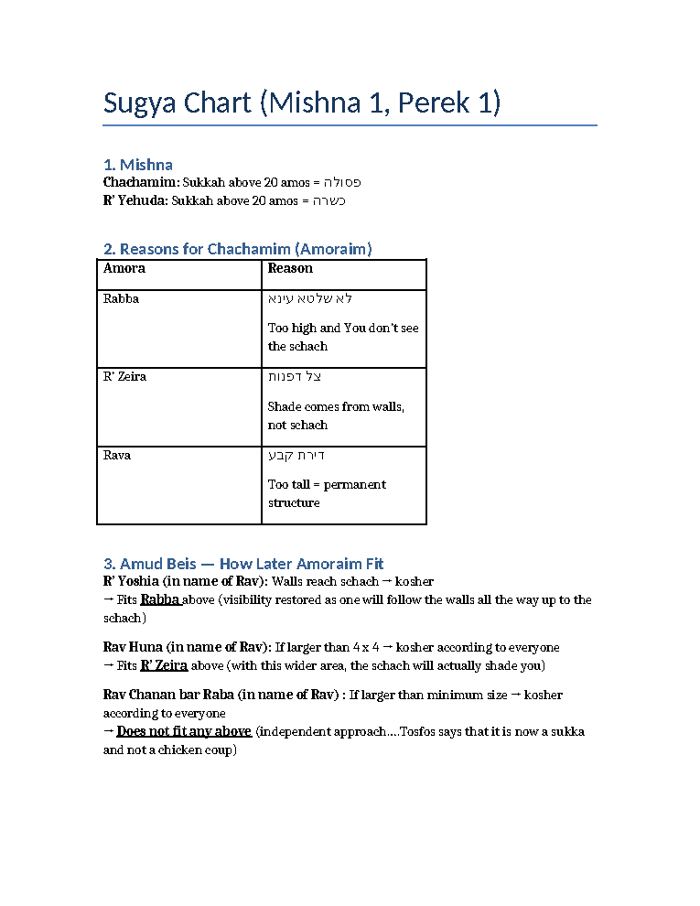
The Gemara gives three sources for why a sukkah higher than 20 amos is pasul. The Rebbi reviewed Rabbah's and R' Zeira's reasons, including Abaye's kasha on R' Zeira from Ashteros Karnayim. He then learned Rava's reason: for seven days one must leave a dirat keva and live in a dirat arai. He covered Abaye's kasha from iron walls and Rava's teirutz that it depends on whether the sukkah could be built arai, not on how it was actually built, then went over Rava a second time.
Step by step (shakla v’tarya)
- ChazarahYesterday we began the reasons why a sukkah may not be higher than 20 amos: Rabbah, and R' Zeira with Abaye's kasha on him. Today we learn Rava.
- ShitahRabbah learns it from the pasuk 'l'maan yeidu doroseichem'. Up to 20 amos a person knows he is living in a sukkah. Above 20 amos he does not, because his eye does not rest on it (לא שלטא בה עינא).
- The RebbiPlaceholder removed
- ShitahR' Zeira (line 17) learns it from 'v'sukkah tihyeh l'tzel yomam meichorev'. The Rebbi noted that the pasuk continues (shelter from rain, etc.), but the relevant part is the shade.
- The RebbiThese pesukim do not speak directly about height. They tell us the function of a sukkah, and from that it follows that it cannot be more than 20 amos.
- ShitahUp to 20 amos a person sits in the shade of the sukkah. Above 20 amos he sits in the shade of the walls, not the schach.
- KashaAbaye: if so, someone who builds his sukkah in Ashteros Karnayim is not shaded by the sukkah. Would that also not be a sukkah?
- TeirutzR' Zeira: there, if you remove Ashteros Karnayim, there is still shade of the sukkah. Here, if you remove the walls, there is no shade of the sukkah.
- ShitahRava learns it from 'basukkos teishvu shivas yamim'. The Rebbi noted this pasuk comes right before 'l'maan yeidu doroseichem'.
- GemaraThe Torah says: all seven days, leave your permanent dwelling (dirat keva) and live in a temporary dwelling (dirat arai).
- GemaraUp to 20 amos a person can make his dwelling a dirat arai. The Rebbi explained this as an engineering fact about how much foundation the structure needs.
- GemaraAbove 20 amos a person cannot make it arai; it must be a dirat keva.
- KashaAbaye: if so, someone who made walls of iron and put schach on them has a permanent structure. Would that also not be a sukkah?
- TeirutzRava: this is what I meant. Up to 20 amos, where a person can make it arai, he is yotzei even if he makes it keva. Above 20 amos, where a person makes it keva, he is not yotzei even if he makes it arai.
- The RebbiIt depends on the ability to make it arai, not on what was actually built. Above 20 amos, even if he got lucky on a calm day and put up something temporary, he is not yotzei.
- The RebbiThe three reasons have nothing to do with one another: Rabbah, that you must see you are in a sukkah; R' Zeira, that you must be shaded by the sukkah; Rava, that since you leave keva for seven days, the sukkah must be arai-worthy.
- We will soon take a tally of the Amoraim who hold sukkah dirat keva and those who hold dirat arai. Rava sounds like he is on the side of dirat arai.
- The RebbiIn answer to a question about why we lower it: this reason is entirely practical. Anything higher involves much more work and a real foundation, so it is not temporary.
- The RebbiEverything is relative: the sukkah must be temporary but stable. A person's house is expected to last more than seven days.
- ChazarahSecond pass through Rava. The focus is on 'shivas yamim': for these seven days leave your permanent dwelling for a temporary one. Above 20 amos the structure must be built to last.
- ChazarahAbaye's kasha from iron walls and Rava's teirutz again. Below 20 amos he did not go against the Torah's keva/arai requirement, because he could have built it temporary. Above 20 amos, even if he builds it unsecured or out of cardboard, he is not yotzei, since such a height requires a permanent building.
Kashas
- Abaye on R' Zeira: a sukkah in Ashteros Karnayim is not shaded by the sukkah. Is it not a sukkah?
- Abaye on Rava: iron walls with schach on them are keva. Is that not a sukkah?
Teirutzim
- Remove Ashteros Karnayim and there is still shade of the sukkah. Remove the walls of a sukkah above 20 amos and there is no shade of the sukkah.
- Up to 20 amos, where it can be arai, it is kosher even if made keva. Above 20 amos, where it must be keva, it is pasul even if made arai.
Rashi & Tosafos
- Rashi: Without the walls, the sun comes in at the angles under the high schach, so there is no shade from the sukkah.
- Rashi: Above 20 amos one must make sure the foundation is a real foundation, perhaps digging, like a very tall tree with deep roots. Therefore it is a dirat keva.
Mareh mekomos
- Vayikra 23:43, 'l'maan yeidu doroseichem': Rabbah's source.
- Yeshayahu 4:6, 'v'sukkah tihyeh l'tzel yomam meichorev': R' Zeira's source.
- Vayikra 23:42, 'basukkos teishvu shivas yamim': Rava's source.
The Rebbi’s chiddushim
- Above 20 amos a person notices the walls, not the sukkah; it feels like a hotel or a big building.
- The pesukim are hints to the function of the sukkah, and the 20-amah limit follows from that function.
- Mashal: a sukkah hung a million feet up gives no shade, because the sun gets in underneath.
- Rava's arai/keva distinction is an engineering reality: how much foundation and rooting the structure needs.
- Rava's criterion is the ability to make it arai, not what was actually built.
- The three reasons are completely independent of one another.
- A sukkah must be temporary but stable.
Unclear in recording
- His description of the place Ashteros Karnayim.
- A question raised about the number 20 being used as an example.
- Whether schach can be placed directly on the iron walls or needs something in between was raised but not resolved.
- Discussion with the chabura about the first opinion and about Abaye's cases versus Rava's reasons.
- In the second pass he gives Rava as line 25; earlier he said line 27.
Drafted from the recording of the shiur, for chazarah. Torah terms follow the Rebbi’s own words; anything that could not be made out is marked “unclear in recording”. Tap a time to hear that point. Corrections welcome.