Shiur summary (draft from the recording)
Braisa of Queen Helene's tall sukkah
מעשה בהילני המלכה
Sukkah 2b · Monday, April 13, 2026
The sugya
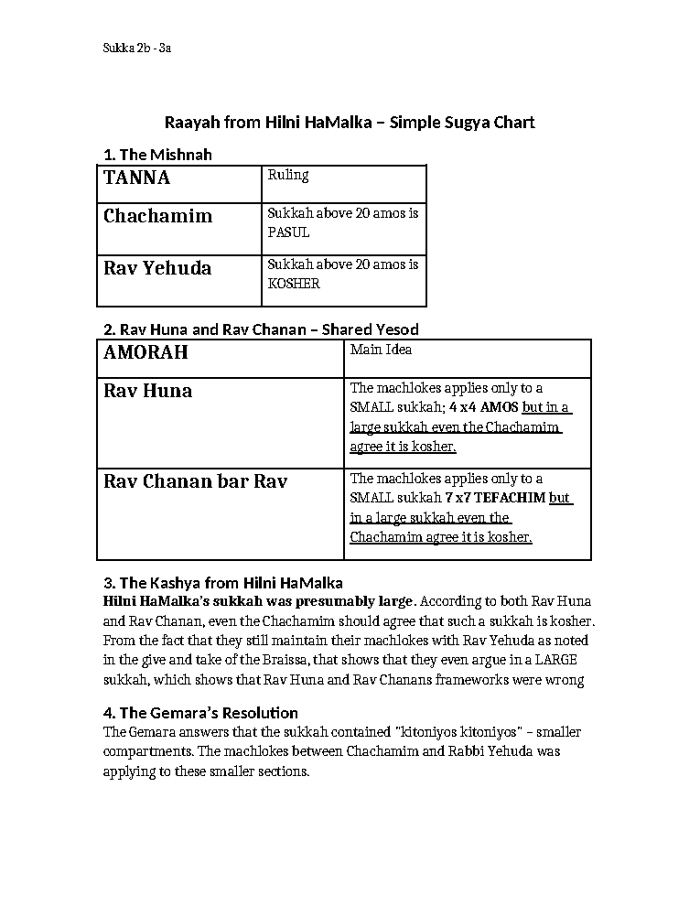
The Gemara brings a braisa (introduced with Meisivi) on the machlokes of the Chachamim and R' Yehuda about a sukkah higher than 20 amos. R' Yehuda brings a proof from Queen Helene's tall sukkah, and the Chachamim and R' Yehuda go back and forth. The Gemara then asks why R' Yehuda needed to add that she did everything al pi Chachamim. The Rebbi stopped before the actual kasha, which he said will come tomorrow.
Step by step (shakla v’tarya)
- GemaraMeisivi: a kasha from a braisa closely connected to our Mishnah. The braisa says a sukkah higher than 20 amos is pasul, and R' Yehuda is machshir up to 40 or 50 amos.
- The Rebbi noted that this sounds slightly different from the Mishnah, since R' Yehuda seems to have a limit as well. We will see later what 40 or 50 means, but the kasha does not come from this point. Basically it is the same machlokes as the Mishnah.
- A participant suggested the height limit depends on how wide the sukkah is. The Rebbi answered that this never made a difference.
- Ra'ayahR' Yehuda cites a maaseh: Queen Helene in Lod had a sukkah higher than 20 amos. The Zekeinim would come in and out and said nothing to her. R' Yehuda proves from this that such a sukkah is kosher.
- DechiyahThe Chachamim answer: is that a proof? She was a woman and patur from sukkah, so there was no reason to tell her anything.
- KashaR' Yehuda answers with a double point. First, she had seven sons. Second, everything she did was al pi Chachamim, so she would not have built an improper sukkah.
- KashaThe Gemara asks why the braisa needs the second point, that all her actions were al pi Chachamim.
- TeirutzR' Yehuda is anticipating the Chachamim's replies. If you say the sons were ketanim and ketanim are patur, then with seven sons it is impossible that none was a katan she'eino tzarich l'imo. If you say such a katan is only chayav mid'rabbanan and she did not pay attention to d'rabbanan, come hear: all her actions were al pi Chachamim.
- ChazarahSummary: R' Yehuda holds she sat in a sukkah much higher than 20 amos, so it is kosher. The machlokes stays as in the Mishnah, and neither side gives in.
- The RebbiPreview: something learned from this braisa will be a kasha on Amoraim who limit the machlokes to a narrow or small sukkah. A queen would not sit in a narrow sukkah, yet they still argue. The kasha itself will be tomorrow.
Kashas
- R' Yehuda against the Chachamim: she had seven sons, and she did everything al pi Chachamim.
- Why does the braisa need the additional point that all her actions were al pi Chachamim?
Teirutzim
- Each part answers a possible reply of the Chachamim. One of seven sons must have been a katan she'eino tzarich l'imo. If such a katan is only chayav mid'rabbanan, she still did everything al pi Chachamim.
Mareh mekomos
- Braisa: higher than 20 amos is pasul; R' Yehuda is machshir up to 40 or 50 amos. Also brings the maaseh of Queen Helene in Lod.
The Rebbi’s chiddushim
- R' Yehuda in the braisa seems to have his own upper limit, unlike the Mishnah, but this is not the point of the kasha.
- R' Yehuda's words are framed as building a defense ahead of time, dismissing each of the Chachamim's possible arguments.
- The kasha to come: a queen sits in a beautiful, spacious sukkah, so the braisa's machlokes cannot be limited to a narrow sukkah.
- The Rebbi described Helene as a Jewish queen who donated to the Beis HaMikdash, and noted that Lod is near the airport.
Unclear in recording
- A remark about a lashon given originally, possibly attributed to Rav Ashi, is unclear in recording.
- The name of Helene's son is unclear in recording.
- A reference to something learned recently about a sukkah for a baby is unclear in recording.
- A participant's comment about the women and the chinuch point, and the Rebbi's reply, are unclear in recording.
- The end of the shiur, from about 15:15 onward, could not be made out.
Drafted from the recording of the shiur, for chazarah. Torah terms follow the Rebbi’s own words; anything that could not be made out is marked “unclear in recording”. Tap a time to hear that point. Corrections welcome.