
Queen Helene's Sukkah and the Kitoniyos Answer
The sugya
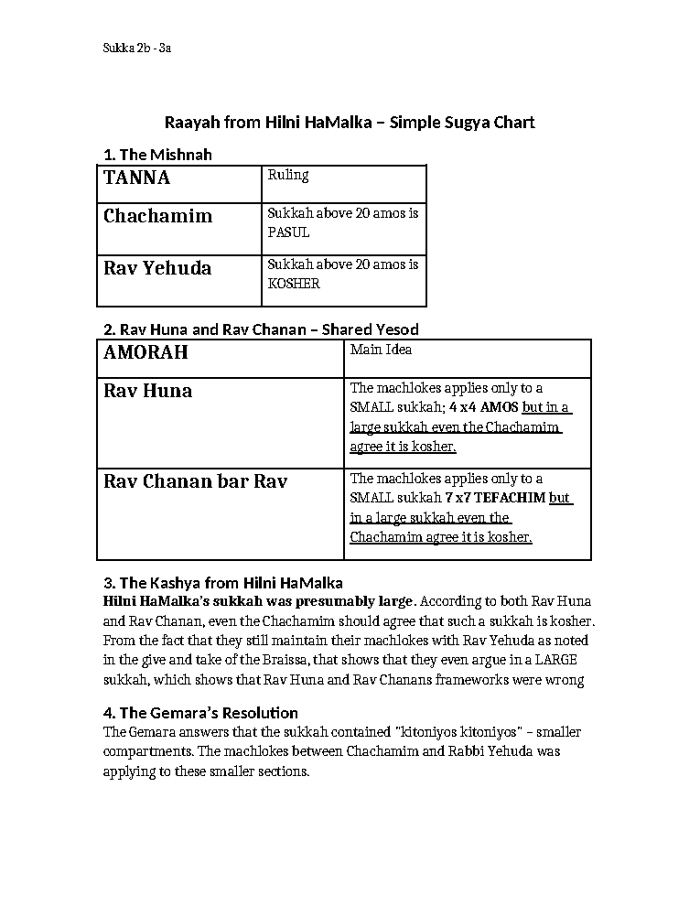
The Gemara tests the three versions of the machlokes between Rabanan and R' Yehuda (20 amos) against R' Yehuda's raya from Queen Helene's tall sukkah. Saying the machlokes is about walls that don't reach the schach fits her sukkah well. But the versions of Rav Huna and Rav Chanan bar Rabbah, which limit the machlokes to a small sukkah, seem pushed out, since a queen would not sit in a small sukkah. Rabbah bar Rav Ada answers that her sukkah was made of many cubicles; Rav Ashi sharpens this to one cubicle inside a big sukkah. The shiur explains how Rabanan and R' Yehuda each read the story, and ends with how Rashi fits the answer to Rav Chanan bar Rabbah.
Step by step (shakla v’tarya)
- ChazarahRabanan and R' Yehuda argue again, now trying to bring a raya. R' Yehuda brings a raya from Helene HaMalka: the elders said nothing to her, and her sukkah was tall.
- Our Mishnah gave a general machlokes about anyone who builds a sukkah over 20 amos. Here the machlokes is framed around her sukkah, so the Gemara will try to squeeze out two of the meimros on this amud.
- GemaraB'shlama l'man d'amar the machlokes is only when the walls don't reach the schach: it is the way of a queen to sit in such a sukkah because of the air. Helene could well have had a beautiful, very tall sukkah whose walls did not reach the schach.
- (Line 51 is where the reading began.)
- KashaBut l'man d'amar the machlokes is about a small sukkah: is it the way of a queen to sit in a sukkah ketana? The question is rhetorical, since she obviously had a big sukkah. This should squeeze out Rav Huna and Rav Chanan bar Rabbah. (This kasha was learned yesterday.)
- TeirutzRabbah bar Rav Ada answers: lo nitzracha ela l'sukkah ha'asuyah kitoniyos kitoniyos. Her sukkah was tall and very expansive, but it was divided into small cubicles. Each cubicle was less than 4 by 4 amos, or 7 by 7 tefachim, depending on which shita.
- KashaLine 4: is it the way of a queen to sit in a sukkah made of kitoniyos kitoniyos, a huge sukkah all chopped into tiny compartments?
- TeirutzRav Ashi: lo nitzracha ela l'kitoniyos sheba. The sukkah was not chopped into many cubicles. It was one big open sukkah with some sub-rooms (a jut-out), and those sub-rooms were what Rabanan and R' Yehuda argued about.
- The RebbiRead alone, the raya looks one-sided. 'She was a woman' is answered with 'but she had sons,' so what is the other side? Finishing the sugya makes it understandable.
- ShitahRabanan held that her sons sat in the proper big sukkah (sukkah me'alya) and she sat in the kitonis. Everyone sat in the big sukkah, she was a woman off in her cubicle, so they said nothing to her even though her cubicle would be invalid according to them.
- The RebbiThe wording changes from 'kitoniyos kitoniyos' to 'kitonis.' This reflects Rav Ashi's sharpening: one big sukkah with one cubicle, rather than a sukkah divided entirely into cubicles.
- ShitahR' Yehuda held her sons sat next to her, at least at times. The main eating or entertaining may have been in the big sukkah, a public room, but there was also a private room. Even so (line 11), they said nothing to her.
- ShitahR' Yehuda's position: unless you prove otherwise, I can surmise they sat next to her at least some of the time.
- RashiRashi and Tosafos deal with this. The answer fits Rav Huna well: 4 amos is about 8 by 8 feet, enough for a woman with a few sons. According to Rav Chanan bar Rabbah the cubicle is only 7 by 7 tefachim, room for one person and a table. Rashi answers that it was that size, there was no table, and they sat tightly, so maybe only two needed to fit.
- MaskanaRav Huna and Rav Chanan bar Rabbah can have a valid machlokes about a specific situation. The story does not squeeze out any of the Amoraim who defined the machlokes.
- ChazarahReview according to Rav Ashi. R' Yehuda says it is impossible her sons were not with her in that small part, yet nobody said anything, so the sukkah can go as high as you want. The other side says that cubicle was just for her, and everyone else sat in the bigger sukkah.
Kashas
- According to Rav Huna and Rav Chanan bar Rabbah (machlokes only in a small sukkah): is it the way of a queen to sit in a sukkah ketana?
- Is it the way of a queen to sit in a sukkah made of kitoniyos kitoniyos?
- According to Rav Chanan bar Rabbah the cubicle is only 7 by 7 tefachim, room for one person and his table. How could her sons sit with her?
Teirutzim
- Rabbah bar Rav Ada: the sukkah was made of kitoniyos kitoniyos, a tall, expansive sukkah divided into small cubicles.
- Rav Ashi: kitoniyos sheba. It was a big sukkah with a sub-room. Rabanan say her sons sat in the big sukkah and she sat in the kitonis. R' Yehuda says her sons sat with her, and still nothing was said to her.
- Rashi: it was that small size, with no table, and they sat tightly; maybe only two needed to fit.
Rashi & Tosafos
- Rashi: Rashi and Tosafos note the answer works better with Rav Huna (4 amos, about 8 by 8 feet, enough for a woman and a few sons). Rashi explains it also works for Rav Chanan bar Rabbah's 7 by 7 tefachim: no table, they sat tightly, and maybe only two needed to fit.
Mareh mekomos
- Our Mishnah: a general machlokes about anyone who builds a sukkah over 20 amos, contrasted with the Baraisa framed around Helene's sukkah.
The Rebbi’s chiddushim
- 'Lo nitzracha' here means the machlokes was limited. They did not need to argue about her whole sukkah, only about the small part.
- Comparison for the first answer: like old single-family houses in Waterbury that were split into five apartments. That does not fit a queen.
- In our Mishnah the argument rests on reasons (l'man yeidu, or keva). Here R' Yehuda's raya looks hands-down, so the sugya must show the other side. This is a sugya you understand better once you finish it.
- The shift from 'kitoniyos kitoniyos' to 'kitonis' (singular) mirrors Rav Ashi sharpening the answer to one cubicle in a big sukkah.
- Picture a public room and a private room: the sons were in the big sukkah at times but with her at least some of the time.
Unclear in recording
- Roughly 6:34 to 7:28: side conversation and looking at a picture of the sukkah; not clear what is shown.
- About 10:38 to 13:08: nothing audible.
- In the review, the name of the one who says 'that was just for her' is garbled; from context it is the other side to R' Yehuda.
- 'She sat there because it's Niyaz': the reason given is unclear in recording.
Drafted from the recording of the shiur, for chazarah. Torah terms follow the Rebbi’s own words; anything that could not be made out is marked “unclear in recording”. Tap a time to hear that point. Corrections welcome.