Heleni's Sukkah; Minimum Size of a Sukkah
The sugya
The shiur finishes the Gemara's resolution of Heleni HaMalkah's sukkah. Rav Ashi says she sat in a small cubicle within a large sukkah. The Rebbi then introduces the three shiurim for the size of a sukkah. He learns Rav Shmuel bar Yitzchak's halacha that a sukkah must hold rosho v'rubo v'shulchano, and R' Abba's challenge that this follows Beis Shammai, in both versions. He then learns Rav Nachman bar Yitzchak's kasha: perhaps Beis Shammai and Beis Hillel argue about a big sukkah, with a gezeirah lest he be drawn after his table, proven from the wording of the Mishnah. No conclusion yet; the Rebbi reviews the whole piece at the end.
Step by step (shakla v’tarya)
- ChazarahYesterday the Gemara resolved the kasha from Heleni's sukkah that seemed to squeeze out Rav Huna and Rav Chanan bar Rabbah.
- ChazarahLine 3: the machlokes is about a big sukkah made of many small cubicles (kitonios), so it is a small-area sukkah: very tall but narrow.
- KashaLine 4: is that a viable proposal? Would a queen sit in a sukkah made of cubicles?
- TeirutzRav Ashi: she sat in the small rooms of a large sukkah.
- ShitahRabbanan: her sons sat in a sukkah me'alya, an upgraded and fully kosher sukkah, wide even though tall. She sat in the kitonios because of tznius, since as a woman she would not be front and center. That is why the zekeinim said nothing to her.
- ShitahR' Yehuda: her sons sat with her, at least some of the time, in the little cubicle. Even so the zekeinim did not protest, so it is a proof for R' Yehuda.
- The Gemara now moves from the height of the sukkah to its size. The Rebbi introduces three shiurim for a sukkah.
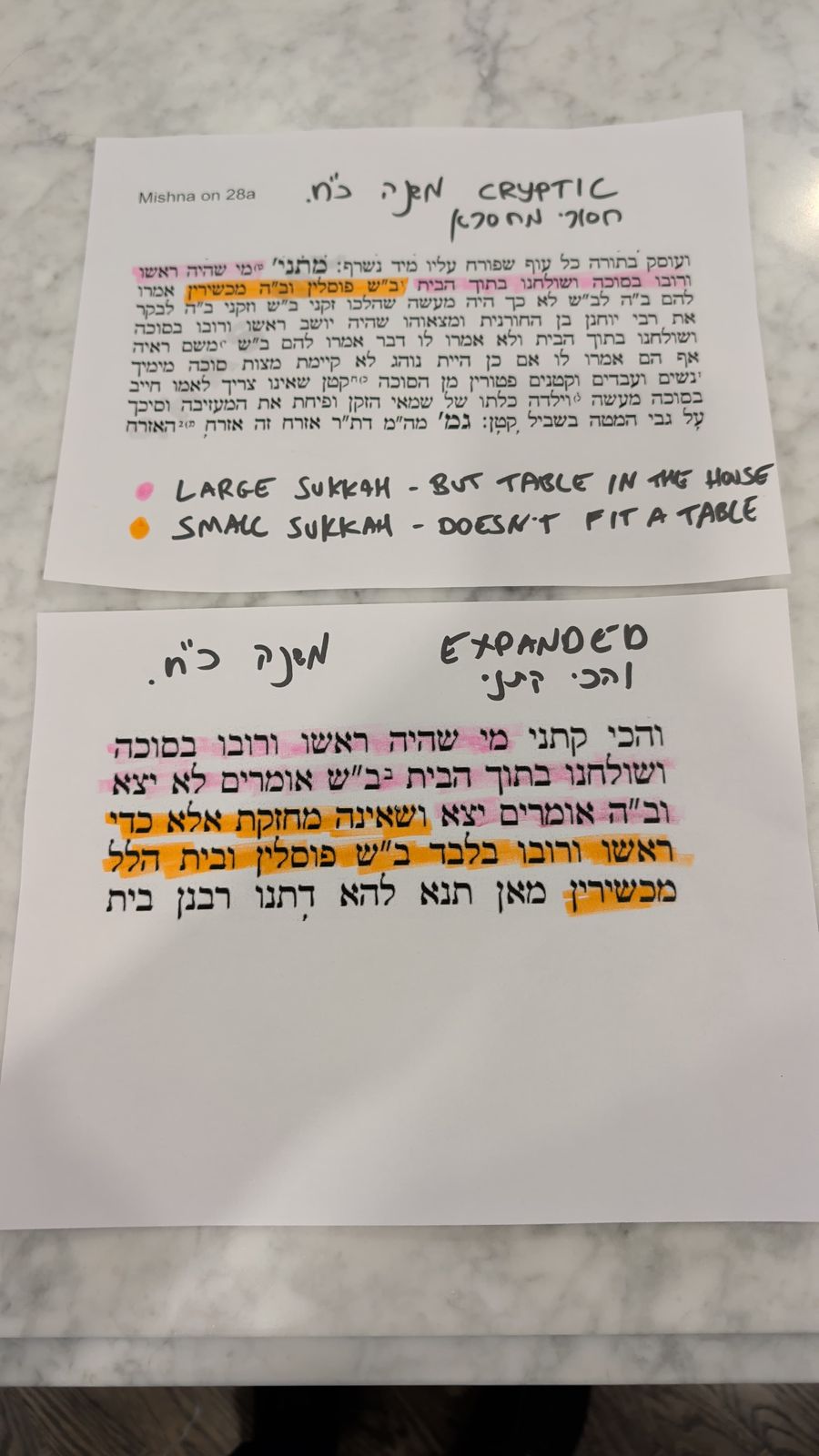
- The three shiurim: (1) 4 amos by 4 amos, roughly 8 by 8 feet; (2) Beis Hillel, rosho v'rubo, 6 tefachim; (3) Beis Shammai, rosho v'rubo v'shulchano, 7 tefachim.
- GemaraLine 11: Rav Shmuel bar Yitzchak says the halacha is that a sukkah must hold rosho v'rubo v'shulchano. The Ein Mishpat notes this is how we pasken.
- KashaR' Abba: like whom? Beis Shammai? We always pasken like Beis Hillel.
- TeirutzRav Shmuel bar Yitzchak answers: 'ela k'man', like whom else? Even though we rarely pasken like Beis Shammai, this is the halacha.
- GemaraIka d'amri: R' Abba did not accuse him of following Beis Shammai but simply asked 'mani', who is this? The answer was: it is Beis Shammai, and don't move from it.
- ChazarahThe only difference between the versions: in the first, R' Abba suggests Beis Shammai and is answered 'who else?'; in the second, R' Abba asks who it is, and Rav Shmuel bar Yitzchak himself says Beis Shammai, don't push back.
- KashaLine 16: Rav Nachman bar Yitzchak asks how we know Beis Shammai and Beis Hillel argue about a small sukkah. Why box Rav Shmuel bar Yitzchak into their machlokes?
- KashaPerhaps they argue about a big sukkah, where he sits at the opening (apuma d'mitalta) with his table inside the house.
- The RebbiThe Rebbi's illustrations: he may have a big sukkah but his wife wants it kept clean, so food stays in the kitchen. Or late at night he wants a nightcap, pulls a chair to the sukkah entrance and leans into the kitchen.
- MachlokesLine 20: Beis Shammai gozrin, shema yimashech achar shulchano; Beis Hillel lo gozrin.
- The RebbiYimashech means being drawn or dragged forward toward the table, not leaning as in haseibah. He digs in and forgets where he is; there are many such gezeiros.
- Ra'ayahDayka nami: sometimes a kasha is mere pushback, and sometimes it comes with a proof by inference (diyuk).
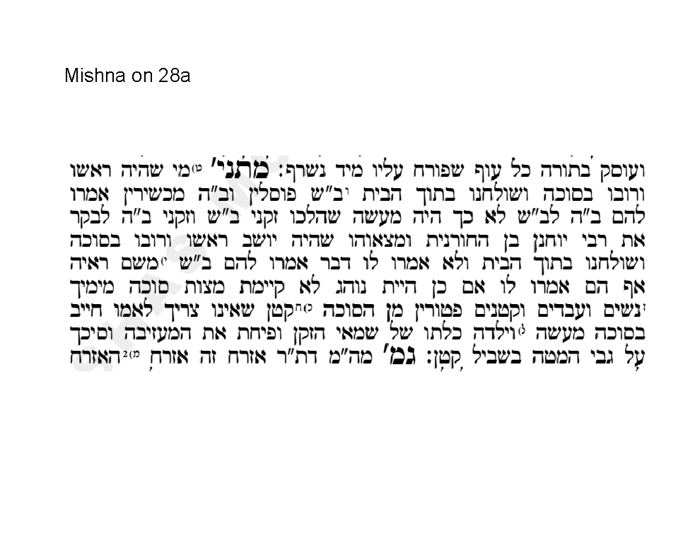
- Ra'ayahThe Mishnah reads: mi shehaya rosho v'rubo ba'sukkah v'shulchano b'soch habayis, Beis Shammai posslin and Beis Hillel machshirin. Line 24: if it were about size, it should have said machzekes v'einah machzekes.
- There is a lot to this Mishnah; the Rebbi says the Gemara will deal with it tomorrow.
- The RebbiSo Rav Shmuel bar Yitzchak's halacha, that the minimum sukkah (e.g. one popped up on a trip) must be 7 by 7 tefachim, need not be aligned with Beis Shammai and Beis Hillel, whose case is a man with his table in the house. No conclusion yet.
- ChazarahFull review from line 11. Rav Shmuel bar Yitzchak's own words use machzekes.
- The RebbiRav Nachman bar Yitzchak's question is on the whole conversation, both Rav Shmuel bar Yitzchak and R' Abba, who were arguing in terms of Beis Shammai and Beis Hillel.
- The RebbiBeis Shammai: when eating in the sukkah your table must be in it, lest you be drawn after it. Beis Hillel: we will not make such a gezeirah; we trust people more.
Kashas
- Would a queen sit in a sukkah made of cubicles?
- R' Abba on Rav Shmuel bar Yitzchak: is this like Beis Shammai? We pasken like Beis Hillel.
- Rav Nachman bar Yitzchak: how do you know Beis Shammai and Beis Hillel argue about a small sukkah? Perhaps they argue about a big sukkah with the table in the house.
Teirutzim
- Rav Ashi: she sat in the kitonios of a large sukkah. According to the Rabbanan her sons sat in the kosher sukkah, and she sat inside for tznius.
- Rav Shmuel bar Yitzchak: like whom else? This is the halacha even though it follows Beis Shammai.
- Ika d'amri: it is Beis Shammai, and don't move from it.
- Rav Nachman bar Yitzchak's alternative: in a big sukkah, Beis Shammai gozrin lest he be drawn after his table, and Beis Hillel lo gozrin.
Mareh mekomos
- Ein Mishpat, referencing the Shulchan Aruch and Rambam: Rav Shmuel bar Yitzchak's statement is the halacha l'maaseh.
- Mishnah 'mi shehaya rosho v'rubo ba'sukkah v'shulchano b'soch habayis': its wording proves Rav Nachman bar Yitzchak's reading.
- Earlier reference to the second perek, where the Beis Shammai and Beis Hillel shiurim appear.
The Rebbi’s chiddushim
- She sat in the kitonios for tznius: as a woman she would not be front and center.
- Framing of the three possible shiurim: 4x4 amos (about 8x8 feet); rosho v'rubo, 6 tefachim; rosho v'rubo v'shulchano, 7 tefachim.
- The Rebbi notes that only four times in Shas do we pasken like Beis Shammai.
- Illustrations of a big sukkah with the table in the house: a wife keeping the sukkah clean, or a late-night snack eaten leaning from the sukkah entrance into the kitchen.
- Yimashech means being drawn forward toward the table, not haseibah.
- A kasha can be mere pushback, or it can come with a proof via diyuk (dayka nami).
- Rav Shmuel bar Yitzchak's minimum-size halacha can stand on its own without being tied to Beis Shammai.
Unclear in recording
- A phrase after the tznius explanation was garbled ('Mishum akhili arula gavar') and unclear in recording.
- The exact words of R' Yehuda's proof (garbled reference, possibly to the 40 or 50 amah height) are unclear in recording.
- A remark about where the Mishnah's source is marked on the page ('little vase there in the back') is unclear in recording.
- A comment on the second part of the Mishnah ('should have said ...') is garbled and unclear in recording.
Drafted from the recording of the shiur, for chazarah. Torah terms follow the Rebbi’s own words; anything that could not be made out is marked “unclear in recording”. Tap a time to hear that point. Corrections welcome.