
A house smaller than four by four amos
The sugya
After reviewing the shiur of hechsher sukkah, the shiur turns to the Baraisa listing the dinim a house lacks if it is less than four by four amos: mezuzah, maakeh, nega'im, batei arei choma, returning from orchei hamilchama, eruv, shituf, ibbur between two cities, and dividing between brothers and partners. The Rebbi explains each din, using diagrams for eruvin and ibbur. The Gemara asks whether the Baraisa follows only Rebbi, who requires a sukkah of four by four. It answers that even the Rabbanan agree, because a sukkah is a dira arai while a house is a dira keva.
Step by step (shakla v’tarya)
- ChazarahReview: the earlier Gemaras discussed opinions on the shiur of hechsher sukkah, including rosho v'rubo v'shulchano.
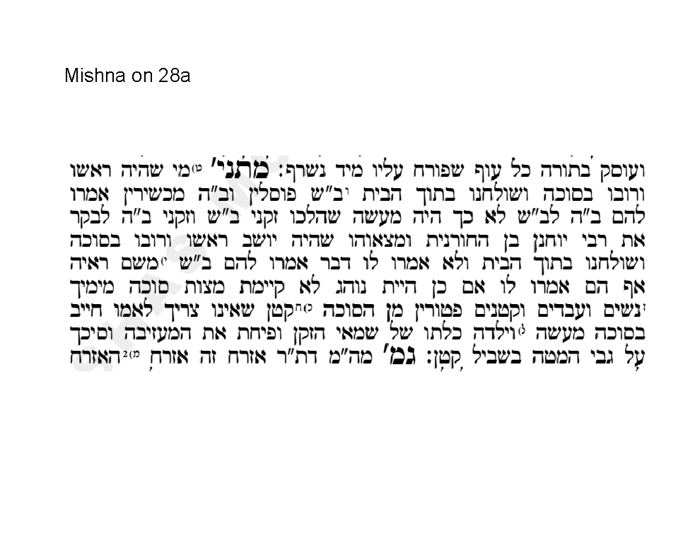
- The sugya now turns to its own question: does a structure smaller than four by four amos have the din of a house for the many dinim that apply to houses?
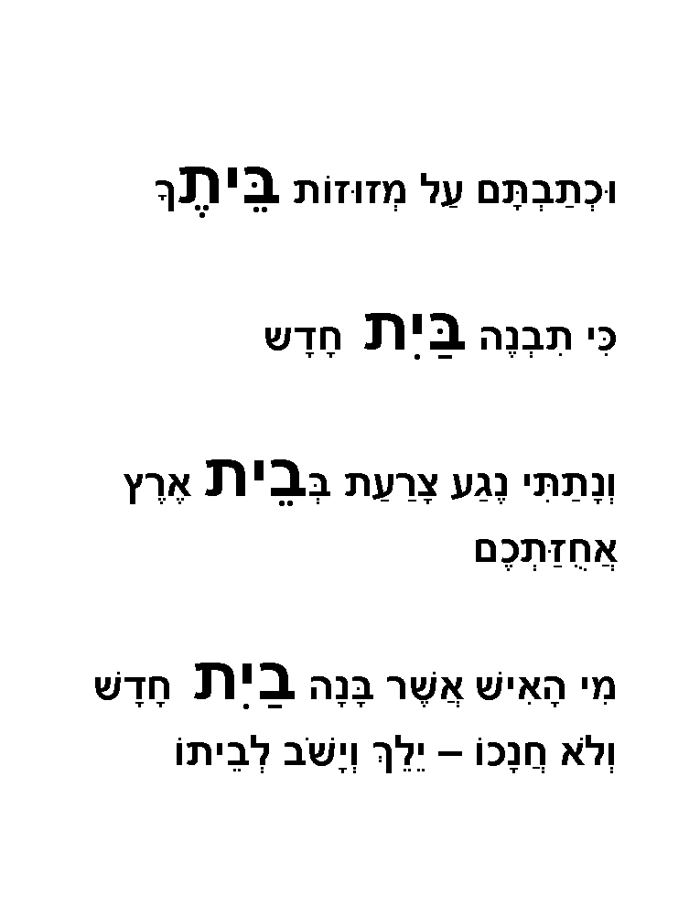
- The RebbiMany of these dinim come from pesukim that use the word 'bayis'. For mezuzah the pasuk says 'beisecha', not a word like 'dirascha'.
- GemaraLine 42: מאן תנא להא דתנו רבנן. A house without four by four amos is patur from mezuzah and from maakeh.
- GemaraIt is not metamei b'nega'im. The Rebbi stressed that tzaraas follows very specific parameters and depends on the kohen's declaration. Part of this discussion is unclear in recording.
- The RebbiIt is not nechlat in batei arei choma. Rather than 'irredeemably sold', he explains that it is not included in the walled-city halacha, where there is only a year to redeem. Instead it is treated like a piece of land, a regular sale, because it is not a house.
- GemaraOne does not return home from orchei hamilchama on account of it.
- GemaraEin me'arvin bo and ein mishtatfin bo, meaning eruv chatzeiros and shitufei mevuos. These are not from pesukim, and the Gemara on amud beis will give the reason.
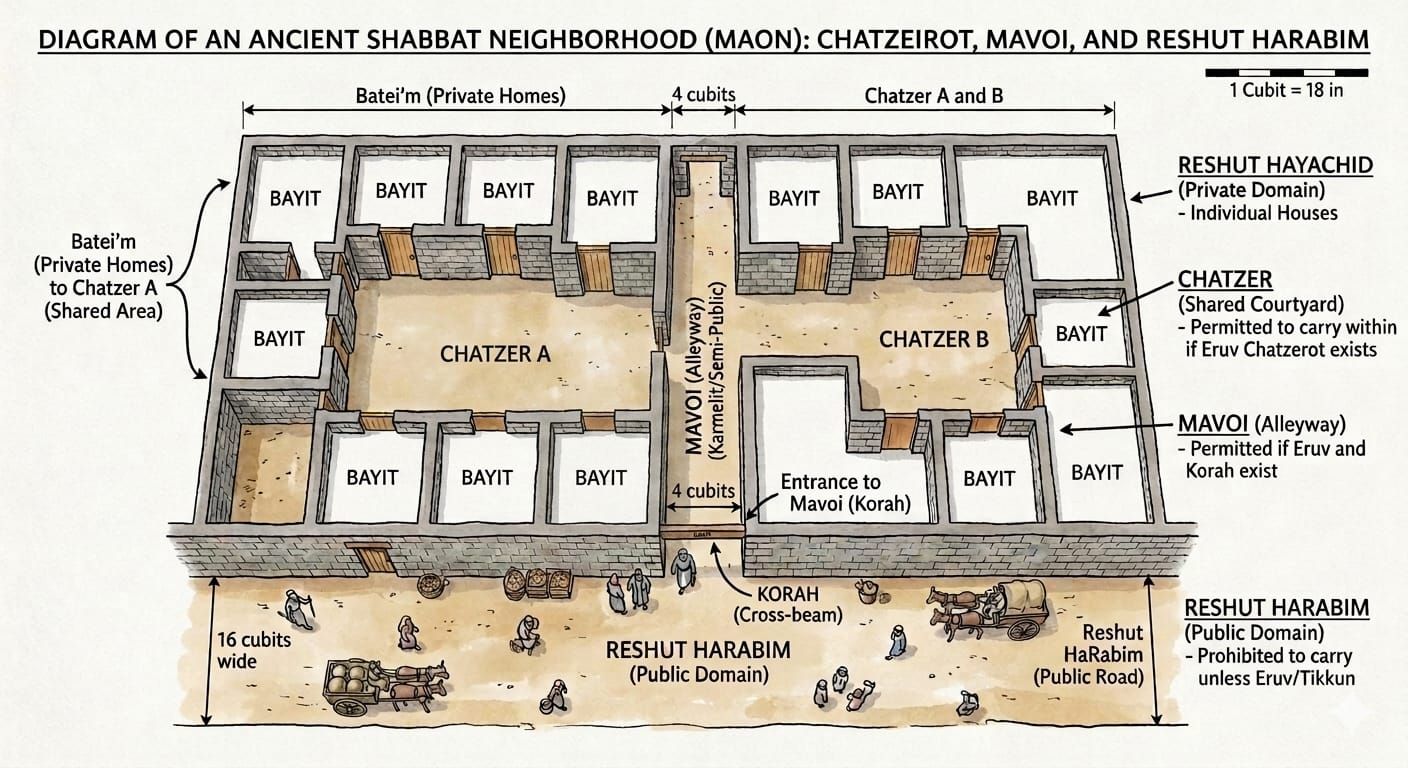
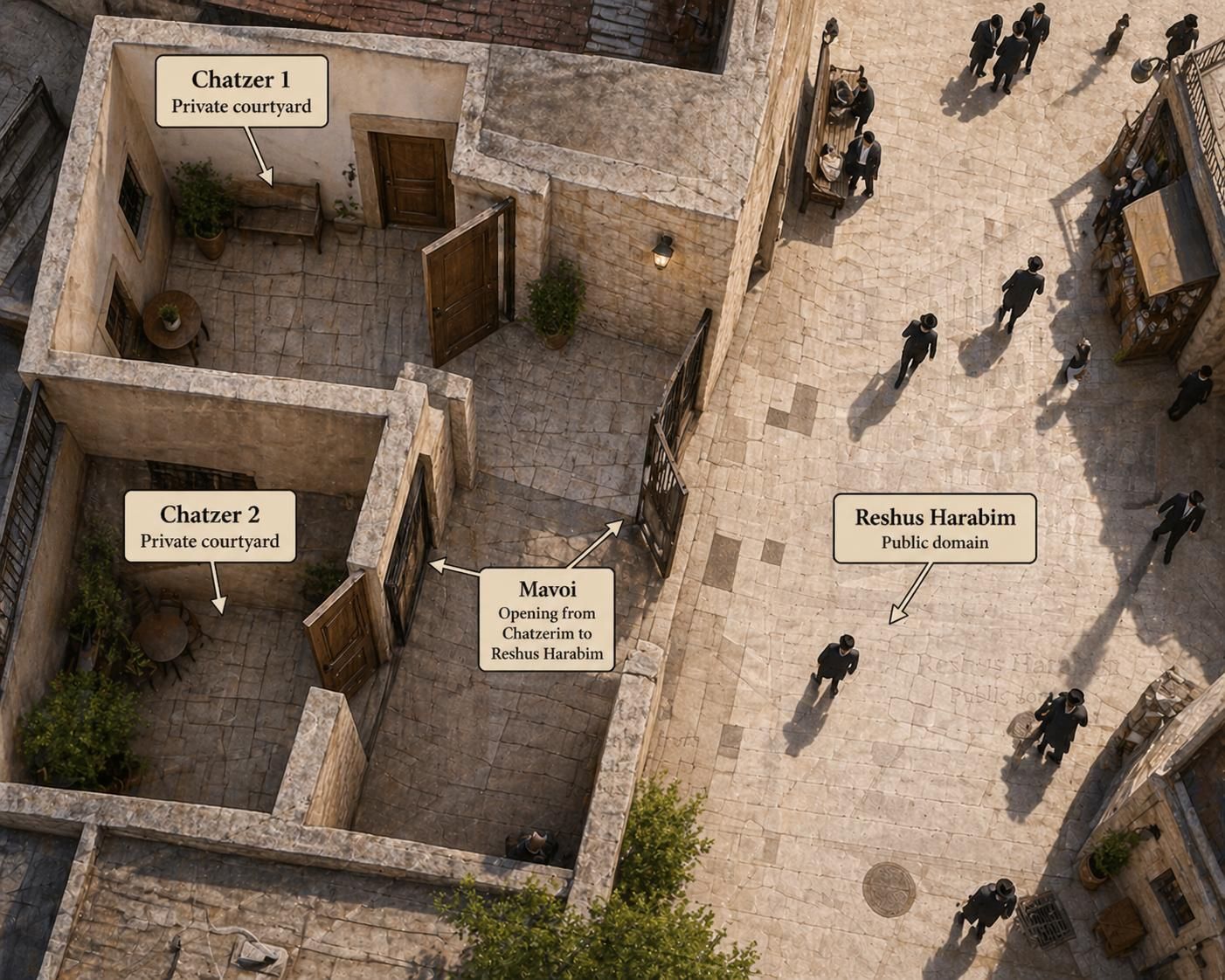
- The RebbiDiagram: a resident of a house under four by four in a chatzer does not have to participate in the eruv. He is not counted as a reshus, he is treated like the chatzer itself, and he may carry. The Rebbi compared him to someone living in a janitor's closet of an apartment building.
- The RebbiA mavoi surrounded by chatzeiros: each chatzer needs its own internal eruv, and the chatzeiros together need a shituf. A chatzer whose only house is under four by four does not participate, but may use the shituf.
- GemaraEin manichin bo eruv. The bread of the eruv chatzeiros must be placed in someone's house, not in the small house, which is viewed as open to and part of the chatzer. He noted that the mavoi eruv can even be put in the courtyard.
- GemaraEin osin oso ibbur bein shtei ayaros. 'Ibbur' means a protrusion, from the same root as a pregnant woman whose stomach protrudes.
- The RebbiTwo cities more than 141.3 amos apart are separate cities. A house of four by four in the gap shortens the space and joins them, so one may walk 2,000 amos from any part of the combined city. A house smaller than four by four does not count.
- GemaraBrothers and partners cannot force a split of such a house. There is no din chalukah, though they can resolve it in other ways, such as one buying out the other. He said the Gemara will discuss this later.
- Kashaלימא רבי היא ולא רבנן: Rebbi requires a sukkah of four by four amos, so it sounds as though Rebbi holds a dwelling is four by four. Is this whole major Baraisa only Rebbi and not the Rabbanan?
- RashiRashi on לימא רבי: Rebbi is the one who says a structure of less than four amos is not a sukkah.
- Teirutzאפילו תימא רבנן: the Rabbanan allow a sukkah smaller than four by four only because a sukkah is a dira arai. A house is a dira keva, so even the Rabbanan agree that if it has four by four amos people live in it, and if not they do not.
- The RebbiThis is a common logical chiluk between a sukkah and the dinim of permanent houses. Later, when the Gemara takes a roll call of who holds sukkah keva and who holds sukkah arai, the Rebbi thinks Rebbi will be listed with the keva opinions, since this is another expression of keva.
- ChazarahReview and punctuation from line 47 to line 2, followed by the question and answer read again.
Kashas
- לימא רבי היא ולא רבנן? Since Rebbi requires a sukkah of four by four, perhaps the Baraisa about a house of four by four follows only him.
Teirutzim
- Even the Rabbanan agree. Their leniency is only by sukkah, a dira arai. A house is a dira keva, and people do not live in one smaller than four by four.
Rashi & Tosafos
- Rashi: On לימא רבי: Rebbi is the one who holds that a sukkah of less than four amos is not a sukkah.
Mareh mekomos
- Mezuzah, 'uchsavtam al mezuzos beisecha': the word 'bayis' is the source that a small house is patur.
- Maakeh, 'ki sivneh bayis chadash' (parshas Ki Seitzei).
- Tzaraas, 'v'nasati nega tzaraas b'veis eretz achuzaschem'.
- Orchei hamilchama, 'mi ha'ish asher bana bayis chadash...': he returns home and does not go to the army.
- Rashi on לימא רבי.
The Rebbi’s chiddushim
- Each din from the Torah depends on the word 'bayis' in its pasuk. The Torah does not use a word like 'dirascha'.
- 'Nechlat' here means the house is not absorbed into the walled-city halacha. It is treated like land, a regular sale.
- Eruv, shituf and placing the eruv are d'rabbanan, so naturally no pasuk is given for them. 'Shitufei' comes from 'shutfus', partnership.
- 'Ibbur' means a protrusion, like a pregnant woman.
- Rebbi's requirement of four by four for a sukkah is an expression of sukkah being keva. He will likely be counted among those who hold sukkah keva.
Unclear in recording
- In the opening review, the reference to a shitah about hechsher sukkah is unclear in recording.
- The side discussion about nega'im (neighbor having the same thing, going to the doctor) is unclear in recording.
- The exact redemption period for the small house in a walled city ('until Ya'idah') is unclear in recording.
- The reason given for the gezeirah of carrying from reshus to reshus is unclear in recording.
- The answer to whether the small-house resident could carry if no eruv was made is unclear in recording.
- The side discussion about a 'Konya' carrying a goat and continuation of cities is unclear in recording.
- A remark about whether we pasken like Rebbi is unclear in recording.
Drafted from the recording of the shiur, for chazarah. Torah terms follow the Rebbi’s own words; anything that could not be made out is marked “unclear in recording”. Tap a time to hear that point. Corrections welcome.