Where to place the halachic tefach
The sugya
The shiur opens with the Gemara's question of where the tefach of the third wall goes, which the Rebbi says is the subject of the whole next amud. He first covers Rav Masna's source for R' Shimon from the pasuk, then Rav (and Shmuel in the name of Levi): opposite the outer wall. Rav Kahana and Rav Asi suggest placing it at an angle. R' Simon (or R' Yehoshua ben Levi) says to make a tefach sochek within lavud of the wall. The shiur continues to Rav Yehuda's sukkah shaped like a mavoi, where the tefach can go on any side, and R' Simon's requirement there of a board of four and a bit. It stops before the Gemara asks what the difference is, and goes back to review from line 4.
Step by step (shakla v’tarya)
- Gemaraואותו טפח היכן מעמידו: where do we put the tefach that everyone agrees is needed? The Rebbi says this question runs through the whole next amud.
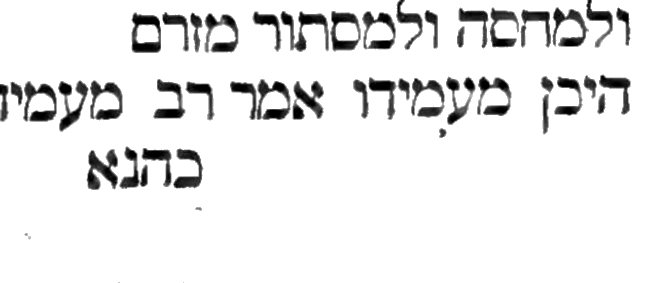
- ShitahRav Masna gives the reason of R' Shimon, who always requires one wall more than the Rabbanan whichever way the ibaayis eimas are learned. It comes from the pasuk וסוכה תהיה לצל יומם מחורב ולמחסה ולמסתור מזרם וממטר: shade by day from the heat, refuge and shelter from storm and rain.
- ShitahRav says מעמידו כנגד היוצא: put the tefach opposite one of the walls that end. 'Yotzei' means a wall that ends, with nothing attached to it.
- KashaRav Kahana and Rav Asi ask Rav: let him put it כנגד ראש תור, bent in at an angle (diagonally) rather than straight, so it looks like more of a sukkah. Rav was silent; it is not clear whether he agreed.
- Ra'ayahLine 2, איתמר נמי: Shmuel in the name of Levi also says מעמידו כנגד היוצא. Rav and Shmuel agree, and that is how it was paskened.
- ShitahLine 4: R' Simon (not Shimon), or some say (ואיתימא) R' Yehoshua ben Levi. Make a tefach sochek and place it less than three tefachim from the wall, since anything less than three next to the wall is k'lavud dami.
- RashiTefach sochek means a generous tefach. A regular tefach is measured tight, with the fingers touching. Here you leave a little room between the fingers.
- The RebbiWhy a tefach sochek? If the tefach were exactly three away from the wall, lavud would not apply, since lavud needs slightly less than three. Together they should come to a bit more than four tefachim.
- The RebbiWhy four tefachim? The aim is to use the tefach so that you get rov of a dofen. A sukkah wall is seven, so this gives a solid rov, a 'super rov', rather than placing the tefach plainly as in the picture in Rashi.
- ChazarahLine 5 reviewed: make a generous tefach and put it within three of the wall. Then the Gemara states the rule: anything less than three next to the wall is k'lavud dami.
- The RebbiWhat does this add? The Rebbi's view: halacha l'Moshe miSinai on its own probably allows using the tefach the way Rav and Shmuel said. R' Simon is giving an eitzah for a better use of it, to gain more of an enclosure. He leaves open whether the halacha is a tefach and they are being machmir in how to use it, or whether this placement is itself the halacha.
- In Rashi's picture beis, the small tefach is not in the center. It is closer to one wall, because it must be within lavud range of that wall; further away it would be too far.
- GemaraRav Yehuda says סוכה העשויה כמבוי כשרה (picture gimel). A mavoi is an alleyway: a mavoi sasum is closed at one end, and a mavoi mefulash is open at both ends, leaving just two parallel walls. Until now the two walls were at a right angle (as Rashi says, north and east). It is kosher as long as the tefach is added.
- Gemaraואותו טפח מעמידו לכל רוח שירצה: here the tefach may go on any side, four choices. Under Rav and Shmuel's case, as in Rashi's picture, there were only two.
- ShitahLine 9: R' Simon (or R' Yehoshua ben Levi) says that for the mavoi shape a tefach is not enough. One must make a pas (board) of four and a bit and place it less than three from the wall, k'lavud dami, so that one has the full seven (picture dalet). It only needs to be close to one wall.
- The Gemara will next ask what the difference is between the two cases. The shiur stops there, before line 13, and goes back to review from line 4.
Kashas
- Rav Kahana and Rav Asi to Rav: why not place the tefach כנגד ראש תור, at an angle, so it looks more like a sukkah? Rav was silent.
- Raised at the end, to be answered in the Gemara next time: why does R' Simon allow a tefach sochek in the right-angle case but require a pas of four and a bit in the mavoi case?
Rashi & Tosafos
- Rashi: A tefach is normally measured with four fingers touching. For a tefach sochek, separate each finger slightly.
- Rashi: Rashi's diagrams are used throughout. Picture beis shows the tefach for walls at a right angle, picture gimel the mavoi, picture dalet the pas of four and a bit. In the basic case the two walls are at a right angle, e.g. north and east.
Mareh mekomos
- Pasuk וסוכה תהיה לצל יומם מחורב ולמחסה ולמסתור מזרם וממטר: Rav Masna's source for R' Shimon requiring an extra wall.
The Rebbi’s chiddushim
- R' Shimon always requires one wall more than the Rabbanan, no matter how the ibaayis eimas are learned.
- The tefach sochek gives a safety margin. Lavud needs slightly less than three, so a tight tefach placed at the edge of lavud would not reach the goal of more than four.
- The goal of R' Simon's placement is rov of a seven-tefach wall. The Rebbi calls it a 'super rov'.
- Halacha l'Moshe miSinai on its own probably allows Rav and Shmuel's simple placement. R' Simon is giving an eitzah to use the tefach smartly and gain rov of a dofen; possibly this is a chumra in how to use it.
- R' Simon is 'pushing the envelope'. In the right-angle case he requires the tefach to be used in a lavud way, and in the mavoi case he is even more machmir and requires a pas of four and a bit to reach a full seven.
Unclear in recording
- Why it is called 'sochek': the Rebbi said he does not know.
- A reference to someone who says a sukkah wall is seven by seven. The name is unclear in the recording.
- The calculation about 3.5 versus four tefachim is partly unclear in the recording.
- A side discussion on measurements: etzbaos, a tefach of four, six tefachim in an amah, and whether we are machmir in our tefachim. Partly unclear in the recording.
Drafted from the recording of the shiur, for chazarah. Torah terms follow the Rebbi’s own words; anything that could not be made out is marked “unclear in recording”. Tap a time to hear that point. Corrections welcome.