Shiur summary (draft from the recording)
Sukkah higher than twenty amos
סוכה שהיא גבוהה למעלה מעשרים אמה
Chazarah · Sukkah daf 2 · Wednesday, June 10, 2026
The sugya
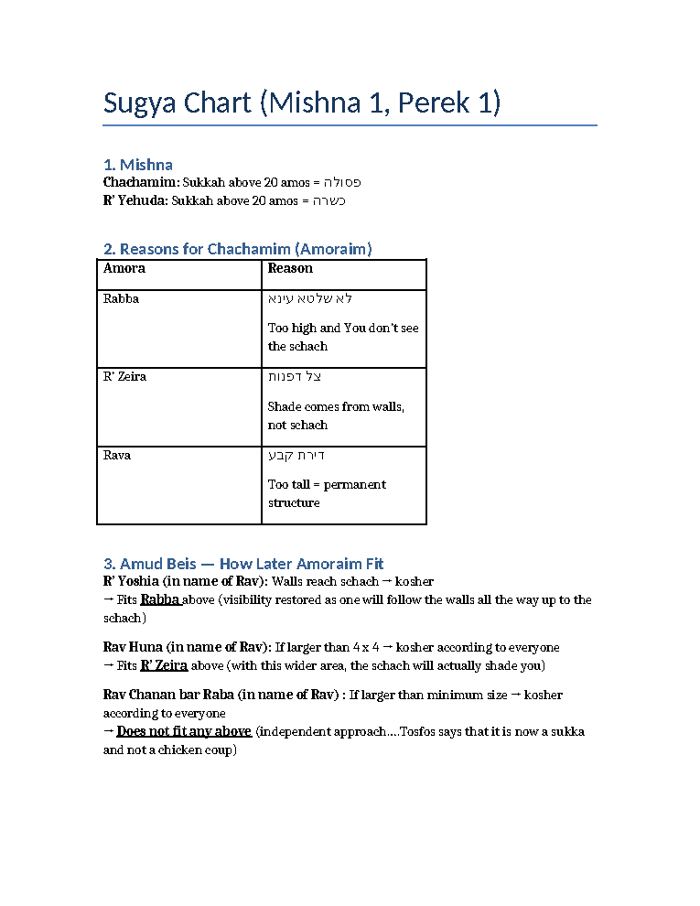
The Mishnah rules that a sukkah higher than 20 amos is pasul, while R' Yehuda is machshir. The Gemara compares the lashon to the Mishnah of mavoi and brings three sources for the pesul: Rabbah, R' Zeira and Rava. Each one's reason for not holding like the others is explained. The shiur then matched the three Amoraim who limit the machlokes (Rav Yoshiya, Rav Huna and Rav Chanan bar Rabba) to these sources, and worked through the Heleni HaMalkah proof and how it fits the opinion that the machlokes is about a small sukkah.
Step by step (shakla v’tarya)
- MishnahA sukkah higher than 20 amos is pasul; R' Yehuda says it is kosher. It is also pasul if it lacks three walls, is not ten tefachim high, or its sun is more than its shade.
- KashaBy mavoi higher than 20 amos (the beam), the Mishnah uses the lashon of a tikkun (lower it). Why does our Mishnah say pasul?
- TeirutzSukkah is d'oraisa, so it says pasul. Mavoi is d'rabbanan, so it gives a tikkun.
- TeirutzSecond answer: even by a d'oraisa a tikkun could be given. But our Mishnah has three more cases, so instead of giving a tikkun for each it simply says pasul. Mavoi has only one case, so the tikkun is given.
- ShitahRabbah: the pasuk says 'l'maan yeidu,' so you must know you are sitting in a sukkah. Above 20 amos the eye does not reach the schach, so you do not know.
- ShitahR' Zeira: the pasuk says 'tzel,' so the shade must come from the schach.
- KashaAbaye asks from a sukkah made in Ashteros Karnayim, a valley between two mountains, where the mountains provide the shade. Would you say that is not a good sukkah?
- TeirutzR' Zeira: there, if you remove the mountains, the schach provides shade. Here, with schach above 20 amos, even if you remove the walls the schach gives no shade.
- ShitahRava: 'basukkos teishvu shivas yamim' requires a temporary dwelling. Under 20 amos a person makes a temporary dwelling; above 20 amos it is a permanent one.
- KashaAbaye asks: if someone builds a sukkah under 20 amos out of iron walls, would you say it is not a sukkah?
- TeirutzRava: under 20 amos it is kosher even if built permanently. Above 20 amos it is pasul even if built temporarily.
- GemaraWhy do the others not hold like Rabbah? 'L'maan yeidu doroseichem' refers to knowledge for future generations, not knowing now that you are in a sukkah.
- GemaraWhy do the others not hold like R' Zeira? The 'tzel' pasuk refers to the days of Moshiach.
- TeirutzR' Zeira: the pasuk could have said 'chupah.' Saying 'sukkah' teaches two things: the shade of the sukkah now, and also the days of Moshiach.
- GemaraThe others do not hold like Rava because of Abaye's kasha.
- ShitahRav Yoshiya in the name of Rav: the machlokes is where the walls do not reach the schach. Where they do, it is kosher even above 20 amos. This fits Rabbah: since the walls reach the top, the eye sees the schach.
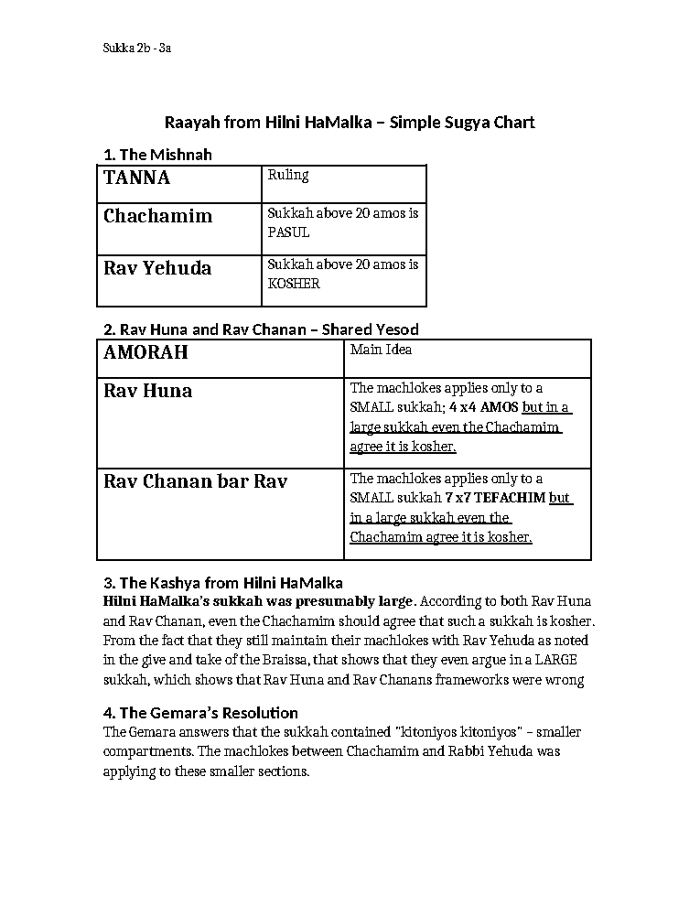
- ShitahRav Huna in the name of Rav: the machlokes is only in a sukkah of four by four amos. When it is larger, even the Rabbanan agree, since a larger sukkah provides shade (like R' Zeira).
- ShitahRav Chanan bar Rabba: the machlokes is only in a sukkah that holds just roshu v'rubo v'shulchano.
- GemaraRav Yoshiya clearly differs from the other two, since his machlokes has nothing to do with measurement. Perhaps Rav Huna and Rav Chanan bar Rabba argue about the minimum size of a sukkah: Rav Huna four by four amos, Rav Chanan bar Rabba roshu v'rubo v'shulchano (which the Rebbi called seven by seven).
- TeirutzNo. Both hold the minimum is roshu v'rubo v'shulchano (seven by seven). Rav Chanan bar Rabba holds they argue only at that minimum size. Rav Huna holds they argue from that size up to four by four amos, and above four by four even the Rabbanan are modeh.
- Ra'ayahBeraisa: R' Yehuda is machshir even up to 40 or 50 amos. He brings a proof from Heleni HaMalkah, whose sukkah was higher than 20 amos; the Zekeinim went in and out and said nothing to her.
- DechiyahThe Rabbanan answer: she was a woman and patur from sukkah.
- Ra'ayahR' Yehuda replies that she had seven sons with her, and that she did everything according to the Chachamim.
- GemaraWhy add that she followed the Chachamim? With seven children, at least one is old enough not to need his mother. Should you say his chiyuv is only d'rabbanan, R' Yehuda adds that she followed the words of the Chachamim even in that.
- KashaAccording to Rav Yoshiya, the sukkah's walls did not reach the schach. But how would Rav Huna and Rav Chanan bar Rabba explain it, if the machlokes is only about a small sukkah?
- TeirutzFirst answer: the sukkah was divided into many small rooms (kitoniyos). Question: is it the way of a queen to sit in such a sukkah?
- TeirutzRather, there was one small room where the queen sat. According to the Rabbanan her children sat in the kosher, large part, so the height did not matter. According to R' Yehuda her children were with her, and still nothing was said even though it was over 20 amos.
Kashas
- Why does our Mishnah say pasul when the Mishnah of mavoi gives a tikkun?
- Abaye on R' Zeira: a sukkah in Ashteros Karnayim, shaded by the mountains.
- Abaye on Rava: a sukkah under 20 amos with iron walls.
- Do Rav Huna and Rav Chanan bar Rabba argue about the minimum size of a sukkah?
- How do Rav Huna and Rav Chanan bar Rabba explain the Heleni HaMalkah story?
- Is it the way of a queen to sit in a sukkah made of small rooms?
Teirutzim
- Sukkah is d'oraisa, so pasul; mavoi is d'rabbanan, so a tikkun.
- Our Mishnah has several cases, so it says pasul; mavoi has one, so it gives a tikkun.
- Remove the mountains and there is still shade of the schach. Remove the walls of a sukkah above 20 amos and there is no shade from the schach.
- Under 20 amos, even a permanent structure is kosher. Above 20 amos, even a temporary one is pasul.
- R' Zeira: the word 'sukkah' rather than 'chupah' teaches both the present din and the days of Moshiach.
- Both hold the minimum is roshu v'rubo v'shulchano. They differ on how far up the machlokes extends.
- The queen sat in one small room. Per the Rabbanan her sons were in the large kosher part; per R' Yehuda they were with her.
Mareh mekomos
- Mishnah of mavoi higher than 20 amos (tikkun of lowering), compared with our Mishnah's lashon.
- Pasuk 'l'maan yeidu doroseichem': source for Rabbah.
- Pasuk of 'tzel' (v'sukkah tihyeh l'tzel yomam): source for R' Zeira.
- Pasuk 'basukkos teishvu shivas yamim': source for Rava.
- Beraisa of Heleni HaMalkah: R' Yehuda's proof that above 20 amos is kosher.
The Rebbi’s chiddushim
- Rav Huna's view fits R' Zeira's reason. In a larger sukkah the schach provides shade, so it is a sliding scale.
- Rav Yoshiya fits Rabbah. When the walls reach the schach, the eye is drawn up and sees the schach.
- The Rebbi framed the son who does not need his mother as being chayav because of chinuch, which is only d'rabbanan.
Unclear in recording
- The Rebbi introduced the three opinions as the 'reason for d'rabbanan'. The intent appears to be the source for the 20-amah pesul; unclear in recording.
- Exact daf reference at the start of this section ('on the top of these, on the base') is unclear in recording.
- Names of the Amoraim giving the two answers about the small rooms were not clearly heard.
Drafted from the recording of the shiur, for chazarah. Torah terms follow the Rebbi’s own words; anything that could not be made out is marked “unclear in recording”. Tap a time to hear that point. Corrections welcome.