Shiur summary (draft from the recording)
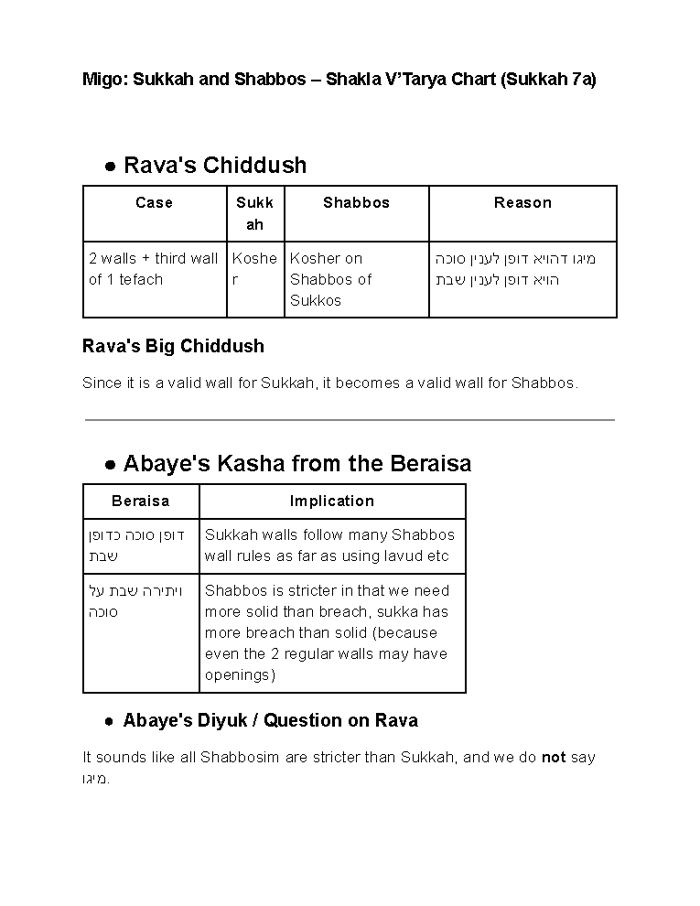
Rava's migu: Shabbos walls and sukkah walls
סיכך על גבי מבוי
Sukkah 7a · from line 33 · Thursday, June 18, 2026
The sugya
The shiur goes back over Abaye's kasha on Rava's migu, that a wall which counts for sukkah also counts for Shabbos, and the Gemara's back-and-forth on it. It then learns the Gufa: Rava's two dinim that schach over a mavui with a lechi and schach over pasei bira'os are kosher. It ends with the Gemara's tzricha explaining why all three of Rava's statements are needed, followed by a quick review.
Step by step (shakla v’tarya)
- ChazarahBack to Abaye's kasha on line 33, against Rava's migu that what is a wall for sukkah is a wall for Shabbos.
- KashaAbaye: the braisa says Shabbos is more strict than sukkah, so you cannot say such a migu.
- TeirutzAnswer (line 34): the braisa means a random Shabbos (Shabbos d'alma) is stricter than sukkah. Fill in the blanks: but Shabbos of a sukkah is the same as the sukkah.
- KashaAbaye: then the braisa should be fair and also say the other way, that a regular sukkah is stricter than a sukkah of Shabbos. A regular sukkah needs a solid tefach, while according to Rava a sukkah on Shabbos in a mavui needs only a little lechi. Rava himself said that schach over a mavui with a lechi is kosher.
- TeirutzAnswer: that was not needed. Now that we say it works from the kula to the chumra (sukkah to Shabbos), from the chumra to the kula (Shabbos to sukkah) all the more so.
- GemaraGufa: going back to line 26. Rava says that if you put schach on a mavui that has a lechi, it is kosher.
- GemaraRava's second statement: schach over pasei bira'os is kosher.
- Pasei bira'os only work if there is a well.
- Pasei bira'os are the corner pillars, really the corner L-shapes, of a well. Rashi has a picture.
- GemaraTzricha. What bothers the Gemara: once Rava says migu, the concept is that anything which is a mechitza for Shabbos works for sukkah too. So why does he need to give two Shabbos examples?
- Background on pasei bira'os: it is very hot, and you may go into this little enclosure and draw water for your animals. Normally, bringing water up from a well onto land is carrying from a different reshus. Here, if you put up four double pillars before Shabbos, it works.
- GemaraRava's chiddush applied: on Shabbos of Sukkos you can put schach on the pasim and eat there too.
- GemaraIf Rava taught only mavui, I would say it works because it has two good walls (me'alyasa). By pasei bira'os, which lack two good walls, I might say it does not work for sukkah.
- GemaraIf he taught only pasei bira'os, I would say it works because there are four walls: not good walls, but four. A mavui lacks four walls, so I might say no.
- Side question on the size of the pasim: an amma on each side. Lavud cannot be applied, since they are far apart from each other.
- GemaraLast line: if he taught only these two Shabbos chiddushim, I would say they work because they go from chamirta to kilsa (serious Shabbos to the lighter Sukkos). But from kilsa to chamirta, sukkah to Shabbos (Rava's first din), maybe not.
- MaskanaSo all three are needed: sukkah to Shabbos, to teach kula to chumra, and two Shabbos cases going from chumra to kula.
- ChazarahQuick review of the whole Gufa and tzricha.
Kashas
- Abaye: the braisa says Shabbos is stricter than sukkah, so how can we say migu?
- Abaye: then the braisa should also say that a regular sukkah, which needs a solid tefach, is stricter than a sukkah of Shabbos, where a lechi suffices according to Rava.
- Once Rava has the migu concept, why does he need two Shabbos examples (mavui with lechi, pasei bira'os)?
Teirutzim
- The braisa refers to a random Shabbos (Shabbos d'alma), not the Shabbos of a sukkah.
- Not needed: once it works from kilsa to chamirta, from chamirta to kilsa all the more so.
- Mavui alone: it has two good walls. Pasei bira'os alone: it has four walls. Each case teaches something the other does not.
- The two Shabbos cases go from chamirta to kilsa, so the sukkah-to-Shabbos din is also needed.
Rashi & Tosafos
- Rashi: Rashi has a picture of pasei bira'os.
The Rebbi’s chiddushim
- Shabbos is the chamirta because it carries chatos and skila and all these very serious things. If something works for Shabbos, it would surely work for sukkah.
- Rava is coming out of the gate with a sweeping concept: you can apply things from Sukkos to Shabbos and from Shabbos to Sukkos.
- Me'alyasa means two genuinely good walls. Pasei bira'os have four walls, but they are poor ones. The key point is the me'alyasa.
- Every time the Gemara says 'eima', it means 'I would maybe say no'.
Unclear in recording
- Short phrase after the first teirutz is unclear in recording.
- A remark about relying on something on Shabbos (pasei bira'os) is partly unclear in recording.
- The words translated here as 'different reshus' / the place where the pasim are used are unclear in recording.
- A remark comparing to the sukkah's walls at the end of the mavui point is unclear in recording.
- A short exchange with a talmid about which of Rava's cases is the 'first thing' is unclear in recording.
Drafted from the recording of the shiur, for chazarah. Torah terms follow the Rebbi’s own words; anything that could not be made out is marked “unclear in recording”. Tap a time to hear that point. Corrections welcome.