Shiur summary (draft from the recording)
Sukkah under a tree: Rava's limitation
העושה סוכתו תחת האילן
Sukkah 9b · Wednesday, August 26, 2026
The sugya
The shiur began the Mishnah of a sukkah made under a tree ('k'ilu asa'ah b'soch habayis') and briefly introduced the second case, a sukkah on top of a sukkah, along with R' Yehudah's opinion. The Gemara then brings Rava, who limits the Mishnah to a tree whose shade is more than its sun, and derives this from the Mishnah's wording 'k'ilu asa'ah b'soch habayis': a tree is like a house. The Rebbi went over the Gemara twice and closed with an Elul thought about calibrating our 'weights and measures.'
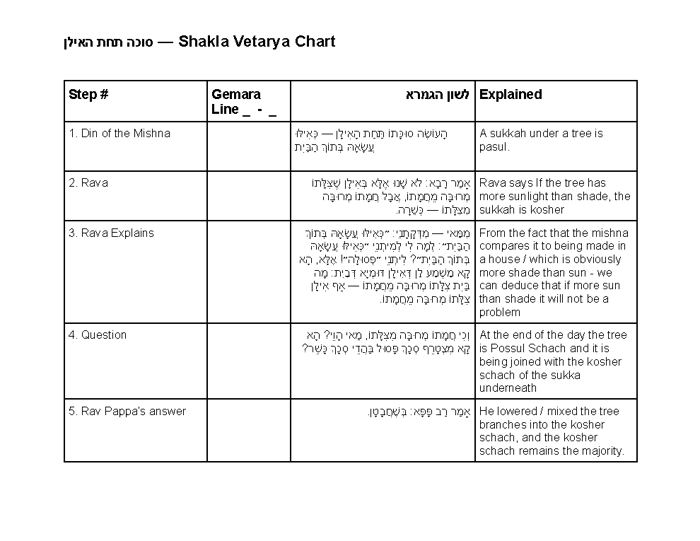
Step by step (shakla v’tarya)
- MishnahMishnah: one who makes his sukkah under a tree, it is k'ilu asa'ah b'soch habayis, as if he made it inside the house. A very practical Mishnah.
- RashiRashi: this means the sukkah is pasul. Why the Mishnah speaks in this 'poetic' way instead of just saying pasul will be seen in the Gemara.
- MishnahSecond, separate halacha: sukkah al gabei sukkah, a 'double-decker' sukkah. The top one is kosher and the bottom one is pasul.
- The Rebbi asked what the pesul of the bottom sukkah is. Where are you sitting? Is there enough schach? There is some sort of pesul on the bottom sukkah.
- ShitahR' Yehudah: if there are no dwellers (dayorin) in the top sukkah, the bottom one is kosher.
- The RebbiLogically you might think it is fine: you have kosher schach over your head and another sukkah with kosher schach above it, two levels of schach.
- The second part of the Mishnah will be learned later in the week. Today's focus is the first part.
- GemaraRava: lo shanu ela b'ilan shetzilaso merubah mechamaso. The Mishnah only means a tree whose shade is more than its sun.
- GemaraAval chamaso merubah mitzilaso, kesheirah. If its sun is more than its shade, the sukkah under it is kosher.
- The RebbiSo according to Rava, a sukkah under a few sparse branches is not pasul. The Mishnah's pesul refers to a dense tree.
- Practically, this is not how we act today. We are noheg not to sit under any part of a tree that comes over the sukkah.
- KashaMimai? From what words in the Mishnah does Rava derive this qualification?
- Ra'ayahMidkatani 'k'ilu asa'ah b'soch habayis': from the fact that the Mishnah used this dramatic wording.
- KashaLama li l'misni 'k'ilu asa'ah b'soch habayis'? Lisni pesulah. Why not just say it is pasul?
- TeirutzEla hakka mashma lan: ilan dumya d'bayis, a tree is similar to a house.
- GemaraMa bayis tzilaso merubah mechamaso, af ilan tzilaso merubah mechamaso. Just as a house has more shade than sun, so too the tree must have more shade than sun.
- MaskanaSummary of Rava: it is only a problem under a very shaded tree. Had the Mishnah just said 'pasul,' we would have said any tree. Saying 'as if in a house' tells us something house-like is needed.
- ChazarahChazara of the Mishnah and the Gemara so far.
- The RebbiExample: in the fall, when the leaves have already fallen, the sun is certainly more than the shade, so the sukkah is kosher.
- No one in the Gemara seems to argue on Rava. The Rebbi said we do not hold like that because of the next part of the Mishnah, to be seen later, and that according to Rashi sitting under a tree is not such a problem, with other opinions.
- Closing thought on the parsha's prohibition of dishonest weights and measures. Weights wear down and must be calibrated against the king's untainted weights. Likewise in Elul and Rosh Hashanah we recalibrate our values, and we should hold on to the original inspiration we had when we began learning a year ago.
Kashas
- Mimai: from which words in the Mishnah does Rava know the pesul is only under a tree with more shade than sun?
- Lama li l'misni 'k'ilu asa'ah b'soch habayis'? Let the Mishnah just say pesulah.
Teirutzim
- Midkatani 'k'ilu asa'ah b'soch habayis': the comparison to a house is the source.
- Hakka mashma lan: ilan dumya d'bayis. Just as a house is tzilaso merubah mechamaso, so too the tree must be tzilaso merubah mechamaso.
Rashi & Tosafos
- Rashi: 'K'ilu asa'ah b'soch habayis' means the sukkah is pasul.
Mareh mekomos
- This week's parsha, the prohibition of dishonest weights and measures, used as a mashal for calibrating ourselves in Elul and Rosh Hashanah.
The Rebbi’s chiddushim
- The Gemara's whole derivation rests on the Mishnah's 'poetic,' dramatic wording ('as if') rather than simply saying pasul.
- 'Mimai' here does not just mean 'how does he know?' It asks from which part of the text of the Mishnah.
- A house has no gray area: by nature it is always more shade than sun. That is why comparing a tree to a house means a dense tree.
- 'Lo shanu ela' (the three words go together) is always a limitation of the Mishnah's scope. Without Rava we would say any tree.
- Over a year our own 'weights,' our sense of what life should look like, wear down while we think everything is fine. Rosh Hashanah and Elul are the chance to recalibrate against how things are really meant to be.
Unclear in recording
- A remark about the case being above 20 amos in the sukkah-on-sukkah case is unclear in recording.
- Reference to an earlier case with two levels of schach where each level did not necessarily have enough schach. The name of the case is unclear in recording.
- Remarks about checking the schach from above (with a drone) versus from below are unclear in recording.
- Exactly why we do not hold like Rava (the next part of the Mishnah, Rashi, other opinions) is unclear in recording.
- Reference to the first blatt learned a year ago is unclear in recording.
Drafted from the recording of the shiur, for chazarah. Torah terms follow the Rebbi’s own words; anything that could not be made out is marked “unclear in recording”. Tap a time to hear that point. Corrections welcome.